

Conducting a Cyber Security Assessment, Pentesting Testing vs. Security Risk Assessment
Do You Need a Penetration Test, a Security Risk Assessment, or Both? A cyber security assessment usually means one of two things. A security risk assessment identifies assets, threats, and control gaps across the organization and rates each risk by likelihood and impact, following frameworks such as ISO/IEC 27005 or NIST SP 800-30. A penetration test proves which weaknesses in specific systems are exploitable. The risk assessment sets priorities, and the pentest verifies them.
The two are often bought interchangeably, and auditors, regulators, and enterprise customers increasingly expect evidence of both. This guide is for CISOs, risk and compliance leads, and founders preparing for ISO 27001, SOC 2, or a regulator’s review.
What is a Cyber Security Assessment?
A cyber security assessment is any structured evaluation of how well an organization protects its systems and data. The term covers several distinct services: security risk assessments, vulnerability assessments, penetration tests, control audits, and red team exercises.
Because the label is broad, two proposals titled “cyber security assessment” can describe very different work. The first step in any procurement is deciding which question you need answered.
What is a Security Risk Assessment?
A security risk assessment is a structured process for identifying information security risks, analyzing their likelihood and consequences, and deciding how to treat them. It works at the level of the organization or a business service, and most of its evidence comes from interviews, documents, architecture, and control reviews.
Two frameworks are widely used. ISO/IEC 27005:2022 provides guidance on managing information security risks in support of an ISO/IEC 27001 management system, covering assessment, treatment, communication, and monitoring. NIST SP 800-30 Rev. 1 gives step-by-step guidance for conducting risk assessments within a broader risk management process. A typical assessment follows these steps:
1. Establish context, scope, and risk acceptance criteria
2. Identify assets and the business services they support
3. Identify threats and existing controls
4. Analyze likelihood and consequence for each risk
5. Rate and rank risks against the acceptance criteria
6. Assign a risk owner and a treatment decision to each risk
What is a Penetration Test?
A penetration test is an authorized, time-boxed attempt to exploit weaknesses in defined systems, such as an application, API, network, or cloud environment. Its evidence is technical: the requests sent, the access gained, and the data reached.
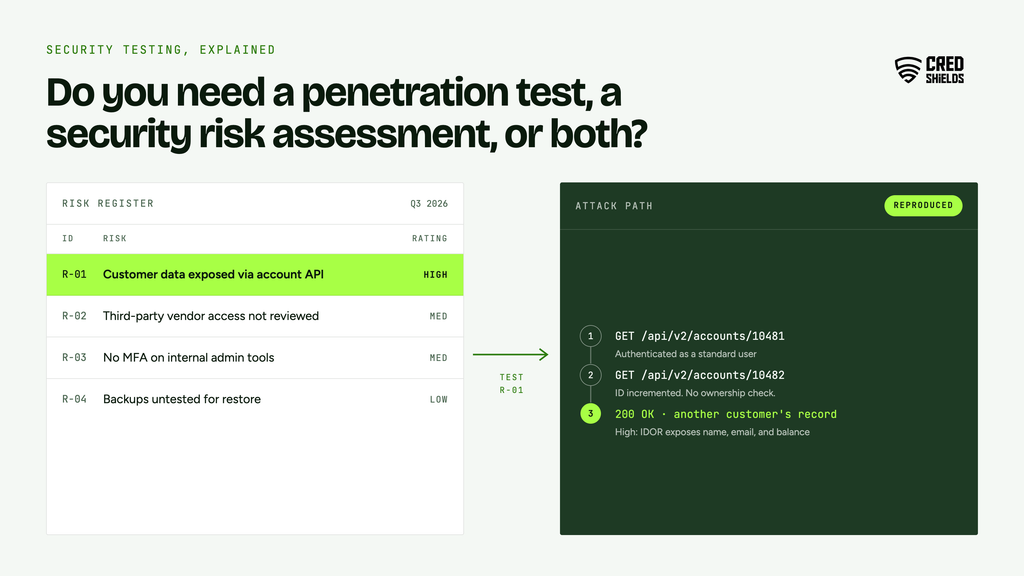
Where a risk assessment might rate “unauthorized access to customer records” as a likely risk, a penetration test shows whether it can actually happen, through which path, and what an attacker would see.
Penetration Testing vs Security Risk Assessment Compared
The two assessments answer different questions and produce different evidence. The table sets them side by side.
| Dimension | Security risk assessment | Penetration test |
| Core question | Which risks matter most to the organization, and how should we treat them? | Which weaknesses in these systems can an attacker exploit? |
| Scope | Organization, business unit, or service | Specific applications, networks, or cloud environments |
| Method | Interviews, document and architecture review, control evaluation | Hands-on technical testing and exploitation |
| Evidence | Asset inventories, threat analysis, control gaps | Reproduced attacks with requests, screenshots, and data samples |
| Output | Risk register with ratings, owners, and treatment plans | Findings with severity, reproduction steps, and fixes |
| Performed by | Risk, compliance, or security governance specialists | Offensive security testers |
| Typical frameworks | ISO/IEC 27005, NIST SP 800-30 | OWASP testing guides, PTES, NIST SP 800-115 |
| Typical frequency | Annually and after major business change | Annually per critical system and after significant technical change |
How Risk Assessments and Pentests Work Together?
Each assessment makes the other more accurate. Used in sequence, they form a cycle:
1. The risk assessment sets priorities. It identifies the most important assets and the risks that would hurt most.
2. The pentest targets those priorities. Scope is drawn from the top of the risk register, so testing time goes where it matters.
3. Findings recalibrate the register. A proven attack path raises a risk’s likelihood from estimated to demonstrated; a failed attempt supports a lower rating.
4. Treatment is verified. Retesting confirms that fixes work, so the register can record the residual risk with evidence.
Which Cyber Security Assessment to Start With?
The right starting point depends on what you already have and what you need to show. These patterns cover most situations:
• Start with a risk assessment if you have no current asset inventory or risk register, or you are building an ISO 27001 management system
• Start with a penetration test if a product is launching, a customer or insurer has asked for a pentest report, or you have a specific concern about a system
• Plan both if you are regulated, handle sensitive personal or financial data, or have been asked for evidence of both governance and technical testing
Cyber Security Assessment Planning Checklist
Use this list to plan an assessment program for the year.
• Decide which question you need answered before requesting proposals
• Maintain a current asset inventory tied to business services
• Keep a risk register with owners, ratings, and treatment decisions
• Draw pentest scope from the highest-rated risks
• Update risk ratings with pentest evidence after each engagement
• Verify treatments through retesting before lowering a risk rating
• Schedule both assessments around audits and major changes
Frequently asked questions (FAQs) about cyber security assessments in Singapore
These answers cover what risk and security leaders ask most often when planning assessments.
Q1. What is a cyber security assessment?
A structured evaluation of how well an organization protects its systems and data. It can mean a security risk assessment, vulnerability assessment, penetration test, control audit, or red team exercise.
Q2. What is the difference between a penetration test and a security risk assessment?
A security risk assessment identifies and rates risks across the organization and decides how to treat them. A penetration test proves whether specific systems can be exploited, and how.
Q3. Which frameworks are used for security risk assessments?
ISO/IEC 27005, which supports ISO/IEC 27001, and NIST SP 800-30 Rev. 1 are two of the most widely used.
Q4. Does ISO 27001 require a penetration test?
ISO 27001 requires a risk-based approach to selecting controls. Many organizations use penetration testing as evidence that technical controls work, and auditors often ask for it.
Q5. Should a pentest come before or after a risk assessment?
Ideally after, so the pentest scope reflects the highest-rated risks. Pentest findings then feed back into the risk register.