

The Cyber Crisis Simulation Blueprint for Board Directors in Singapore
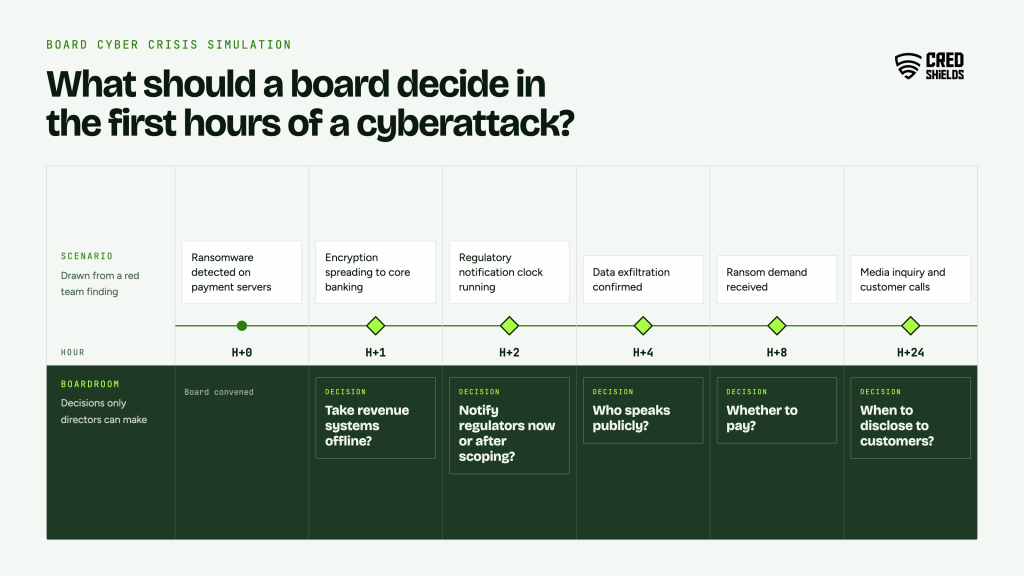
What should a board decide in the first hours of a cyberattack? A cyber crisis simulation for board directors is a facilitated exercise that places the board inside a realistic attack timeline and forces the decisions only directors can make: whether to pay, when to disclose, whether to take revenue systems offline, and who speaks publicly. In Singapore, it should rehearse regulatory notification clocks and draw its scenario from a recent penetration test or red team finding.
Singapore’s director community now has a CSA-endorsed framework for this work, financial regulators expect scenario-based exercises that involve senior management, and the amended Cybersecurity Act widens what critical infrastructure owners must report. This blueprint is for board chairs, audit and risk committee members, company secretaries, and the CISOs who brief them.
What is a Board-Level Cyber Crisis Simulation?
A board-level cyber crisis simulation is a scenario exercise designed around decision rights. Incident responders rehearse containment in their own tabletop; the board rehearses the choices that change the company’s legal, financial, and reputational exposure while facts are still incomplete.
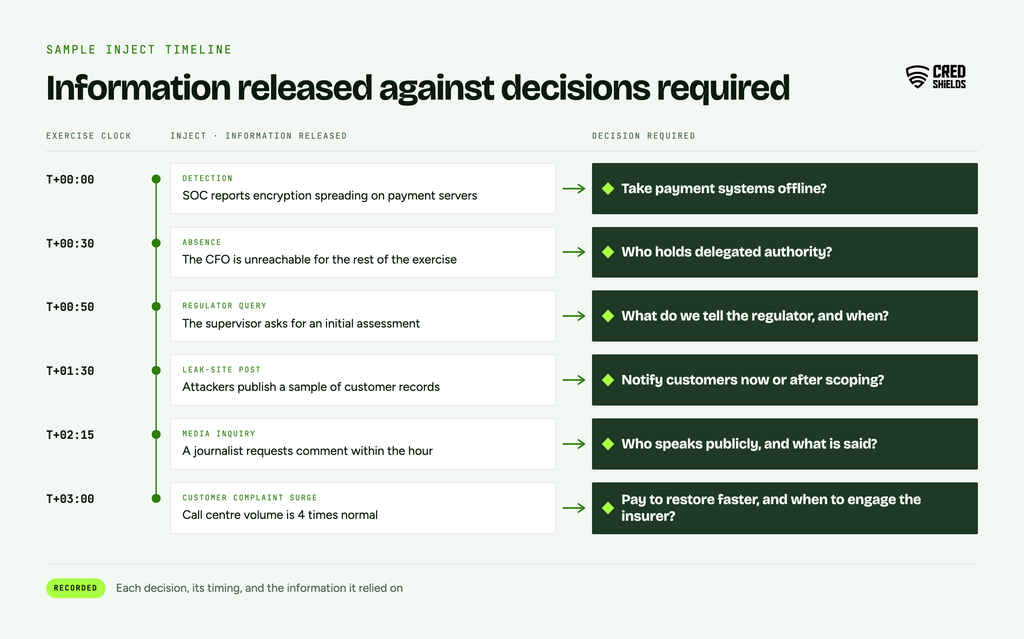
The format is simple: a facilitator releases timed injects, such as a ransom note, a regulator’s call, or a journalist’s question, and the board decides and records its reasoning at each step. The exercise ends when the board has made every decision it would face in the first days of a real incident.
Why Singapore Boards Are Running Cyber Simulations Now
Three developments have moved cyber exercises onto board agendas in Singapore. Each one sets an expectation that a simulation can help a board meet.
The director community has a shared framework. The Singapore Institute of Directors launched a Cyber Resilience Guide for Boards on 12 February 2025, developed with ISTARI and NCS and endorsed by the Cyber Security Agency of Singapore. The guide sets out tenets, an eight-step process to cyber resilience, and a board readiness checklist, and SID planned training for about 500 directors through 2025.
Financial regulators expect exercises that include senior management. MAS’s Technology Risk Management Guidelines call for regular scenario-based cyber exercises to validate response, recovery, and communication plans, involving senior management, business functions, corporate communications, the crisis management team, and service providers where applicable.
Critical infrastructure reporting now reaches suppliers. Parliament passed the Cybersecurity (Amendment) Bill on 7 May 2024. Herbert Smith Freehills explains that owners of critical information infrastructure must additionally report incidents affecting other systems under their control and supplier systems interconnected with their CII.
The Six-Stage Blueprint for a Board Cyber Crisis Simulation
The stages below take a board from scenario design to a closed remediation register. Most boards can complete the live session in half a day, with preparation spread across the preceding weeks.
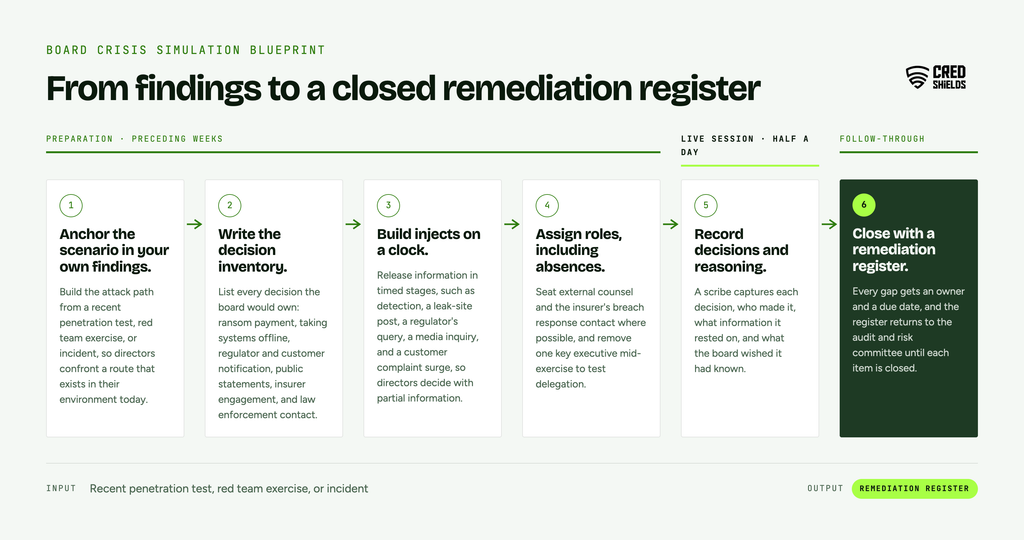
1. Anchor the scenario in your own findings. Build the attack path from a recent penetration test, red team exercise, or incident so directors confront a route that exists in their environment today.
2. Write the decision inventory. List every decision the board would own: ransom payment, taking systems offline, regulator and customer notification, public statements, insurer engagement, and law enforcement contact.
3. Build injects on a clock. Release information in timed stages, such as detection, a leak-site post, a regulator’s query, a media inquiry, and a customer complaint surge, so directors decide with partial information.
4. Assign roles, including absences. Seat external counsel and the insurer’s breach response contact where possible, and remove one key executive mid-exercise to test delegation.
5. Record decisions and reasoning. A scribe captures each decision, who made it, what information it rested on, and what the board wished it had known.
6. Close with a remediation register. Every gap gets an owner and a due date, and the register returns to the audit and risk committee until each item is closed.
Scenario Library for Singapore Boards
The strongest scenarios force a trade-off between two things the board values. The table pairs common scenarios with the decision each one tests.
| Scenario | What it tests | Decision it forces |
| Ransomware with a data leak threat | Backup integrity, restoration time, negotiation governance | Whether to pay, and on whose authority |
| Supplier compromise reaching critical systems | Third-party visibility and contract rights | When to notify regulators about a supplier’s incident |
| Deepfake executive instruction for an urgent transfer | Payment authorization controls | Whether to reverse, freeze, or disclose |
| Cloud data exposure found by a researcher | Data mapping and personal data breach assessment | Customer notification timing and wording |
| Customer-facing AI assistant leaking account data | AI governance and kill-switch authority | Whether to pause a revenue-generating product |
Questions Directors Should Ask During the Exercise
Directors add the most value by probing assumptions management has not tested. These questions surface gaps quickly:
• When did we last restore our most critical system from backup, and how long did it take?
• Which regulators must we notify, within what window, and who has authority to file?
• Does our cyber insurance policy require insurer consent before we engage negotiators or vendors?
• Which suppliers could see this incident before we do, and are we contractually entitled to be told?
• If our primary communications channel is compromised, how will this board meet and decide?
• What would we say to customers in the first statement, and what would we be unable to say yet?
Turning the Simulation Into Evidence
A simulation that leaves no record helps the directors who attended and nobody else. Documented outcomes support regulatory reviews, insurance renewals, and the next exercise. MAS’s 2021 guidelines also suggest tracking and resolving issues identified from cyber assessments and exercises, which is what a remediation register does.
Keep these records from every session:
• Attendance, roles, and the scenario brief
• Each decision, its timing, and the information it relied on
• Gaps found, each with an owner and due date
• Evidence of closure, such as a retested control or an updated playbook
• The date and scenario of the next exercise
Board Cyber Simulation Readiness Checklist
Use this list when preparing the board’s next exercise.
• Base the scenario on a real attack path from a recent pentest or red team
• Write the board’s decision inventory before designing injects
• Map regulatory notification obligations and who can file each one
• Confirm insurer consent requirements and breach response contacts
• Include at least one supplier-driven inject
• Test an out-of-band channel for board communication
• Appoint a scribe and record decisions with their reasoning
• Assign every gap an owner and a due date, and track closure at committee level
• Schedule the next exercise before the debrief ends
Frequently asked questions (FAQs) about cyber crisis simulations for boards in Singapore
These answers address what directors and company secretaries most often ask before a first exercise.
Q1. What is a cyber crisis simulation for boards?
It is a facilitated exercise that places directors inside a realistic attack timeline and records the decisions only the board can make, such as ransom payment, disclosure, and taking systems offline.
Q2. How is it different from a technical tabletop exercise?
A technical tabletop tests containment and recovery steps by responders. A board simulation tests decision rights, escalation, and communication, using the same scenario at a different altitude.
Q3. Do Singapore regulators expect boards to take part in cyber exercises?
MAS’s Technology Risk Management Guidelines expect regular scenario-based cyber exercises involving senior management, corporate communications, and the crisis management team. SID’s CSA-endorsed Cyber Resilience Guide for Boards gives directors a framework for the same work.
Q4. How often should a board run a cyber simulation?
At least once a year, and after any major change such as an acquisition, a core system migration, or a significant incident. Each exercise should use a different scenario.
Q5. Where should the scenario come from?
From a real attack path in your environment, ideally one found in a recent penetration test or red team exercise, so the board rehearses a risk that exists today.