

SOC 2 Penetration Testing: What You Should Expect Before An Audit

A SOC 2 report makes one guarantee to your customers: The data they give you is secure, and you can prove it. One of the most direct methods to show it is with a penetration test. SOC 2 doesn’t specifically call out penetration testing as a required checkbox, but your enterprise buyers and auditors most certainly do. Policies tell you that your security measures operate, but a penetration test is the real confirmation that your monitoring, detection and access systems are up to the task of real world threats.
By the end of this book, you’ll be able to identify the criteria a penetration test best supports, how to translate its results into tangible proof for your SOC 2 audit, and how to set up your testing timeline to pass smoothly.
Table of Contents
Is Penetration Testing Required for SOC 2? (Technical Reality vs Practical Reality)
If you search the text of the American Institute of CPAs (AICPA) Trust Services Criteria you will not find a single clear requirement that states, “An organization must conduct an annual penetration test.” Technically, SOC 2 framework standards are about outcomes, not tooling. You need to design controls to limit the risk, but how you make the decision of mechanism is up to you. But the real world is a very different place:
| AICPA Standard (Framework) | Focuses on risk outcomes |
| Auditor Expectations | Demands technical validation (Pentest) |
| Enterprise Buyer Requirement | Mandates a pentest report before contract sign off |
Type 1 vs. Type 2 Audits: How Testing Requirements Vary
SOC 2 Type 1 (Point-in-Time)
Looks at how your security controls are developed at a particular moment in time. Technically you can pass a Type 1 audit without having a completed pentest by showing draft risk management policies. But having a clean baseline pentest shows the auditor that your proposed architecture is based on real security.
SOC 2 Type 2 (Period of Time)
Tests the effectiveness of your security procedures over a period of time (usually 3-12 months). Type 2 auditors nearly generally demand a penetration test report performed during the same monitoring interval. If you don’t have a pentest in your observation period, auditors will scrutinise your alternate monitoring controls much more closely and will frequently either delay your report or issue control flaws.
Key point: An auditor won’t fail you on day one for missing a pentest, but your deals will stall out at the enterprise level. Vendor risk management teams at Fortune 500 organisations often reject SOC 2 reports that aren’t validated by an independent third-party penetration test.
Mapping SOC 2 Compliance Criteria to Penetration Testing Results
If you want a penetration test that will qualify for your SOC 2 audit, then you need to understand how the testing results directly relate to the AICPA Common Criteria (CC). A pentest is not a broad safety inspection, it generates concrete data for 3 key groups of criteria:
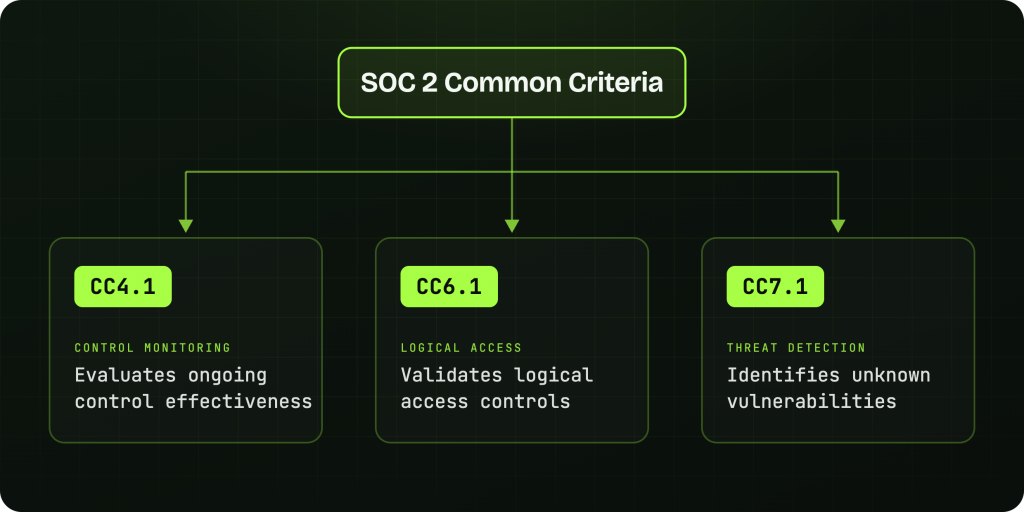
1. CC4.1 & CC4.2 (COSO Principle 16 & 17: Monitoring & Evaluation)
Criteria Objective: The entity selects, creates and executes continuing evaluations to see if internal controls are in place and operating.
How Penetration Testing Helps: The AICPA’s implementation recommendations mention penetration testing as an example of a “separate evaluation.” A third-party test demonstrates to auditors that you are actively stress-testing your control environment and not just assuming it works on paper.
2. CC6.1 & CC6.8 (Logical and Physical Access Control)
Criteria Objective: Systems shall employ logical access security mechanisms to prevent unauthorised access, data exfiltration, or malicious manipulation.
How Penetration Testing Helps: Penetration testers try to get through the authentication barriers, bypass the RBAC (role-based access control), exploit API endpoints, and escalate privileges. A report demonstrating that these efforts have been successfully thwarted would meet CC6 requirements far better than any policy texts ever could.
3. CC7.1 & CC7.2 (System Operations & Vulnerability Management)
Criteria Objective: The entity monitors infrastructure for vulnerabilities, security incidents and configuration drift.
How Pentesting Testing Helps: Vulnerability scanners are great for finding known gaps in patching, but pentesting finds deep logic issues and multi-step exploits. Additionally, a pentest will also test your detection engine (CC7.2): when the penetration tester was probing your perimeter, did your Security Information and Event Management (SIEM) tool or Security Operations Center (SOC) team notice?
Vulnerability Scanning and Penetration Testing for SOC 2
One of the most common stumbling blocks for companies preparing for their first audit is confusing vulnerability scanning with penetration testing. Both are required to satisfy SOC 2 auditors and enterprise prospects.
| Capability | Vulnerability Scanning | Penetration Testing |
| Execution | Automated software driven scans | Manual, human led adversarial simulation |
| Depth | Surface level matching against known vulnerability databases (CVEs) | Exploits business logic flaws, complex auth bypasses, and chained bugs |
| Frequency | Continuous or automated (Weekly/Monthly) | Periodic (Annually or post major infrastructure shifts) |
| SOC 2 Alignment | Supports routine operational maintenance (CC7.1) | Satisfies deep control evaluations & monitoring (CC4.1, CC6.1) |
| Auditor Weight | Baseline requirement for patch hygiene | High value evidence of true defense in depth |
Analogy: Think of vulnerability scanning like walking around a building and checking to see if any doors are unlocked. A penetration test is when you hire a professional locksmith to crawl into ventilation shafts and try to get into the vault by picking the locks.
Scope Your SOC 2 Penetration Test
Among the fastest ways to blow budget or fail an audit is poor scoping. Your penetration testing scope should be a direct reflection of your SOC 2 System Boundary.
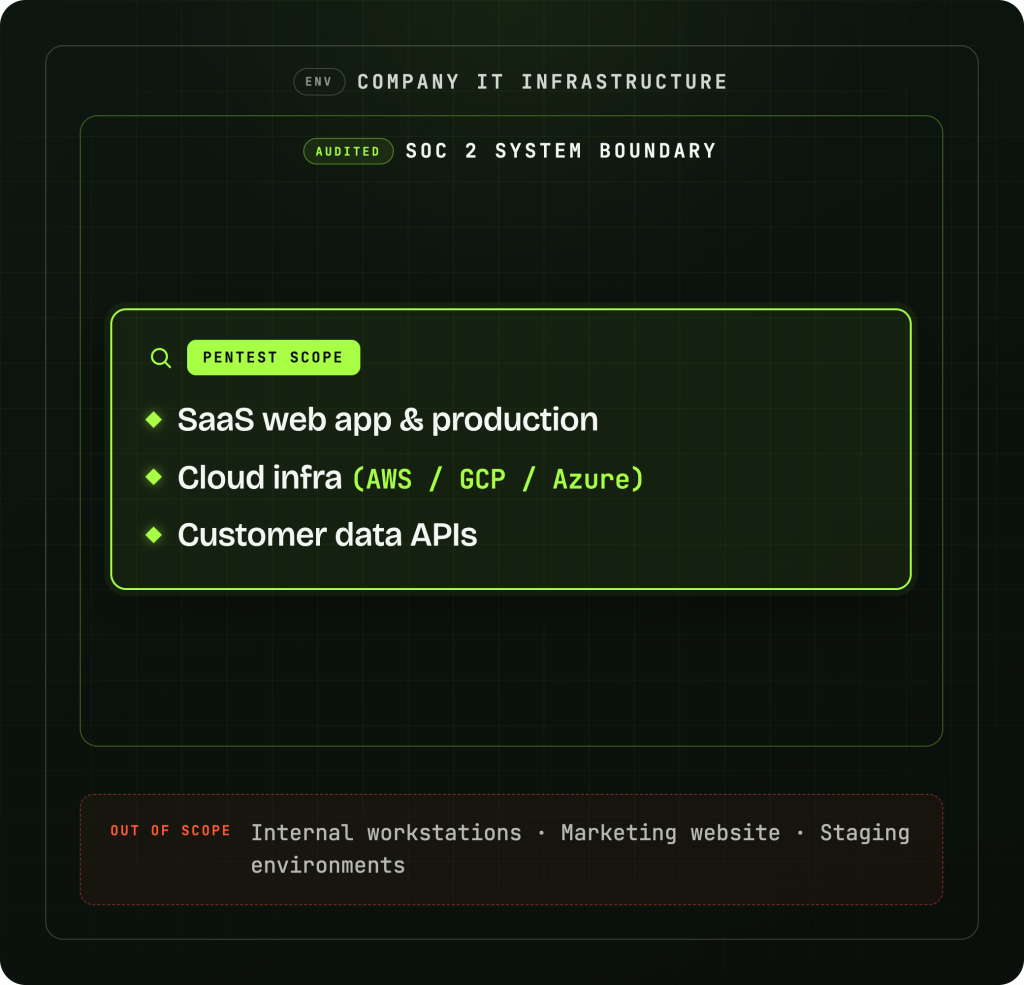
To make sure your test is a genuine proof of compliance, concentrate on three main target layers:
- Web Applications & APIs
Focus areas: Authentication mechanisms, authorisation bypasses (IDOR), SQL injection, cross-site scripting (XSS), business logic flaws and multi-tenancy isolation
Why Auditors Care: B2B SaaS providers store customer data in multi-tenant clouds, and verifying tenant separation is critical to the Confidentiality and Security criteria
- Cloud Infrastructure and External Perimeter
Focus Areas: AWS/GCP/Azure tenant setups, misconfigured S3 buckets/storage, exposed management ports, public API gateways, IAM role escalation paths
Why Auditors Should Care: Misconfigurations are the number one vector for enterprise data breaches in cloud native applications
- Internal Networks & Mobile Applications (If Applicable)
Focus Areas: Corporate network segmentation VPN end points Workstation privilege escalations Mobile app end points communicating to back end APIs
Picking the Right Approach: Black Box vs Grey Box
Black Box testing (zero knowledge) is like an outsider hacker who knows nothing, whereas Grey Box testing (testers are given low level user credentials and architecture context) is significantly more efficient for SOC 2 audits. Grey Box testing is useful to pentesters to check authenticated areas and tenant isolation without wasting paid billable hours guessing fundamental endpoints.
How to Prepare for and Conduct a SOC 2 Pentest
You need clear sequencing to perform a successful penetration test and have actionable data in hand before your auditor accesses your case file.
- Define Scope & Engage Vendor: 4-6 Weeks Before Audit Window
Align your SOC 2 system description to the targeted assets. Hire an impartial third party provider that is CREST or OSCP accredited. Don’t use internal people, as auditors need an impartial assessment. - Perform the Penetration Test: 1-2 Weeks
The vendor actively recons, exploits and maps vulnerabilities across your cloud environments, applications and APIs. Keep your security monitoring tools (SIEM/EDR) running to evaluate detection capabilities. - Review Initial Results & Remediation: 2-4 Weeks
Get the draft report from the pentest team. Prioritise and remediate Critical or High severity vulnerabilities immediately. Document all code changes, pull requests and deploy tickets as evidence of remediation. - Re-Testing Validation & Final Attestation: 1 Week
The pentest firm will re-test your remediated endpoints and provide a final clean Attestation Report for the high risk flaws that have been remediated.
What Happens When a Pentest Discovers Vulnerabilities?
One frequent misunderstanding among engineering teams is that a penetration test uncovering a vulnerability will automatically cause a SOC 2 audit to fail.
There will be vulnerabilities and auditors expect it. For an auditor, what is really important is how you deal with findings. Recognising issues and solving them indicates your risk management strategy is functioning correctly.
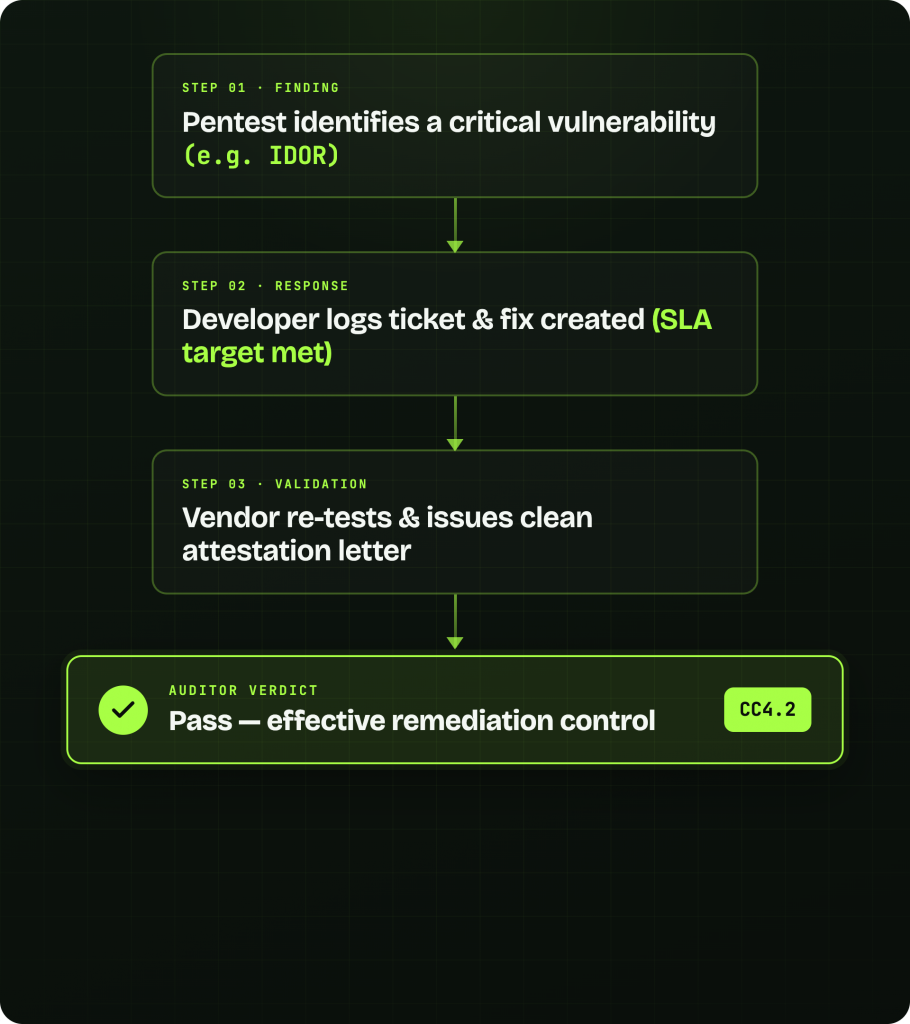
The Auditor’s SLA Checklist
Auditors will look at your remediation lifecycle and compare it to your internal security policies. Auditors expect standard fix timelines to include:
Critical Findings: Remediation in 7-14 days.
High Findings: Resolved within 30 days.
Medium/Low Findings: Remediated within 60-90 days or formally documented on an accepted Risk Register signed off by management
Note: Audit findings/qualified opinions on CC4.2 and CC7.1 will be raised in case Critical/High findings in your final report are not addressed/managed.
What Evidence of SOC 2 Penetration Testing to Provide Auditors
When your auditor asks you for evidence of penetration testing, don’t just email them an 80 page raw technical output of exploit payloads to your trust center.
Develop a comprehensive SOC 2 Evidence Package with three distinct artefacts:
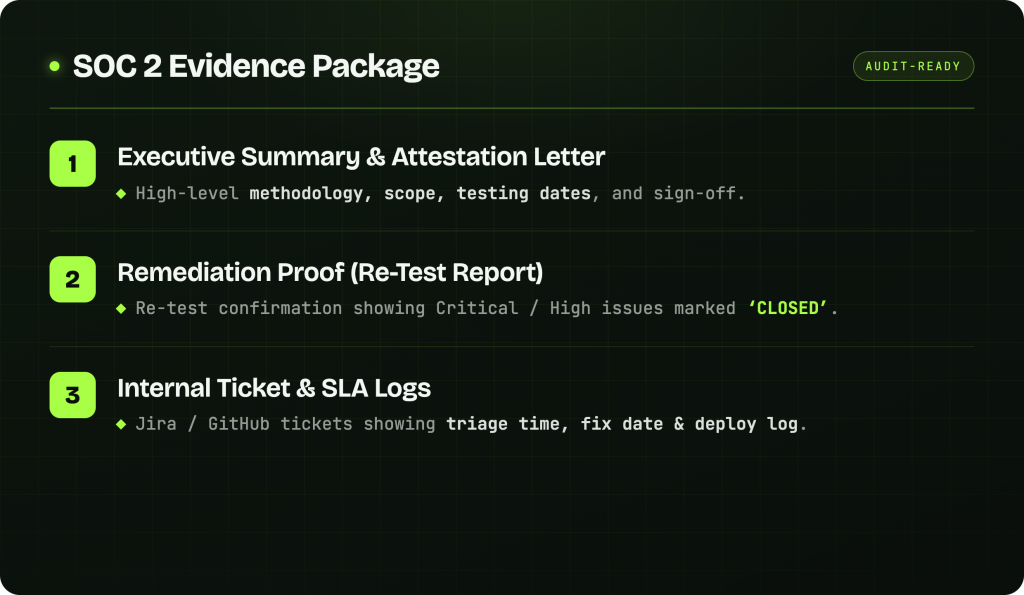
Attestation Letter / Executive Summary: A formal letter from your third party pentest provider describing the scope, testing dates, methodologies used (e.g. OWASP Top 10), and general security posture summary. This is also the artefact you distribute to enterprise prospects under NDA.
Re-Test & Verification Report: Documentation proving that the vendor confirmed that the vulnerabilities found in the first test have been fixed.
Corrective Action Records: Internal engineering tickets (Jira, GitHub Issues, Linear) with details about who assigned the repair, pull request links and verification dates to meet CC4.2 tracking criteria.
Choosing SOC 2 Penetration Testing Services
Not every penetration testing company writes reports that will pass auditor inspection. Apply this criterion checklist while judging SOC 2 penetration testing services:
Certified Security Testers: Make sure your team is certified in a recognised program such as OSCP (Offensive Security Certified Professional), CREST, GPEN, or CEH.
Auditor-Grade Reporting: Ask a sample report (redacted). It will provide a dedicated executive summary, explicit risk scoring (CVSS v3/v4), mapped SOC 2 Trust Services Criteria, and actionable remediation assistance.
Included Re-Testing: Ensure the flat engagement price includes re-testing to remediate vulnerabilities rather than it being an additional hourly add-on.
Compliance Platform Integrations: Modern Penetration Testing as a Service (PTaaS) providers link directly with compliance platforms (such as Vanta, Drata, or Secureframe) and automatically deliver attestation evidence into your auditor dashboard.
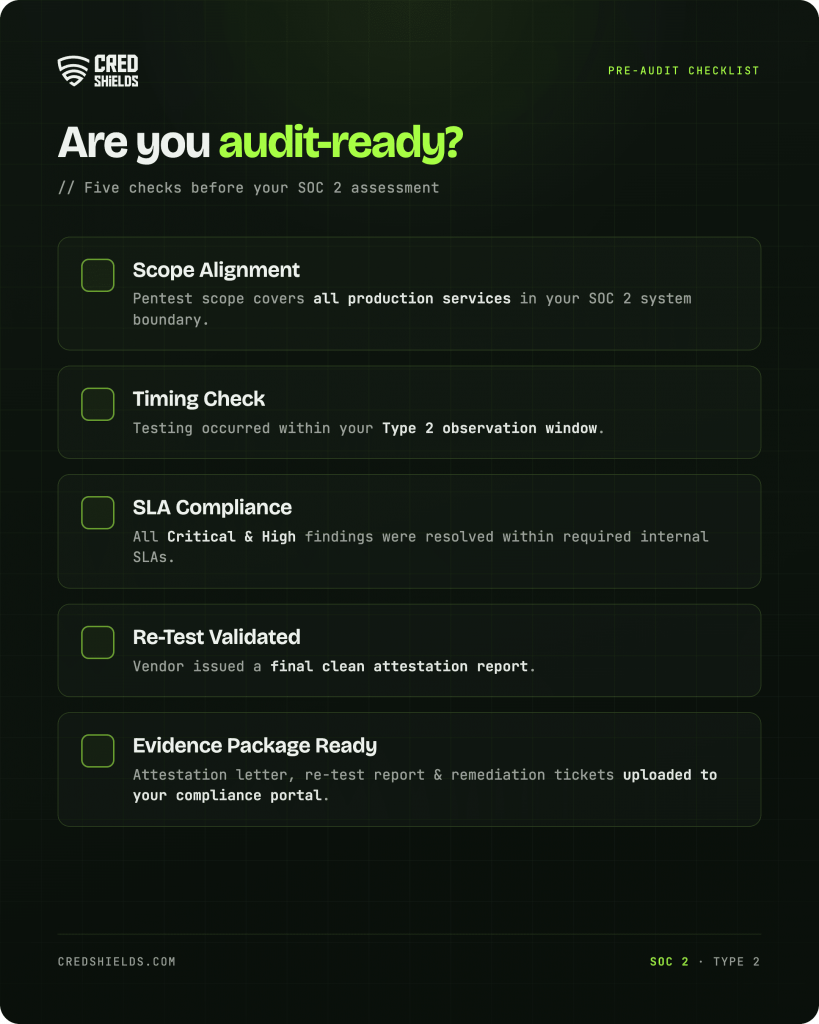
Final Checklist Before Your Audit
To ensure your penetration testing process delivers a smooth SOC 2 audit experience, complete this final review:
By pairing robust policy design with an adversarial penetration test, you give both your auditor and your enterprise buyers total confidence that your platform is truly secure.
Additional read: