

The wp2shell Crisis: Why This WordPress Core RCE Changes the Timeline for Enterprise Defense

The WordPress ecosystem is in the midst of its worst security crisis in almost a decade. wp2shell, a newly discovered exploit chain, has hit the web security worst case scenario: unauthenticated Remote Code Execution (RCE) targeting WordPress Core out of the box.
Unlike most WordPress threats that target abandoned plugins or unpatched third party themes, wp2shell targets the heart of the default WordPress installation.
An online, unpatched site can be compromised in seconds, no user interaction or valid login credentials required. Here’s a breakdown of how the exploit works, why threat actors are weaponising it at unprecedented speeds and the immediate steps your organisation needs to take to secure its digital footprint.
Table of Contents
Technical Breakdown
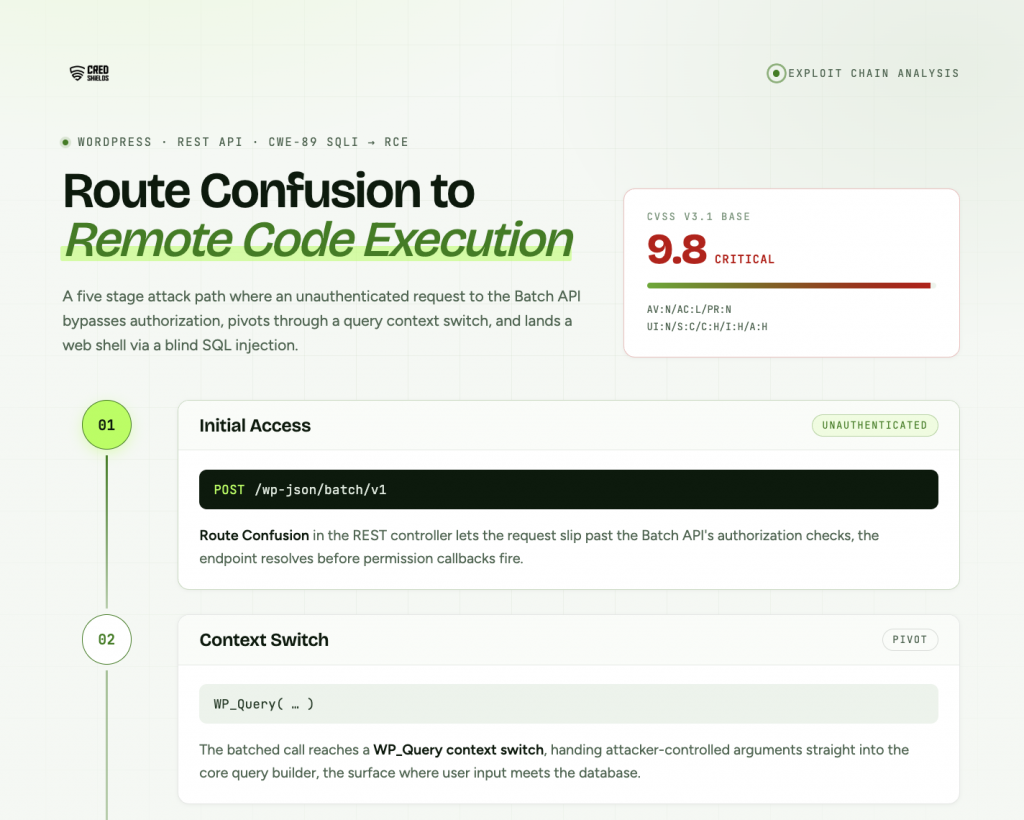
The wp2shell attack vector, discovered by Assetnote researchers, uses two seemingly unrelated vulnerabilities chained together to achieve full server take over:
- CVE-2026-60137 (The SQL Injection): High severity vulnerability in WP_Query author__not_in parameter. This enables an attacker to tamper with raw database queries
- CVE-2026-63030 (The Route Confusion): A critical logic flaw in the default WordPress REST API batch endpoint (/wp-json/batch/v1)
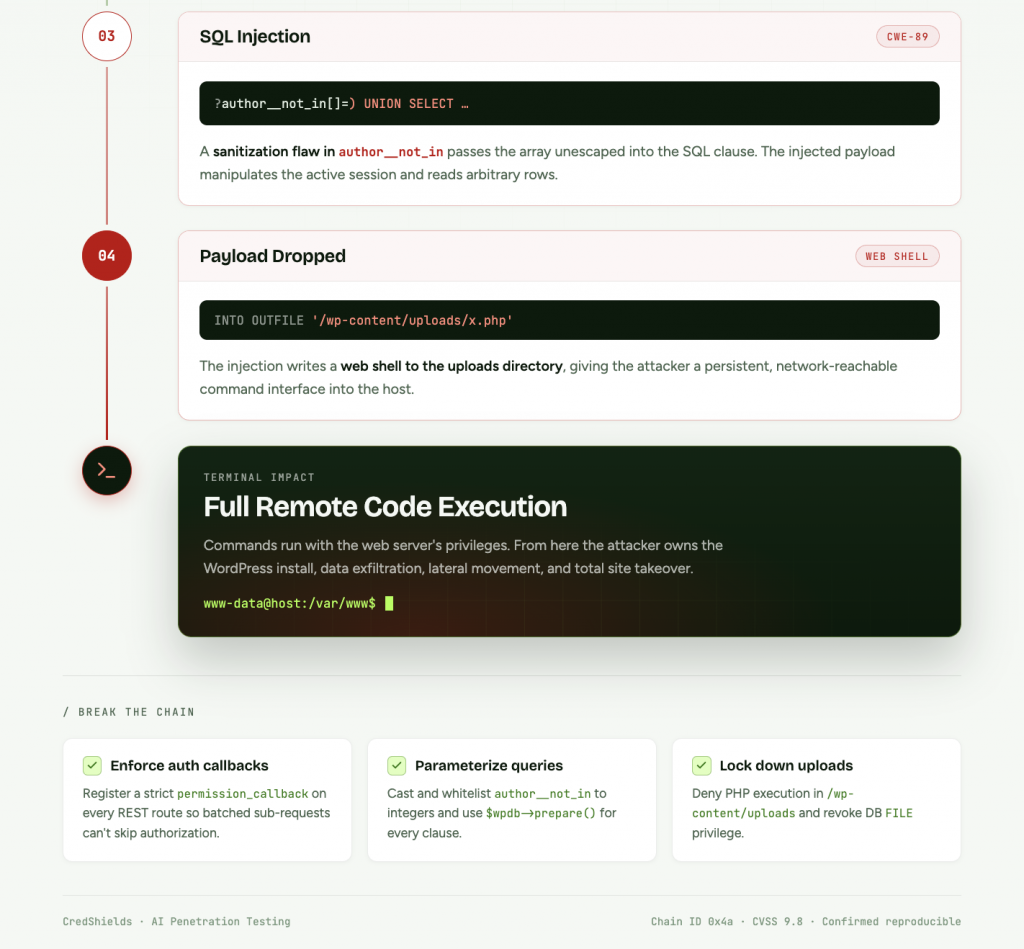
An unauthenticated attacker can inject malicious, structured payloads to the REST API batch handler which can confuse the routing logic and trigger the underlying SQL injection, elevate their privileges to a super-administrator and drop a web shell onto the target server. Once the attacker is there, he has full execution rights to install ransomware, exfiltrate databases or pivot deeper into corporate networks.
Why This Incident is a New and Unprecedented Risk
1. No External Dependencies
This is a core bug. Even a brand new, clean WordPress install (with no plugins active) is completely vulnerable to this exploit chain.
2. Failure of the Patch Window
In the past, there was a gap of a few days between a vulnerability being announced and active automated exploits being deployed. wp2shell compressed that window to a few of hours. Threat actors quickly reverse engineered the fix, and according to live telemetry tracked in the Elastic Security Labs Threat Report, used AI assisted scanning tools to weaponise the exploit globally, seeking out unpatched infrastructure at industrial scale.
3. Limitations of Centralised Updates
The WordPress Security Team did the unusual thing of running a global forced automatic update but there is a dangerous single point of failure in relying on this mechanism. Many enterprise environments also intentionally disable automatic core updates to avoid breaking custom application code, leaving them critically exposed in the hours after disclosure.
Engineering Lessons: Change Your Defensive Architecture
The wp2shell event requires a paradigm shift in how business application security must be performed moving forward. Three lessons in architecture:
De-couple the Content Management Layer
Running WordPress as a monolithic application (admin panel, database and public-facing frontend all in the same container or server) is now a legacy liability. Enterprises must shift to a decoupled or headless architecture. An RCE vulnerability in core is completely unexploitable from the public internet by compiling WordPress into static HTML files served by CDNs and restricting the actual WP core behind a strict VPN/IP restricted staging server.
Audit “Unsafe” Built-in Core Handlers
The API batch endpoint is a classic example of code complexity leading to unexpected attack surfaces. Organisations should perform detailed application profiling. If your marketing site is not actively using the REST API, Gutenberg block endpoints, XML-RPC, or specific admin-ajax endpoints, then they should be structurally disabled at the application layer or server configuration file (nginx.conf or .htaccess) rather than relying on WordPress plugins to block them.
Zero Trust App Containment
Modern defence assumes that your web application layer will be hacked at some point. Never give web servers global write permissions over their own directory trees. Blocking the ability for www-data or server user to write to index.php, root folders and blocking execution files (.php) within /wp-content/uploads/ will prevent a successful SQL injection from ever upgrading into a persistent web shell.
Inside the Payload: How the RCE is achieved
To understand why standard signature based detection fails, we need to understand how the attack bypasses the validation checks. What really breaks down is the way the REST API handles requests serialised in JSON.
Route Confusion (CVE-2026-63030)
The REST API batch endpoint lets us combine multiple API requests into a single HTTP POST request. As mapped out in Picus Security’s chain reproduction analysis, an endpoint vulnerability in parsing nested JSON routing strings allows an attacker to bypass the API’s global authentication middleware checks by passing an internal route. The system treats the nested request as if it originated internally from a trusted system daemon.
The SQLi Primitive (CVE-2026-60137)
The payload targets the author__not_in array parameter handled by WP_Query inside the unauthenticated API wrapper. Normally, WordPress will cast this array to strict int. But it does not support multi-dimensional nested arrays. This allows an attacker to inject a structured raw string. This string breaks out of the SQL delimiter bounds during the construction of the tax_query or meta_query, and allows the attacker arbitrary read/write access to the database.
Achieving the Shell
The site configuration of WordPress and the state of the active plugins are stored directly in the wp_options table. The SQL injection allows the attacker to change the option string active_plugins . They insert a pointer to a malicious payload delivered via the API upload mechanism which causes WordPress to immediately execute the code on the next page refresh.
Securing Your Infrastructure Today
If WordPress is the backbone of your business’s public facing websites, client portals, or marketing hubs, create the following emergency response workflow now:
Step 1: Audit and Enforce Safe Core Versions
Make sure you upgrade all the WordPress instances in your inventory to a safe version. Don’t presume the forced update has been successful.
Safe Versions: Make sure your installations are running 7.0.2, 6.9.5, or 6.8.6 (or higher) as catalogued in the Official WordPress.org Security Release Bulletin.
Step 2: Impose Strict REST API Blacklists
If your website does not use the batch endpoint feature, deploy custom rules at your Web Application Firewall (WAF) layer (e.g. Cloudflare or AWS WAF) to block or heavily rate limit traffic hitting: /wp-json/batch/v1. Enterprise engineering hubs can reference Akamai’s Adaptive Security threat advisory to adjust custom blocking filters.
Step 3: Scan for Indicator of Compromise (IOC)
If you find a site that was not fixed in the initial window of disclosure, undertake a detailed forensic audit. Following Wordfence’s post-exploitation forensics guidelines, specifically look for:
- New user accounts that have been created and have administrator rights
- Unexplainable file modifications in wp-config.php, index.php or in the /wp-content/uploads directory
- Unusual outbound database connections from your web server
The Strategic Takeaway
The wp2shell incident underscores an uncomfortable reality in modern cybersecurity: the time to exploit window is shrinking exponentially. In an era where attackers use automated, AI accelerated frameworks to target infrastructure instantly, organizations can no longer rely on manual patch cycles or reactive security postures.
A robust, multi layered defense combining behavioral WAF filtering, strict asset visibility, and continuous monitoring is the only way to insulate your business when foundational software primitives break.
Is your organization’s web infrastructure resilient against automated RCE chains? Contact our security operations team today for a comprehensive asset vulnerability assessment.
Additional read: