

What ASEAN Health Data Breaches Teach About EHR & Healthcare Data Security
What did Southeast Asia’s most significant health data leaks reveal about where patient data escapes? Read on to find out.
Healthcare data resilience is a provider’s ability to keep patient records confidential and clinical services running through a cyberattack. Regional incidents show a consistent pattern: attackers enter through workstations and reach the EHR with stolen privileged credentials, copies of patient data sit outside the core database, and health app backends leak through misconfiguration. Controls have to follow the data to wherever its copies live.
Singapore’s Health Information Act passed on 12 January 2026, with commencement targeted for early 2027, bringing cybersecurity, healthcare data security, and breach notification obligations to licensed providers across the system. For hospital CISOs, clinic groups, telehealth operators, and health information system vendors, the incidents below show which controls those obligations will test first.
Table of Contents
What Does Healthcare Data Resilience Mean?
Healthcare data resilience is the combination of confidentiality controls that keep patient data where it belongs and continuity controls that keep care running when systems fail. It covers the electronic health record, every system that copies from it, and every app or vendor that collects health data on its own.
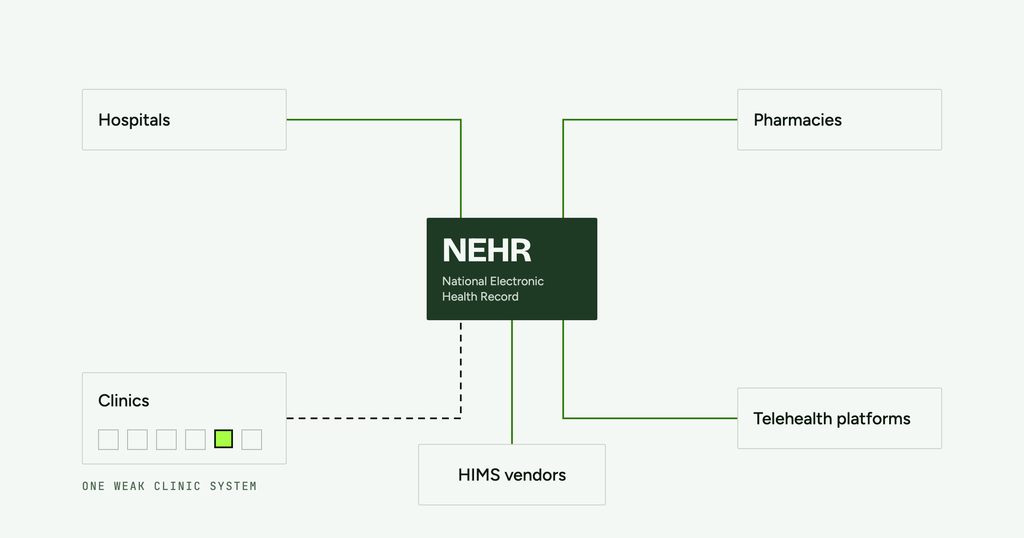
In Singapore, that scope is widening by law. The Health Information Act requires licensed providers to contribute key health information to the National Electronic Health Record, and the Medical Protection Society notes that all licensed providers will need to use HIA-compliant Health Information Management Systems to do so. More connections to a national record mean more places where a single weak clinic system becomes a path to shared data.
Three Regional Health Data Incidents and What Each Exposed
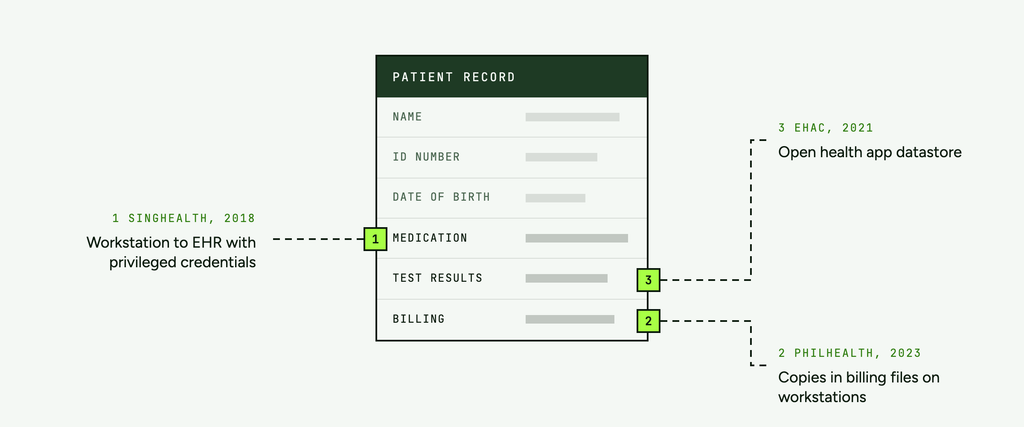
The three incidents below reached patient data through three different routes. Read together, they show that the clinical database is rarely the only place that needs protecting.
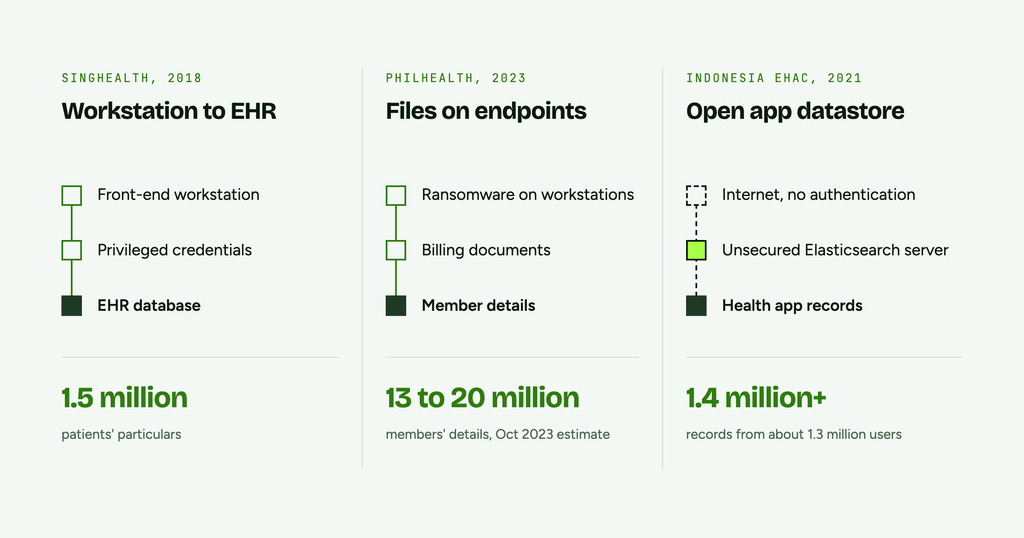
| Incident | Year | How the data was reached | Scale reported | What it exposed about defenses |
| SingHealth | 2018 | Front-end workstation, then privileged credentials to the database | 1.5 million patients’ particulars; about 160,000 outpatient medication records | Privileged access paths to clinical databases |
| PhilHealth | 2023 | Ransomware on workstations holding billing documents | 13 to 20 million members’ details, per PhilHealth’s October 2023 estimate | Patient data copies outside the member database |
| Indonesia eHAC | 2021 | Unsecured Elasticsearch server behind a health app | Over 1.4 million records from about 1.3 million users | App backend configuration and data retention |
SingHealth, 2018: The Workstation Was the Door to the EHR
According to the joint ministry disclosure summarized by Help Net Security, attackers entered SingHealth’s IT system through a front-end workstation, obtained privileged account credentials, and used them to reach the database. They took the personal particulars of 1.5 million patients and outpatient medication data for about 160,000 of them.
At the Committee of Inquiry, the Solicitor-General said the attackers infected workstations with malware and moved laterally through the network, with the ultimate target appearing to be the electronic medical records system. The first hearing also surfaced weak administrative passwords and unpatched workstations. The path ran from an ordinary endpoint to the most sensitive system through credentials, and testing that path end to end is what a clinical network penetration test is for.
PhilHealth, 2023: Patient Data Lived Outside the Member Database
The Medusa ransomware attack on the Philippine Health Insurance Corporation began on 22 September 2023, and PhilHealth ran on manual operations while systems were restored. Early statements from officials maintained that the member database was not affected.
On 18 October 2023, PhilHealth confirmed that around 13 to 20 million members’ details had leaked, drawn from billing documents that included names, identification numbers, and dates of birth. The statement about the member database and the leak of member data were both accurate, because the data sat in files on workstations. A data map that lists only systems of record will miss exports, billing files, and spreadsheets, which is where much of this data actually lives.
Indonesia eHAC, 2021: A Health App Backend Left Open
Researchers at vpnMentor found that the developers of Indonesia’s electronic Health Alert Card app used an unsecured Elasticsearch database holding over 1.4 million records from about 1.3 million users, including test results and identity details. The exposure also covered infrastructure data involving hospitals and officials who used the app. The server was taken down two days after the researchers contacted Indonesia’s national cyber agency.
No attacker was needed. A datastore reachable from the internet without authentication is a configuration finding, and it is the class of issue that telehealth and health app backends accumulate as they scale quickly.
Where Telehealth Platforms Leak Patient Data
A telehealth service joins a mobile app, an API, a video or chat vendor, e-prescription workflows, and often pharmacy delivery and payments. Each join is a place where health data is copied or exposed. These are the areas a telehealth penetration test should cover:
- Authorization on consultation records, prescriptions, and lab reports, where changing an ID in a request can return another patient’s file
- Object storage for uploaded photos, referral letters, and lab PDFs, including link expiry and public access settings
- Analytics and crash-reporting SDKs that capture screen content or form fields containing symptoms or diagnoses
- Retention and access controls at third-party video and chat vendors
- Doctor and admin portals, which often carry broader access than the patient app and weaker authentication
- Search and logging backends, such as Elasticsearch or log stores, reachable from outside the private network
What Singapore’s Health Information Act Requires
The Health Information Bill was passed by Parliament on 12 January 2026, with commencement targeted for early 2027 to give providers time to strengthen their cybersecurity and healthcare data security. Baker McKenzie’s summary of MOH’s implementation resources states that licensed healthcare providers, retail pharmacies, approved NEHR users, and Health Information Management System providers must implement reasonable security measures and meet incident and breach notification obligations. The key provisions:
- Scope: licensees under the Healthcare Services Act, NEHR contributors and users, and HIMS providers
- Security baseline: MOH’s Cybersecurity and Data Security Essentials covers cybersecurity, data security, and common practices such as training, vendor management, and organizational protocols, and applies to both electronic and hardcopy data
- Controls named during the Bill’s passage: requirements ranging from patching and monitoring to multifactor authentication and incident reporting
- Notification: MOH’s 2023 FAQ set the initial report to MOH within two hours of the provider assessing an incident as notifiable.
A two-hour window leaves no time to work out who can declare an incident notifiable. That decision path needs to be written down and rehearsed before commencement.
Building Resilience Into Clinical Operations
Confidentiality controls reduce the chance of a leak. Continuity controls decide whether patients still receive care while an incident is contained. PhilHealth’s weeks of manual processing show what the second set looks like when it is improvised. These are the operational measures worth building before an incident forces them:
- Written downtime procedures for registration, prescribing, and billing, tested with clinical staff
- Offline, immutable backups of the EHR and HIMS, with a timed restoration test
- Privileged access management for database and domain administrators, with session recording
- Alerting on bulk or unusual database queries; SingHealth’s breach was spotted when administrators detected unusual activity on a database
- Segmentation between clinical devices, administrative workstations, and the EHR database tier
- Contract terms that give you breach notification and audit rights over HIMS and telehealth vendors
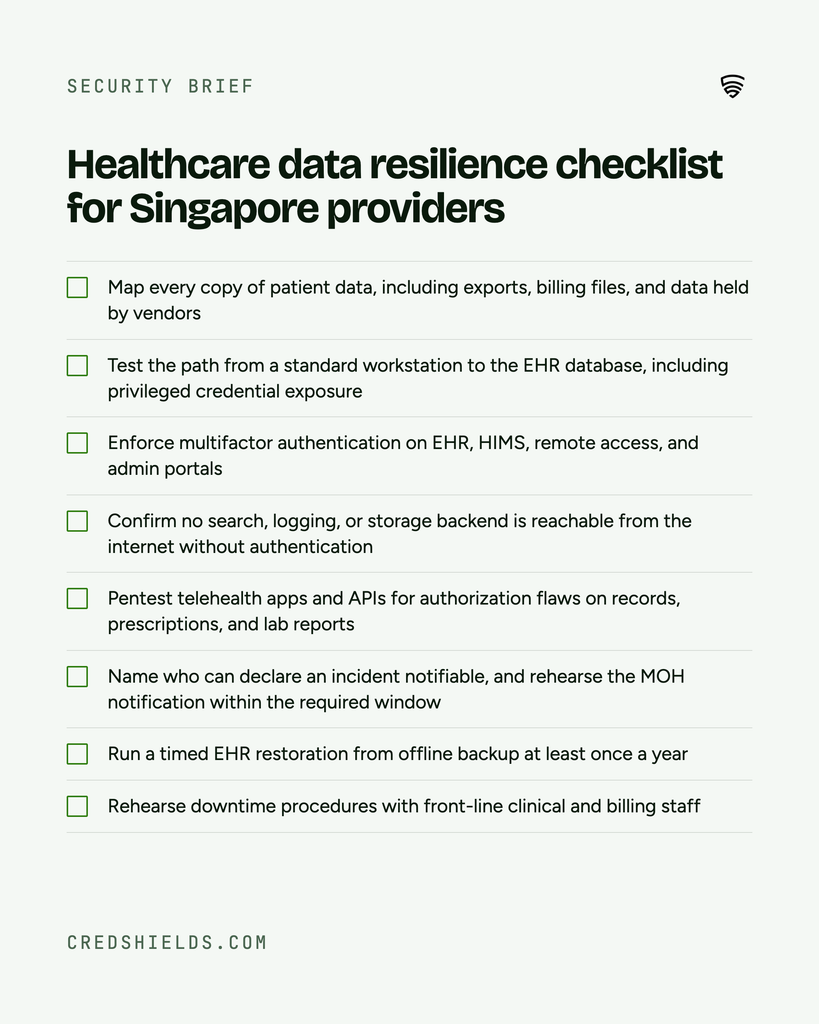
Healthcare Data Resilience Checklist for Singapore Providers
Use this list to check readiness ahead of the Health Information Act’s commencement.
- Map every copy of patient data, including exports, billing files, and data held by vendors
- Test the path from a standard workstation to the EHR database, including privileged credential exposure
- Enforce multifactor authentication on EHR, HIMS, remote access, and admin portals
- Confirm no search, logging, or storage backend is reachable from the internet without authentication
- Pentest telehealth apps and APIs for authorization flaws on records, prescriptions, and lab reports
- Name who can declare an incident notifiable, and rehearse the MOH notification within the required window
- Run a timed EHR restoration from offline backup at least once a year
- Rehearse downtime procedures with front-line clinical and billing staff
Frequently asked questions (FAQs) about healthcare data security in Singapore
These answers address what providers, clinic groups, and health technology vendors ask most often about the new regime.
Q1. What is healthcare data resilience?
It is a provider’s ability to keep patient data confidential and clinical services running through a cyberattack. It combines access controls, data mapping, and monitoring with tested backups and downtime procedures.
Q2. When does Singapore’s Health Information Act take effect?
Parliament passed the Health Information Bill on 12 January 2026, and MOH has targeted commencement for early 2027.
Q3. How quickly must providers notify MOH of a cyber incident?
MOH’s 2023 FAQ set the initial notification within two hours of assessing an incident as notifiable. Providers should confirm the final prescribed period in the regulations issued under the Act.
Q4. What should a telehealth penetration test cover?
Authorization on patient records and prescriptions, object storage for uploads, third-party SDKs and vendors, admin and doctor portals, and any backend datastore reachable from the internet.
Q5. Does the Health Information Act apply to software vendors?
Yes, in part. Health Information Management System providers must implement reasonable healthcare data security measures and meet notification obligations, according to MOH’s published implementation resources.
A CredShields researcher will walk your team through the paths from a clinic workstation or telehealth API to patient records and which of them hold up under test. Scope a healthcare penetration test.