

Red Teaming vs. Pentesting Services, Which Does Your Organization Need?
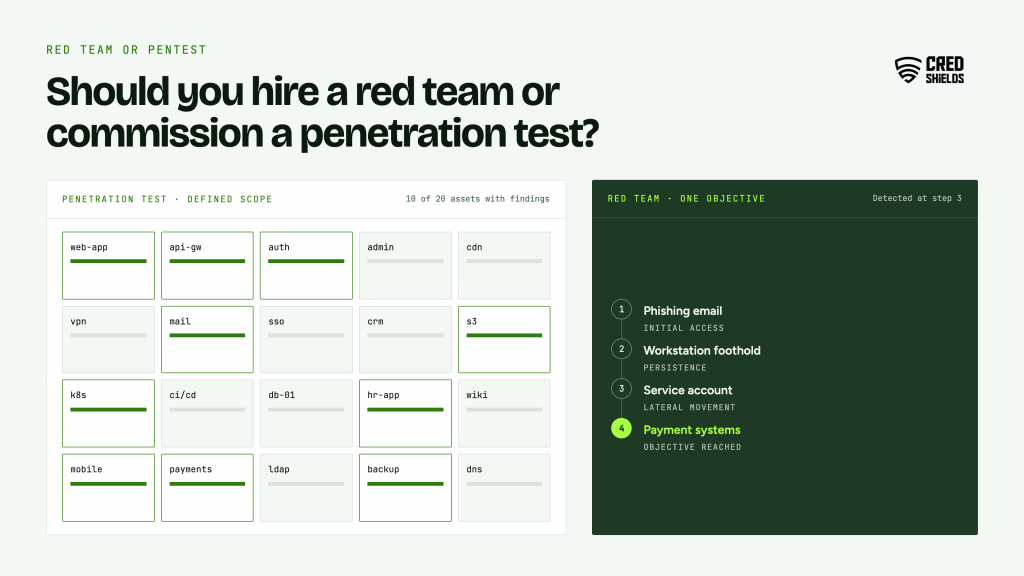
Should you hire a red team or commission a penetration test? A penetration test finds and proves as many exploitable vulnerabilities as possible within a defined scope, usually with defenders aware of the test. A red team exercise pursues a specific objective, such as reaching payment systems, over a longer period while measuring whether defenders detect and respond. Most organizations need regular pentests first, and red teaming once detection and response are established.
Singapore’s financial regulator expects both, and the banking industry’s red teaming guidelines frame the choice as a question of maturity. This guide is for CISOs, heads of security operations, and technology risk teams deciding where the next testing budget should go.
What Penetration Testing and Red Teaming Each Mean
Penetration testing is an authorized, time-boxed assessment in which testers attempt to find and exploit vulnerabilities in a defined set of systems, such as a web application, a network segment, or a cloud account. Its question is breadth: what can be broken here, and how badly?
Red teaming is an authorized, objective-driven simulation of a real adversary. The red team chooses its own route across people, processes, and technology to reach a goal agreed in advance, and the exercise measures detection and response as much as prevention. Its question is resilience: could a capable attacker achieve this outcome, and would we notice in time?
Red Teaming vs Penetration Testing Compared
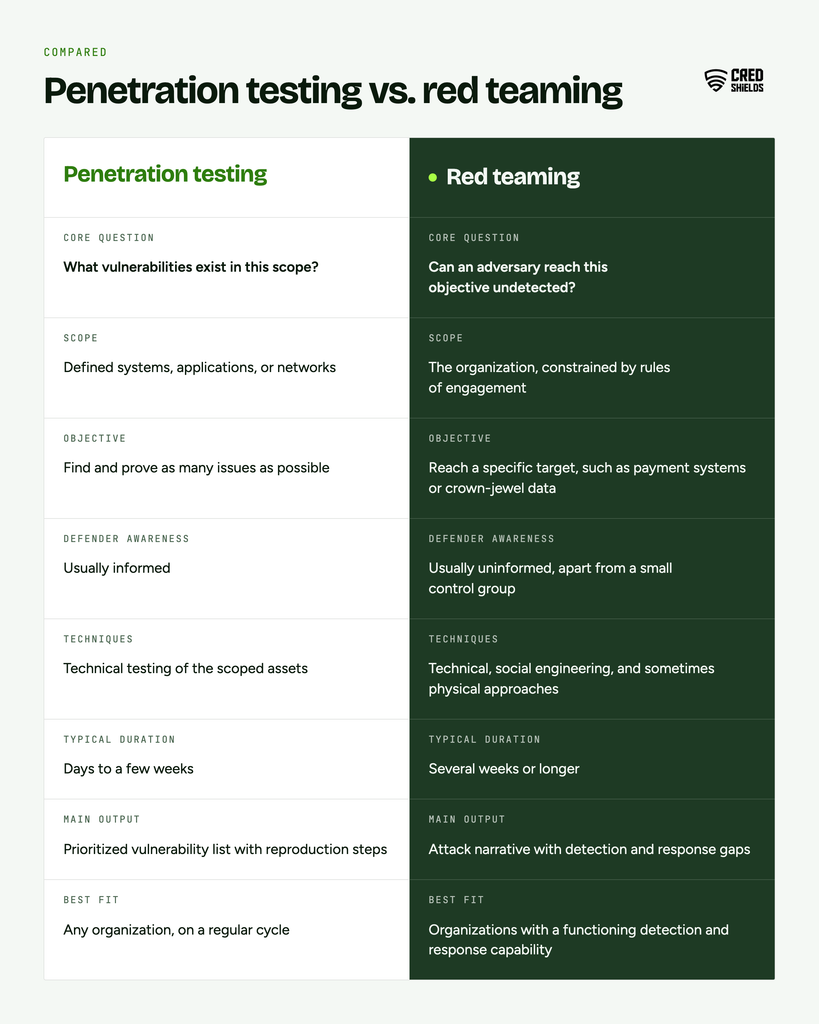
The two services share techniques but differ in almost every other respect. The table sets them side by side.
| Dimension | Penetration testing | Red teaming |
| Core question | What vulnerabilities exist in this scope? | Can an adversary reach this objective undetected? |
| Scope | Defined systems, applications, or networks | The organization, constrained by rules of engagement |
| Objective | Find and prove as many issues as possible | Reach a specific target, such as payment systems or crown-jewel data |
| Defender awareness | Usually informed | Usually uninformed, apart from a small control group |
| Techniques | Technical testing of the scoped assets | Technical, social engineering, and sometimes physical approaches |
| Typical duration | Days to a few weeks | Several weeks or longer |
| Main output | Prioritized vulnerability list with reproduction steps | Attack narrative with detection and response gaps |
| Best fit | Any organization, on a regular cycle | Organizations with a functioning detection and response capability |
How Singapore’s AASE Guidelines Frame the Choice
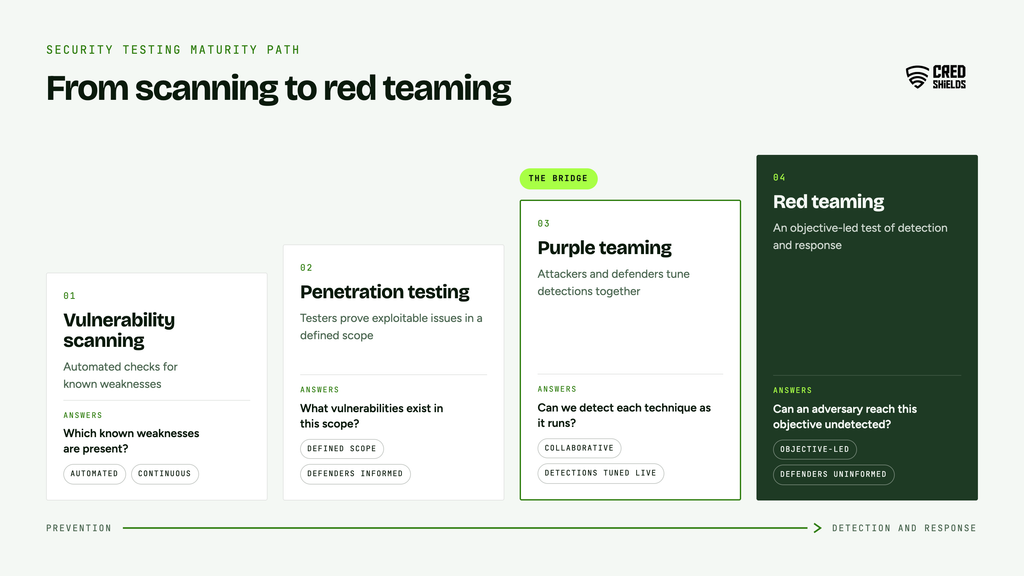
In November 2018, the Association of Banks in Singapore released Red Team: Adversarial Attack Simulation Exercises (AASE) Guidelines for the Financial Industry in Singapore, developed with support from MAS. Picus Security’s review notes that the guidelines explain how and when to use vulnerability scanning, penetration testing, and red teaming, and describe levels of organizational maturity with the kind of attack simulation suited to each.
ABS described the benefits of these exercises as including the identification of weaknesses not detected by standard vulnerability and security testing methods, and an assessment of incident and crisis management response. MAS’s revised Technology Risk Management Guidelines in January 2021 then included red teaming simulations to validate cyber defences among its cyber resilience practices, alongside vulnerability assessment and penetration testing.
The framing is useful outside banking too. Red teaming answers questions a penetration test cannot, but only once the basics a penetration test checks are in place.
Signs Your Organization Needs a Penetration Test First
A red team run against an environment with open basic weaknesses spends expensive time proving what a pentest would have found faster. A penetration test is the better next step if any of these apply:
- You have not tested a major application, network, or cloud environment in the last 12 months
- A new product, platform, or integration is about to launch
- Previous pentest findings of high severity remain open
- A regulator, customer, or insurer has asked for a pentest report
- Your security team does not yet run continuous monitoring with defined escalation
| Recommended read: For teams working out when to book a pentest ahead of a SOC 2 audit, this article on what to expect from SOC 2 penetration testing is a great place to start. |
Signs Your Organization Is Ready for a Red Team
Red teaming pays off when there is a defense worth testing. These conditions suggest readiness:
A security operations function monitors around the clock, in-house or through a managed providerRecent pentests have been remediated and retestedThe incident response plan has been exercised at least onceLeadership has a specific scenario it wants tested, such as ransomware reaching core systemsThe board or regulator wants evidence of detection and response, beyond the absence of vulnerabilities
Purple Teaming as the Bridge Between the Two
Purple teaming joins attackers and defenders in the same room. The offensive team runs specific techniques while the defensive team watches its tools in real time, and both adjust detections before moving to the next technique.
For organizations between the two stages, a purple team engagement builds detection coverage quickly and turns a later red team exercise into a fairer test. It also gives SOC analysts direct exposure to the techniques they are expected to catch.
Red Team or Pentest Decision Checklist
Answer these questions to decide which engagement to commission next.
- Have all critical applications and environments been pentested in the last 12 months?
- Are high-severity findings from those tests closed and retested?
- Do you have continuous monitoring with defined escalation paths?
- Has the incident response plan been exercised?
- Is there a specific adversary objective leadership wants tested?
- Do you need a report of individual vulnerabilities, or evidence of detection and response?
If most answers to the first four are no, start with penetration testing. If they are yes, and the last two point to an objective, scope a red team.
Frequently asked questions (FAQs) about red teaming and penetration testing in Singapore
These answers cover the questions security leaders ask most often when choosing between the two.
Q1. What is the difference between red teaming and penetration testing?
A penetration test finds and proves vulnerabilities across a defined scope. A red team pursues a specific objective like a real adversary and measures whether defenders detect and respond.
Q2. Is red teaming better than penetration testing?
They answer different questions. Pentesting shows what is vulnerable; red teaming shows whether an attacker could reach a goal without being stopped. Most organizations need pentesting first.
Q3. What are Singapore’s AASE guidelines?
Red teaming guidelines for Singapore’s financial industry, released by the Association of Banks in Singapore in November 2018 with MAS support. They explain when to use scanning, pentesting, and red teaming based on organizational maturity.
Q4. Does MAS require red teaming?
MAS’s Technology Risk Management Guidelines, revised in January 2021, include adversarial attack simulation exercises among expected cyber resilience practices for financial institutions, alongside penetration testing.
Q5. How long does a red team exercise take?
Typically several weeks or longer, depending on the objective and rules of engagement, compared with days to a few weeks for most penetration tests.