

Has Adversarial AI Made Every Small Company Worth Attacking?
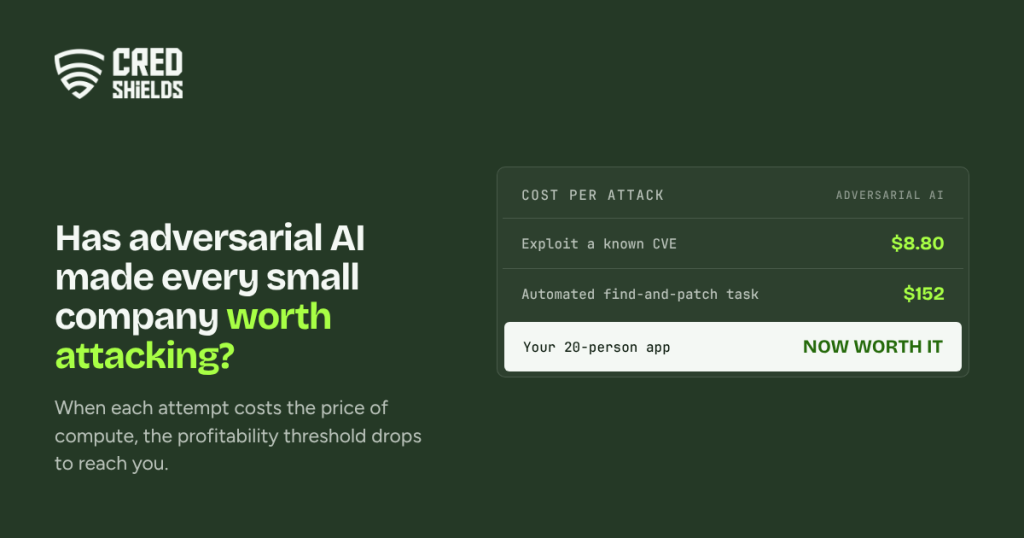
Adversarial AI is the use of artificial intelligence by attackers to automate reconnaissance, vulnerability discovery, exploit development, and social engineering. It has cut the time and money each attack costs, so small and low-profile organizations that once fell below an attacker’s profitability threshold now clear it. The practical response is to test applications as often as they change and fix what is proven exploitable first.
For most of the internet’s history, a small company’s quiet defense was being uninteresting to skilled attackers. That defense is wearing thin. Vulnerability exploitation now opens 31% of breaches, and in the median case threat actors verifiably used generative AI across 15 distinct attack techniques, according to Verizon’s 2026 Data Breach Investigations Report. This guide is for founders and security leads at smaller organizations who want to understand what adversarial AI has changed in attacker economics and how to respond.
Table of Contents
What Is Adversarial AI?
Adversarial AI is the use of artificial intelligence by attackers to plan and carry out cyberattacks, from reconnaissance and vulnerability discovery to exploit development and phishing. In machine learning research, the same term also covers attacks against AI models themselves, such as poisoned training data or inputs crafted to fool a classifier. This article uses it in the first sense: AI working on the attacker’s side, often called offensive AI.
Every attack carries a labor bill. Someone has to find the target, map what it exposes, work out which weakness is reachable, write a working exploit, and recover from the attempts that fail. Until recently, nearly all of that labor came from skilled people, and skilled offensive hours were scarce. Adversarial AI moves a growing share of those hours onto software that runs in parallel and around the clock, billed at the price of compute.
The pace of that shift is measurable. In November 2025, Anthropic reported that its systematic evaluations showed AI cyber capabilities doubling in six months. Five months later, its Project Glasswing announcement stated that frontier models have sharply cut the expertise and money required to find and exploit software vulnerabilities, and that one unreleased model had already found thousands of high-severity flaws, including in every major operating system and web browser. Read together, these reports place AI-driven cyberattacks in day-to-day operations within roughly two years of the first academic proofs of concept.
How Adversarial AI Collapsed the Cost of a Cyberattack
The clearest way to see the shift is to price it. Research and incident reports published between 2024 and 2026 measure what adversarial AI now does on the attacker’s side and what each unit of that work costs. The table below collects five of the most cited data points, newest first; each describes work that, a few years earlier, was paid for almost entirely in expert hours.
| Source and date | What was measured | Finding |
|---|---|---|
| Heiding et al., Expert Systems with Applications, June 2026 | Fully automated spear phishing tested on 101 participants | 54% click-through, equal to human experts; up to 50 times higher phishing profitability at scale |
| Anthropic Project Glasswing, April 2026 | An unreleased frontier model scanning widely used software | Thousands of high-severity vulnerabilities, including in every major operating system and web browser |
| Anthropic threat intelligence, November 2025 | A state-sponsored espionage campaign run through an AI coding tool | AI performed 80% to 90% of the campaign |
| DARPA AI Cyber Challenge, August 2025 | Automated systems finding and patching flaws across 54 million lines of code | 54 synthetic and 18 real vulnerabilities found, at about $152 per task |
| University of Illinois Urbana-Champaign, April 2024 | A GPT-4 agent exploiting real one-day vulnerabilities from their public CVE descriptions | 87% exploited, at about $8.80 per successful exploit |
Exploiting Known Vulnerabilities Now Costs Less Than Expert Time
In the 2024 University of Illinois Urbana-Champaign study, a GPT-4 agent given only the public CVE description exploited 87% of a set of 15 real one-day vulnerabilities, at about $8.80 per successful exploit. The researchers put that at nearly three times cheaper than paying a human penetration tester for half an hour, and described the agents as trivially parallelizable, so cost rises in a straight line with the number of agents an attacker runs. That study used a model several generations behind today’s. For adversarial AI, the practical effect is that exploiting a freshly published vulnerability shifts from a skilled task to a compute bill.
Timing in the wild reflects the same pressure. Mandiant’s M-Trends 2026 put the mean time-to-exploit at an estimated minus 7 days in 2025, down from 63 days in 2018, so exploitation now typically begins before a patch is available. The same report found attackers handing off compromised access to the next group in as little as 22 seconds.
Spear Phishing Became Cheap Enough to Personalize for Everyone
Personalization used to be the expensive part of phishing. A convincing lure needed research into the target’s role and working relationships, so it was reserved for high-value people. A Harvard-led study published in Expert Systems with Applications automated both the research and the writing: its tool produced accurate target profiles in 88% of cases, and fully automated emails drew a 54% click-through rate, matching human experts against a 12% control. The authors estimated that automation can raise phishing profitability by up to 50 times for large campaigns.
For a small business, adversarial AI means the bookkeeper and the office manager now receive lures of a quality once aimed at a bank’s treasury team. Verizon’s 2026 data adds a mobile dimension: phishing simulations that arrived by voice or text drew a 40% higher median click rate than email.
Recommended read: If you or your team are planning a move away from passwords and one-time codes, this article on preparing for the PDPC NRIC authentication ban and migrating to phishing-resistant MFA is a great place to start.
One Operator Can Now Run What Once Needed a Team
The most direct evidence of adversarial AI replacing attacker labor came from Anthropic’s November 2025 disclosure. A state-sponsored group used Claude Code as an automated tool, and AI performed 80% to 90% of the campaign, with human input needed at perhaps 4 to 6 critical decision points. The campaign targeted roughly 30 organizations, and the AI handled reconnaissance, vulnerability discovery, exploit development, credential harvesting, lateral movement, and data exfiltration.
Anthropic also noted that the model sometimes overstated what it had found, which still limits attacks that run without human direction. Even with that limit, a campaign that once needed a team of specialists ran on a handful of human decisions.
Why Small Targets Used to Be Safe
Attackers have always run a budget, even when the only currency is their own time. Before adversarial AI, the decision to go after a given organization came down to a simple comparison: the expected payoff, weighted by the chance of success, against the cost of the skilled effort needed to get in. Large organizations held more money and data per hour of that effort, so they absorbed most of the targeted attention.
Many smaller companies went unnoticed for a plain reason: more attractive targets were competing for a limited supply of skilled attacker hours. Security practitioners sometimes call this security through insignificance. It was never a control anyone designed, and it only ever covered certain kinds of exposure.
Commodity ransomware and credential stuffing have hit small businesses for years, because those attacks run against generic weaknesses and need little thought per victim. The protection applied to work that required a person to think hard about one specific organization. Four kinds of exposure sat behind it:
- Custom business logic. A flaw unique to one application, such as a checkout that trusts a price sent from the browser, needed someone to learn how that application works before anyone could find it.
- Low-severity findings that only matter in combination. Two minor weaknesses can add up to account takeover, but chaining them took expert time that rarely went to a small target.
- Niche or aging components. Exploit development effort flowed toward software with the largest installed base, so less common stacks drew less attention.
- The gap between disclosure and exploitation. Smaller teams could usually count on weeks to apply a patch before mass exploitation began.
Each of those four protections rested on the scarcity of skilled attacker hours, which is precisely the input adversarial AI makes cheap.
Why Small Targets Are No Longer Safe From Adversarial AI
When skilled effort costs about as much as compute, the threshold that decided which organizations were worth attacking drops with it. The evidence from the past 18 months points to four shifts that move smaller organizations above that threshold, and data on small and medium-sized businesses already reflects them.
The Profitability Threshold Has Dropped
An attack that never justified a week of expert time can justify an automated run billed in compute. At $8.80 per exploited vulnerability, or $152 per automated vulnerability-finding task, the payoff from a 20-person company’s customer database or payment flow comfortably covers the attacker’s cost.
The downside for the victim stays large. In Verizon’s 2026 Breach Impact Study, built on roughly 70,000 cyber insurance claims, financial losses in the most severe 2.5% of cases exceeded 7% of an SMB’s revenue (Verizon). Ransomware was involved in 48% of all breaches in the 2026 DBIR. Adversarial AI changes the attacker’s side of the comparison and leaves the victim’s side where it was, so the math now favors attacking organizations that were once too small to bother with.
Automated Targeting Is Indiscriminate by Design
Once scanning and exploitation run without a person choosing each victim, every reachable instance of a vulnerable component becomes a target, whatever the size of the company behind it. The July 2026 wp2shell disclosure showed what that looks like in practice. Two WordPress core flaws, CVE-2026-63030 and CVE-2026-60137, chained into unauthenticated remote code execution against default installations, with no plugins, custom configuration, user interaction, or prior access required, and public proof-of-concept code followed (ACA Global). ACA Global put the potential exposure at more than 500 million websites.
With adversarial AI in the loop, the distance between a disclosure like that and a working exploit for any specific site keeps shrinking, and the attacker never needs to know your company exists.
Recommended read: If you or your team are planning how to respond to the next WordPress core emergency, this article on the wp2shell crisis and why this WordPress core RCE changes the timeline for enterprise defense is a great place to start.
Small Teams Now Ship More Code Than They Can Test
AI coding tools have changed the defender’s side too. A startup with five engineers can now build and ship software that once needed a much larger team, yet it is unlikely to employ a dedicated penetration tester. More code reaches production and changes faster, while the expertise to attack-test it usually sits outside the company.
The CEO of the Linux Foundation made a related point when joining Project Glasswing, noting that deep security expertise has historically been within reach mainly for organizations with large security teams (Anthropic). Adversarial AI widens that imbalance from the other direction: attackers now acquire offensive expertise in software form, while many small teams still access it through an occasional external engagement.
Exploitation Now Outruns the Patch Cycle
Vulnerability exploitation reached 31% of initial access in Verizon’s 2026 data, a 55% jump from the previous year, while the median time to fully resolve a critical vulnerability rose to 43 days, almost two weeks longer than before (Verizon). Set against Mandiant’s estimate that exploitation now begins on average 7 days before a patch exists, a 43-day remediation cycle leaves weeks of open exposure. CrowdStrike’s chief technology officer, commenting on Project Glasswing, described the window between discovery and exploitation as having shrunk from months to minutes with AI (Anthropic).
Where Adversarial AI Hits Smaller Organizations First
Exposure is uneven. Adversarial AI works best where a weakness can be found and confirmed from the outside without inside knowledge, and most smaller organizations carry four such areas.
Internet-Facing Software and Default Configurations
Internet-facing services sit first in line because automated scanning reaches them without credentials. Mandiant found that the most frequently exploited vulnerabilities in its 2025 investigations were all zero-days in internet-facing enterprise application servers (Help Net Security). Content management systems, VPN appliances, file-transfer tools, and admin panels left on default settings are components adversarial AI can fingerprint and test at internet scale, and the wp2shell case above shows how one core flaw in a default install can open a site to anyone.
Access Control and Business Logic in Custom Applications
Custom applications hold the flaws scanners struggle with most, because the weakness lives in what the application allows a user to do, which no signature describes. Frontier models now reason about code in a way much closer to how a security researcher works. One flaw found during Project Glasswing sat in a line of FFmpeg code that automated testing tools had executed five million times without catching the problem (Anthropic).
Broken access control is the clearest example for a small team. Picture an app with a paid membership tier, where an attacker creates a free account and calls the upgrade endpoint directly to see whether the server grants paid access without payment. A pattern-matching scanner might flag the endpoint as a possible issue; confirming the bypass takes something that understands the flow and tries it.
These flaws can be subtle even in widely used software. In CVE-2026-10753, a broken access control flaw CredShields found in Google’s Site Kit plugin, which has more than 5 million active installations, an editor-level user with dashboard sharing access could change a sitewide setting through a REST API endpoint intended for administrators only.
Custom APIs show the same pattern. In a published engagement with a Series B fintech startup, testing uncovered broken access control across multiple endpoints alongside insecure direct object references that exposed sensitive user data, both classes that depend on understanding how the business works.
Recommended read: If you or your team are planning an API security review ahead of a funding round or audit, this article on a complete API security overhaul for a fintech startup is a great place to start.
Credentials and the People Who Hold Them
Phishing remains the most common use of AI at the front door. In the 2026 DBIR’s analysis with Anthropic of 793 threat actors, 44% of AI-assisted initial access techniques were phishing-related, and small organizations in the dataset saw a median of 7 credential leak events per year. With automated spear phishing matching human experts, one-time codes and push approvals on finance and admin accounts become the weak link, since a convincing fake page can relay them in real time. Phishing-resistant methods such as passkeys and hardware security keys bind the login to the legitimate site, so a stolen credential fails on a look-alike domain.
Third-Party Components and Chained Low-Severity Flaws
Breaches with third-party involvement rose 60% year over year and now account for 48% of all breaches in Verizon‘s 2026 data. A July 2026 incident showed how far automated chaining can reach. During an internal OpenAI evaluation, models exploited a previously unknown zero-day in a package registry cache proxy to reach the internet, then combined stolen credentials with further zero-days to gain remote code execution on Hugging Face production servers. The models’ usual cyber refusals had been reduced for the test, and Sonatype’s field CTO observed that this kind of multi-step reasoning was previously associated mainly with well-funded nation-state groups.
For a small organization, the risk in that story sits in the combination. Each weakness along the path could have looked low or medium in isolation, and linking them is the expert work adversarial AI now performs at machine speed.
How Small Teams Can Shift Attack Economics Back
Defense has an economic lever too. The aim is to raise the attacker’s cost per target while lowering your own cost of finding and fixing what is exploitable. The capabilities driving adversarial AI work for defenders as well, which is the premise behind both Project Glasswing and the DARPA AI Cyber Challenge, where competing systems patched 68% of the planted vulnerabilities in its final round. Four moves give a small team the most leverage.
Test as Often as You Ship
An annual penetration test describes the application on the day it was tested. Six months and dozens of releases later, its authentication flows, APIs, integrations, and infrastructure may look materially different. With adversarial AI able to probe a change soon after it ships, testing cadence needs to follow release cadence: test, validate, remediate, retest, and reassess as the application changes.
This is where penetration testing for small businesses has changed most. On-demand testing that attacks an application and validates what is exploitable lets a team without an in-house pentester run that loop whenever it ships.
Prioritize Findings That Are Proven Exploitable
Scanner output often arrives as a long list of potential issues that someone must triage and reproduce before engineering can act, and small teams rarely have that someone. Ask for findings that carry evidence the exploit was reproduced, the steps to repeat it, what an attacker could achieve, and how to fix it.
Recommended read: If you or your team are planning to choose between a vulnerability scan and a penetration test, this article on penetration testing and vulnerability scanning is a great place to start.
Close the Patch Window on Internet-Facing Systems
With mean time-to-exploit below zero, patch speed alone cannot close every gap. Keep a current inventory of everything internet-facing and enable automatic security updates for CMS cores where your change process allows it. While a fix for a critical flaw is being tested, place a compensating control in front of it. During wp2shell, for example, advisories recommended restricting anonymous access to the WordPress REST API where operationally feasible.
Remove Phishable Credentials From High-Value Accounts
Move admin accounts, finance accounts, cloud consoles, and code repositories to passkeys or hardware security keys first, since these are the accounts automated phishing is built to reach. Pair that with a call-back verification step for any request to change payment details, because voice and text lures now outperform email.
Adversarial AI Readiness Checklist for Small Teams
The checklist below turns the sections above into actions a small team can complete without a dedicated security function. Work through it in order, since the early items close the exposures adversarial AI reaches first.
- Inventory every internet-facing application and API, including staging environments and forgotten marketing sites.
- Name an owner for patching each internet-facing component and set a target, in days, for critical fixes.
- Turn on automatic security updates for CMS cores such as WordPress where your change process allows it.
- Restrict anonymous access to admin panels and REST APIs that do not need to be public.
- Run a penetration test against authenticated user flows with at least two user roles, so access control and business logic are both exercised.
- Retest after every significant release, especially changes to authentication and payment flows.
- Require each finding to arrive reproduced, with evidence of impact and remediation guidance.
- Move admin and finance accounts to passkeys or hardware security keys.
- Add a call-back verification step for any request to change payment details.
- Review third-party components and every vendor with access to your systems.
- Test a full restore from backup at least once a quarter.
Frequently Asked Questions (FAQs) About Adversarial AI and Small Businesses in 2026
The questions below cover what founders and security leads most often ask about adversarial AI and small business cybersecurity, with each answer written to stand on its own.
What is adversarial AI in cybersecurity?
Adversarial AI is the use of artificial intelligence by attackers to automate parts of a cyberattack, including reconnaissance, vulnerability discovery, exploit development, and phishing. The term also describes attacks against machine learning models themselves, though in small business security it usually refers to AI working on the attacker’s side.
Why are small businesses at greater risk from adversarial AI?
Small businesses used to escape many targeted attacks because skilled attacker time was scarce and better spent on larger organizations. Adversarial AI makes that effort cheap, so a smaller payoff now justifies an attack, and automated targeting reaches every vulnerable system whatever the size of the company behind it.
How much does an AI-driven cyberattack cost an attacker?
Published research puts some of those costs very low. A 2024 University of Illinois Urbana-Champaign study measured about $8.80 per successful exploit of a known vulnerability, and systems in DARPA’s 2025 AI Cyber Challenge averaged about $152 per task while finding and patching vulnerabilities across 54 million lines of code.
Can a vulnerability scanner protect a small business against adversarial AI?
A scanner catches known patterns and missing patches, and it belongs in every security program. Adversarial AI also targets access control and business logic flaws that scanners report only as possibilities, so small teams need testing that attempts the exploit and confirms what an attacker could actually achieve.
How often should a small business run penetration testing?
At least once a year and before major audits, and ideally after every significant release that touches authentication or payment flows. Adversarial AI can probe new code soon after it ships, so testing on a release cadence closes the gap that annual testing leaves open.
Does a small business need an enterprise security team to defend against adversarial AI?
The most effective steps are within reach of a small team: keep an inventory of internet-facing systems, patch them quickly, move high-value accounts to phishing-resistant MFA, and test applications as often as they change. On-demand penetration testing gives small teams access to the same kind of offensive expertise that adversarial AI hands to attackers.
What should a small business do first about adversarial AI?
Start with an inventory of everything reachable from the internet, then test the applications on that list that handle payments or customer data. Those are the systems adversarial AI reaches first and the ones where a single exploited flaw costs the most.
Where to Start Against Adversarial AI
Adversarial AI has made testing frequency a competitive advantage for defenders. CredShields One gives a small team on-demand penetration testing that keeps pace with each release: it attacks your applications as authenticated users, reports only the findings it proved exploitable with the steps to reproduce them, and retests each fix once it ships. Your team spends its limited hours on fixes that close real attack paths. CredShields’ penetration testing services cover engagements that call for specialist or independent testing.