

Your Scanner Got an AI Upgrade. Is It a Pentest Now?
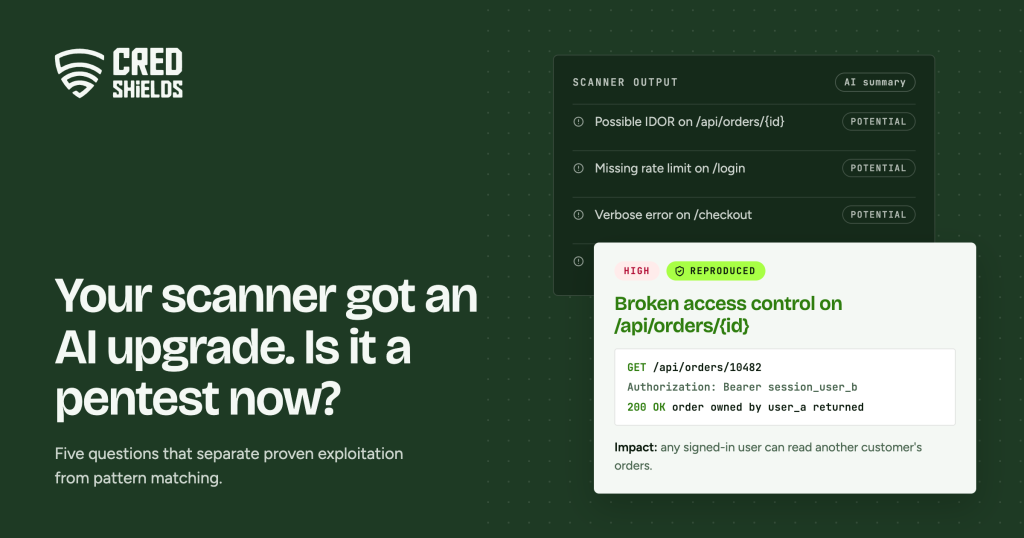
AI pentesting means AI agents attack a running application, attempt exploitation, and report what they reproduce. A scanner with an AI layer still matches known patterns, and the AI summarizes, deduplicates, or ranks the output. The deciding test is evidence. An AI pentest shows the request, the response, and what an attacker gained, while an upgraded scanner reports a likely issue for someone to confirm.
Vendors now attach AI to almost every security product, and the labels blur. For a buyer, the distinction decides whether the security team keeps triaging long lists of possibilities or starts receiving proven findings. This guide is for AppSec leads, CISOs, procurement teams, and engineering managers comparing tools that describe themselves in similar terms.
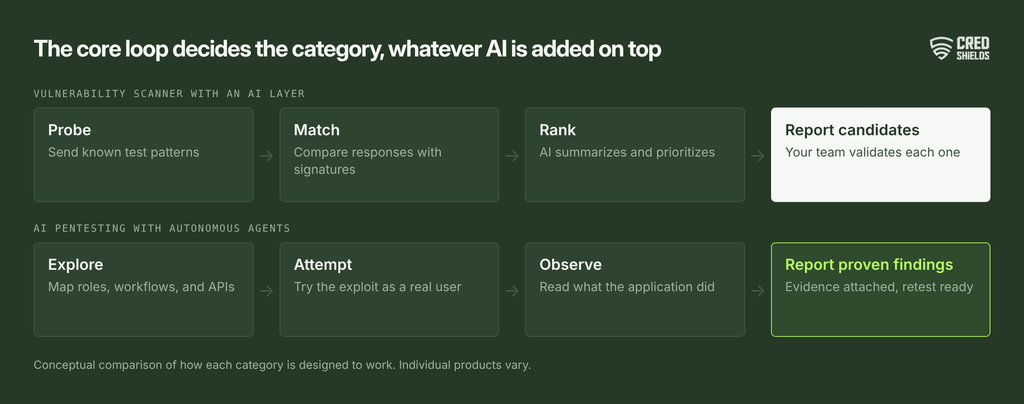
Table of Contents
What Counts as a Penetration Test
A penetration test is an authorized, simulated attack that tries to exploit weaknesses in a system to show what a real attacker could achieve. Its output is evidence of compromise: access gained, data reached, or actions performed that the application should have refused.
Standards have long treated scanning and penetration testing as separate controls. PCI DSS, for example, sets internal and external penetration testing at least once every 12 months and after any significant change, by a qualified resource, as its own requirement apart from vulnerability scanning. Adding AI to a scanner does not move it from one requirement to the other. AI pentesting earns the name only when the agents perform the attack and verify the outcome.
What AI Adds to a Vulnerability Scanner
AI improves scanners in real and useful ways, and those gains deserve credit. Most fall into the following categories.
1. Deduplication and grouping, so one root cause appears as one finding.
2. Plain-language summaries and remediation text for developers.
3. Prioritization that weighs severity against asset context.
4. Smarter crawling of single-page applications and API schemas.
5. Payload variation that tries more input forms per parameter.
The core loop stays the same. The scanner sends probes, compares responses with known signatures, and reports candidates. An AI vulnerability scanner is a better scanner, and the security team still has to prove which candidates are real.
Five Tests That Separate AI Pentesting From an Upgraded Scanner
The questions below work in any vendor demo. Each one asks the tool to do something that only an attacking agent can do.
Does It Attempt Exploitation or Infer It?
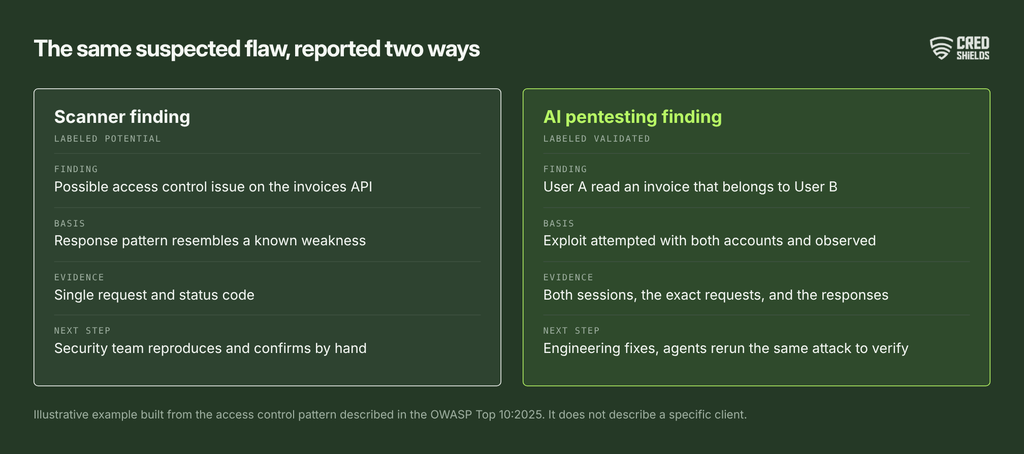
A scanner infers a vulnerability from a response that looks like a known signature. AI pentesting tries the exploit and checks whether it worked: whether data from another account came back, whether a privileged action completed, or whether a payload executed. Ask the vendor to show a finding’s raw request and response.
Does It Reason About Business Logic?
Business logic flaws use valid requests in an order or combination the application should refuse, such as applying a discount twice or skipping a payment step. The OWASP Web Security Testing Guide notes that automated tools struggle to understand this kind of context, because nothing in the traffic looks malformed. An agent that understands what a workflow is for can test what happens when its rules are bent.
Does It Hold State Across Workflows and Roles?
Real attacks span sessions. An agent must log in as a standard user, carry tokens through a multi-step checkout or approval flow, then repeat the flow as a second user and compare what each one can reach. Single-request scanning, however intelligent its payloads, rarely holds that state.
Does It Chain Weaknesses?
Two low-severity issues, such as a leaked user ID and a missing ownership check, can combine into account takeover. AI pentesting looks for those combinations because an attacker would. A scanner reports each issue on its own and ranks both as low.
Recommended read: If you or your team are planning an access control review, this article on CVE-2026-10753, a broken access control flaw CredShields found in Google’s Site Kit is a great place to start.
Does Every Finding Carry Reproduction Evidence?
The output of AI pentesting reads like a short attack narrative: what the agent did, what the application returned, what an attacker could achieve, and how to fix it. If a tool’s findings still say “potential” or “possible”, the validation step has been left to your team. A sample pentest report shows the level of evidence to expect.
AI Pentesting and AI Scanners Compared
The table brings the five tests together. It reflects how the two categories are designed to work, and individual products vary.
| Capability | Scanner with an AI layer | AI pentesting with AI agents |
|---|---|---|
| Identifies potential vulnerabilities | Yes | Yes |
| Attempts exploitation | Limited | Yes |
| Tests business logic | Limited | Yes |
| Holds state across roles and workflows | Limited | Yes |
| Chains weaknesses | Limited | Yes |
| Validates exploitability before reporting | Requires the security team | Yes |
| Provides evidence of exploitation | Limited | Yes |
| Runs on demand | Yes | Yes |
Recommended read: If you or your team are planning to shortlist AI-based testing providers, this article on what to know before choosing an AI penetration testing vendor is a great place to start.
Why the Difference Shows Up in the Security Team’s Week
The practical gap between the two categories is measured in analyst hours. Scanner output, with or without AI, usually moves through a sequence like this before engineering acts on it.
- Triage the alert and remove obvious noise.
- Investigate whether the affected code path is reachable.
- Reproduce the issue manually in a test environment.
- Confirm impact and assign a realistic severity.
- Write it up for engineering with steps to reproduce.
An AI layer speeds up the first step. AI pentesting moves the third, fourth, and fifth steps into the tool, so the security team reviews proven findings and spends its time on decisions. For a startup without an AppSec function, that difference often decides whether findings get fixed at all.
Recommended read: If you or your team are planning how automated and manual testing should divide the work, this article on manual versus automated penetration testing is a great place to start.
Where Vulnerability Scanners Still Belong
Scanners remain the right tool for breadth. They check known CVEs, misconfigurations, TLS settings, exposed services, and vulnerable dependencies cheaply and continuously, and AI makes their output easier to act on. CredShields’ guide to vulnerability scanning versus penetration testing explains how the two fit together.
A mature program runs scanning continuously and adds AI pentesting wherever an application moves money, holds sensitive data, or changes often. Agentic pentesting runs authenticated tests against web applications and APIs, so that layer can run on the release schedule.
Recommended read: If you or your team are planning an API security program for a regulated product, this case study on a fintech startup’s API security overhaul is a great place to start.
AI Pentesting Evaluation Checklist
Use this checklist in demos and proofs of concept to confirm that a product performs AI pentesting.
- The tool logs in with credentials you provide and tests as more than one role.
- Findings show the exact requests, responses, and resulting impact.
- At least one finding in the demo is a business logic or authorization flaw.
- The tool reports chained attack paths as single findings with combined impact.
- Unconfirmed candidates are labeled separately from proven findings.
- Retesting a fix is a built-in step that produces a recorded result.
- Scope controls prevent testing outside the assets you authorized.
Recommended read: If you or your team are planning to decide between a pentest and a broader risk review, this article on penetration testing versus security risk assessment is a great place to start.
Frequently Asked Questions (FAQs) About AI Pentesting in 2026
These answers cover the questions buyers ask most often when comparing AI pentesting with AI-enhanced scanners.
What is AI pentesting?
AI pentesting is penetration testing carried out by AI agents that explore an application, attempt exploitation, test business logic, chain weaknesses, and report findings they have reproduced, with evidence and remediation guidance.
Is an AI vulnerability scanner the same as a penetration test?
No. An AI vulnerability scanner matches responses to known patterns and uses AI to rank or explain results. A penetration test attempts exploitation and proves what an attacker could achieve.
Can AI pentesting find business logic vulnerabilities?
Yes, when the agents can authenticate, hold state across multi-step workflows, and compare what different roles can do. Those capabilities let agents test whether business rules hold under misuse.
Do I still need a vulnerability scanner if I use AI pentesting?
Yes. Scanners provide cheap, continuous coverage of known CVEs, misconfigurations, and dependencies. AI pentesting adds proven exploitability, business logic coverage, and chained attack paths on top.
How can I tell whether a vendor offers real AI pentesting?
Ask to see the raw evidence behind a finding, a business logic finding, and a retest result. If findings are labeled potential and need your team to confirm them, the product is a scanner with an AI layer.
Where to Start With AI Pentesting
CredShields One is built around the five tests in this guide. It signs in as each role you provide, attempts exploitation across workflows, and reports only the findings it reproduced, with the request, the response, and the impact attached. For engagements that call for specialist or independent testing, CredShields also provides penetration testing services.