

The Hidden Cost of False Positives: How Scanner Noise Drains Engineering Velocity
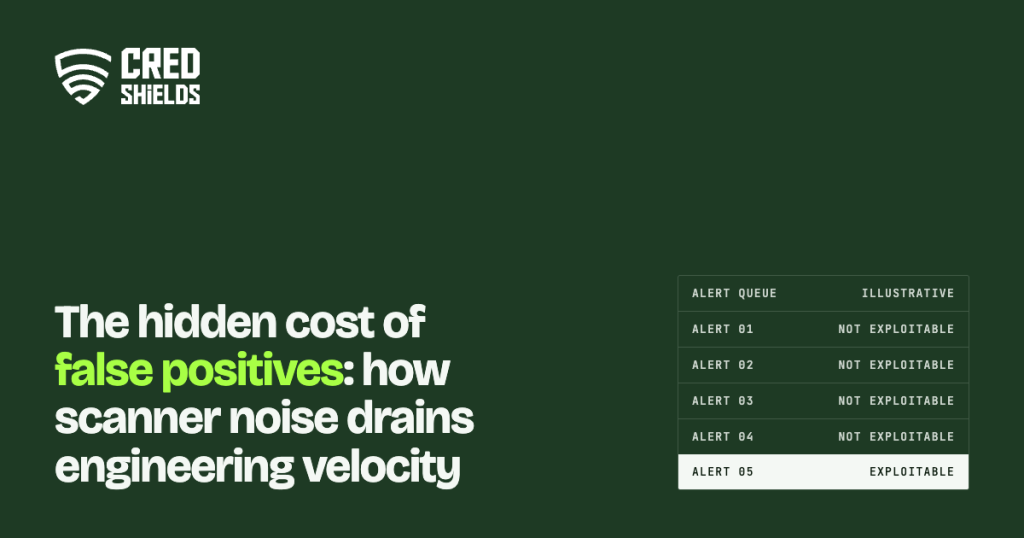
Most security tools promise to protect your software before it reaches production. You turn them on, run a scan, and wait for the results. Ten minutes later, your dashboard lights up with hundreds of new warnings. On paper, finding more issues sounds like a good thing. In practice, it brings your engineering team to a crawl. Most of those alerts are not real threats. They are guesses based on static code patterns or outdated package lists. When you hand a developer a list of 200 unverified flags, you do not make your app safer. You just give your team a massive pile of busywork. False positives carry a steep, hidden price tag. They drain engineering hours, break trust between teams, and leave real vulnerabilities wide open.
Here is how scanner noise slows down your developers, and how active validation clears the backlog.
Table of Contents
1. Security and engineering teams lose half their week to manual triage
A raw scanner alert is never ready for a developer to fix. Someone has to open the ticket, read the code, trace the data flow, and figure out if an attacker can actually reach that function in your live app.
That manual triage eats up huge amounts of time. Data from the National Institute of Standards and Technology shows that static scanners can hit false positive rates as high as 78% in complex codebases. The OWASP Benchmark Project found a similar pattern, with legacy tools reaching false positive alarm rates up to 82%.
Look at what that noise does to your staff. The Ponemon Institute reports that security and engineering teams spend 50% to 80% of their security hours just sorting through alerts. In the Nagomi CISO Pressure Index, 52% of security leaders also named false positives as a top drain on team output. Your highest paid engineers end up acting as human filters for noisy software.
2. Alert fatigue trains developers to ignore security tickets
Developers want to ship clean, working features. They hate context switching out of a sprint to investigate a security ticket, only to discover three hours later that a firewall or login check already blocks the issue.
When that happens once or twice, engineers sigh and move on. When it happens every week, they stop trusting your security tools altogether.
Alert fatigue sets in fast. Developers start treating security warnings like background noise. They push tickets to the bottom of the sprint, mark warnings as won’t fix without checking them, or mute scanner notifications in their pull requests. Once your team stops believing the alerts, even critical warnings get ignored.
3. Real vulnerabilities hide inside a massive backlog
Scanner noise does more than waste time. It actively hides real danger.
When an AppSec team faces 5,000 open alerts, it becomes nearly impossible to spot the 15 flaws that an attacker could actually exploit today. Real bugs get buried under thousands of theoretical warnings about missing headers or low risk libraries.
Because teams cannot sort through the pile fast enough, critical fixes stall for months. Research from Veracode in its State of Software Security Report shows that the average time to fix a flaw in traditional workflows stretches to 298 days. About 41% of first party flaws remain unfixed after a full year. Meanwhile, attackers use automated tools to find and exploit exposed weaknesses in days.
4. Friction between AppSec and engineering stalls release cycles
High velocity teams ship code constantly. According to the 2026 JetBrains Developer Ecosystem Survey, 85% of developers now use AI tools to write code, while Microsoft and Accenture found that AI assistance helps developers finish tasks up to 55% faster. DORA research also shows that top teams deploy code on demand, often multiple times a day.
When a noisy scanner blocks a deployment pipeline over a false positive, friction spikes immediately. Product managers push to override the security gate so they can hit their launch date. AppSec engineers get stuck playing the bad guy, asking developers to pause feature work for bugs they have not even proven are real. Security turns into a roadblock instead of an enabler.
5. Autonomous validation filters out noise before developers see a ticket
You cannot fix a noisy scanner by hiring more people to triage alerts. You have to stop unverified guesses from entering your engineering backlog in the first place.
Autonomous AI agents solve this by testing leads before a human ever sees them. Instead of handing your team a list of theoretical warnings, autonomous agents act like skilled penetration testers inside a safe test environment. They form an attack hypothesis, send real exploit payloads against your live app, and watch how your defenses respond.
If a gateway rule, input filter, or permission check blocks the attempt, the agent drops the alert immediately. Your engineers never see it. When an attack path actually works, the agent captures the exact request, response, and reproduction steps. Your developers only receive validated findings that are proven to be exploitable, allowing them to patch real risks fast and get back to building features.
Additional Read: 4 Ways AI Is Double Edged for Enterprise Cybersecurity
Clearing the noise to restore engineering speed
Your developers are shipping code faster than ever, and your security process has to match that pace. Static scanners that flood your backlog with false positives only slow down releases and burn out your staff. When you bring autonomous offensive validation inside your workflow, you cut out the triage noise, restore developer trust, and keep your engineering velocity moving at full speed.