

3 Security Bottlenecks Slowing Down High Velocity Dev Teams (And How to Fix Them)
Developers ship code fast. Really fast. According to the 2026 JetBrains Developer Ecosystem Survey, 85% of developers now use AI tools to write their code. Microsoft and Accenture also found that developers finish tasks up to 55% faster when they use AI help.
Your security setup has not kept up.
When your team pushes updates every day, old security habits get in the way. Work piles up. Releases stall. Worse yet, real bugs slip right into your live app.
Here is what slows your team down, and how you can fix it.
Table of Contents
1. Chasing fake scanner alerts all week
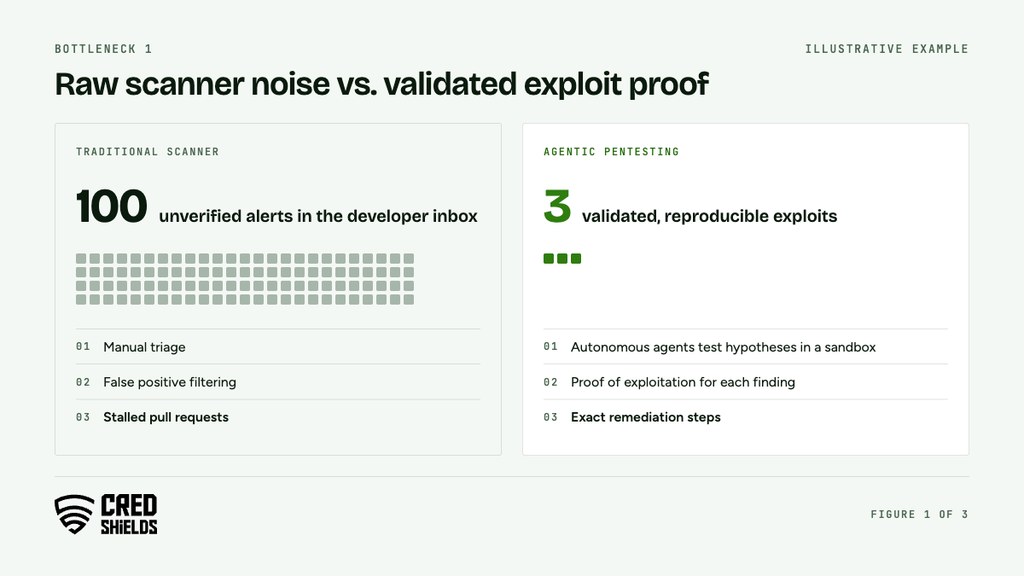
Most teams still rely on old scanners to check code before a release. The problem is simple. Scanners only look for known code patterns and guess at the risk. They do not prove if a bug can actually be exploited.
So the noise piles up. Data from the National Institute of Standards and Technology shows that static scanners can hit false positive rates as high as 78% in some codebases. The OWASP Benchmark Project found the same thing, with legacy tools hitting false alarm rates up to 82%. Look at what that does to your team. The Ponemon Institute reports that security and dev staff spend 50% to 80% of their security time just sorting through alerts. In the Nagomi CISO Pressure Index, 52% of security leaders also named false positives as a top drain on team output.
Developers hate chasing bugs that are not real. After a while, they stop trusting the scanner. They start ignoring the alerts.
Fix this by testing the bugs before a developer ever sees them. Do not hand your team a list of 100 unverified warnings. Let autonomous AI agents test those leads safely in a live setup first. If a firewall or a login check blocks the attack, the agent drops the alert. Your team only sees bugs that actually work, along with the proof they need to fix the code.
2. Waiting months for a point in time pentest
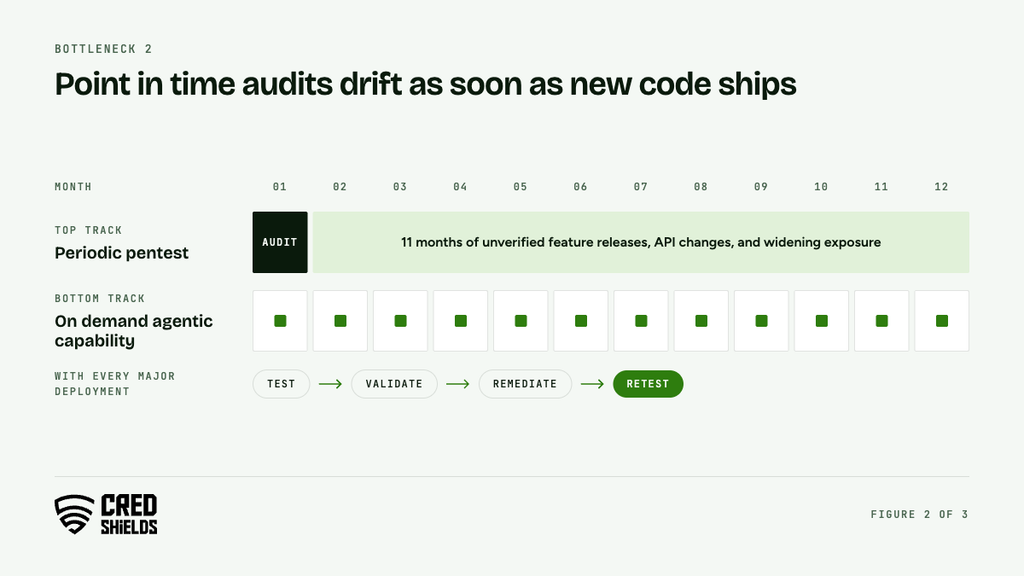
Many companies still treat pentesting like a once-a-year chore. You hire an outside firm. You wait weeks for a report. Then you ask your team to patch what is on the list.
That works if you ship code twice a year. It breaks when you deploy every day. DORA research shows that top dev teams now deploy code multiple times a day. That means your app changes completely just a few weeks after an audit ends. At the same time, Veracode found in its State of Software Security Report that the average time to fix a flaw in old workflows hits 298 days. About 41% of first party bugs stay unfixed after a full year.
A static PDF report goes stale the moment your team merges the next big pull request. You cannot secure daily code pushes with a quarterly audit.
Stop waiting on an outside calendar. Bring pentesting inside your own workflow. Autonomous agents can run right when your team ships a new API or changes how users log in. Once a developer pushes a fix for a bug, the agent tests that fix right away. You know the patch works in minutes, not months.
3. Missing flaws hidden in your business logic
Basic scanners read code syntax, yet they have no idea how your business works. They do not know what a paid user should see versus what a free user should see.
That blind spot hides some of the worst bugs. The OWASP API Security Top 10 ranks Broken Object Level Authorization as the top threat to modern APIs. Scanners miss it because they do not know your user rules. Meanwhile, Veracode found in its GenAI Code Security studies that nearly 30% of AI written code snippets carry known security flaws.
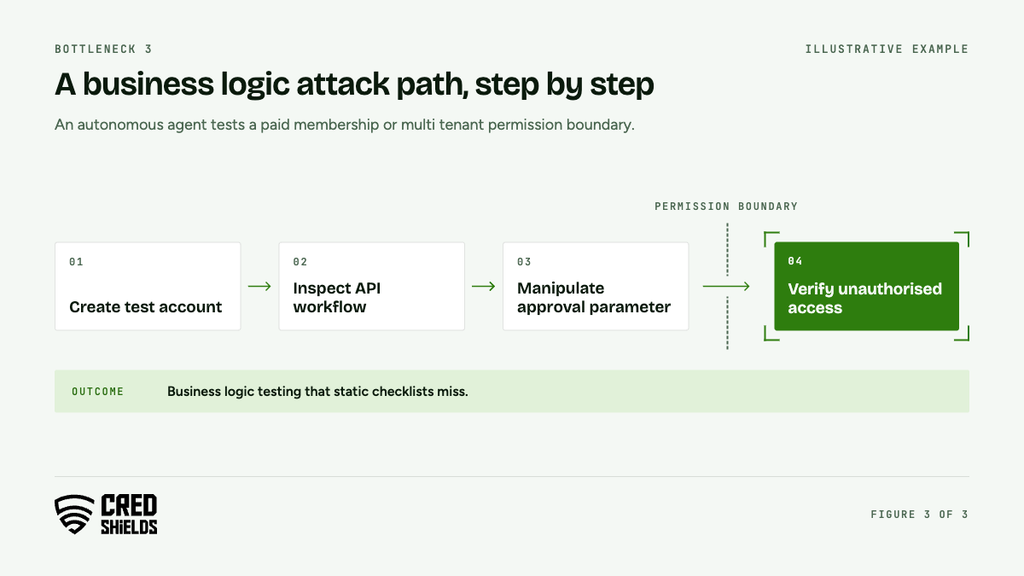
Picture a user who signs up for a free plan on your app and tweaks one API parameter to unlock paid features. A pattern scanner sees valid code and stays quiet. An attacker sees an easy way in.
To catch those flaws, your tests have to act like a real user. Autonomous agents log into your app with real test accounts. They click through checkout steps, test user roles, and try to break the rules of your app. If two small bugs can be linked together to take over an admin account, the agent follows that path and proves it.
Moving past the old way
You do not have to choose between shipping fast and staying safe. Old scanners flood your team with false alarms, and yearly audits leave your app exposed between tests. When you bring autonomous pentesting inside your team, you test real attack paths, skip the noise, and keep shipping code on schedule.