

4 Ways AI Is Double Edged for Enterprise Cybersecurity
Artificial intelligence is changing both sides of enterprise security at the exact same time. It gives your engineering teams the speed to build and ship software faster than ever before. Yet it also gives attackers the tools to find and exploit weaknesses at a massive scale.
For enterprise security leaders, the core problem is not a lack of talent. Your organization likely already employs skilled AppSec engineers, runs mature security processes, and uses established scanning tools. You do not need someone telling you that your team lacks basic security hygiene. The real problem is capacity.
Engineering output is growing faster than security headcount can ever match. When code moves at AI speed, traditional security workflows break down under the pressure.
Here is how AI is shifting the balance on both sides of the equation, and how your security team can gain the leverage needed to keep up.
Table of Contents
1. Attackers automate recon and exploit discovery
Breaking into a large enterprise used to take a lot of manual effort and patience. Attackers had to map out public assets, study how an application worked, research known flaws, write custom scripts, and test attack paths by hand. When an attempt failed, a human had to figure out why and try a different angle.
That time cost acted as a natural economic filter. Smaller applications, internal tools, or obscure API endpoints often stayed safe simply because they were not worth the attacker’s time. Attackers focused their limited hours on the most obvious, high value targets.
AI removes that economic filter completely. Research from Mandiant M Trends shows that the time between vulnerability disclosure and active exploitation continues to shrink as threat actors automate their workflows. Today, attackers use AI to automate target reconnaissance, source code analysis, vulnerability discovery, and exploit generation.
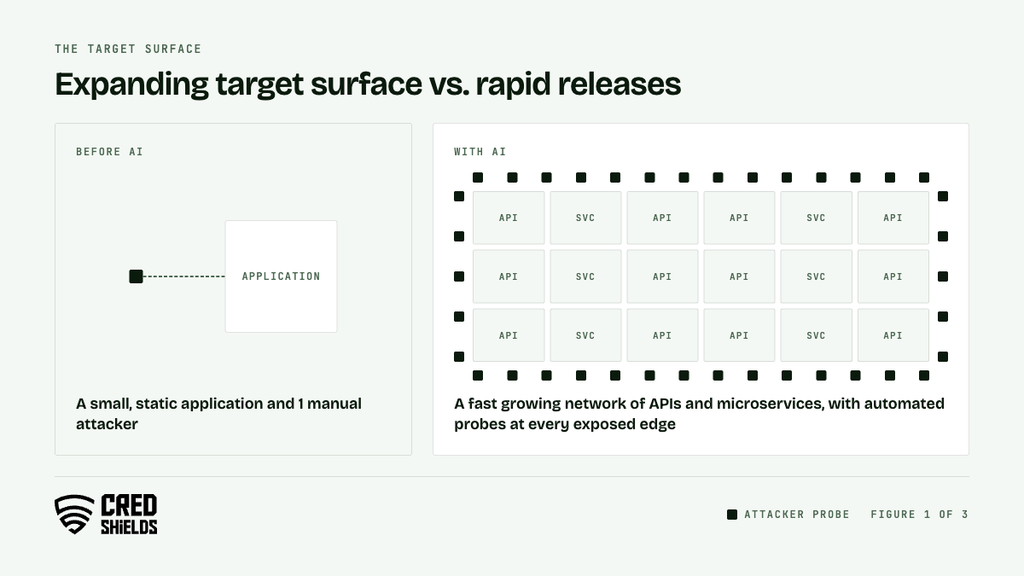
A single attacker can now probe thousands of endpoints in the time it used to take to inspect just a few. They can map out complex application logic and test weak spots around the clock without getting tired. Being a smaller target or hiding behind complex business logic is no longer enough to keep attackers away. The cost of launching a sophisticated attack has dropped, which means your entire attack surface is now in reach.
2. Developers ship more code and APIs every week
At the exact same time, AI coding assistants are pushing engineering output through the roof. According to the 2026 JetBrains Developer Ecosystem Survey, 85% of developers now rely on AI tools to write their code. Enterprise studies from Microsoft and Accenture also show that developers finish coding tasks up to 55% faster when they use AI assistance.
Small teams now build complex products that once required large engineering departments. Large enterprise organizations ship new features, microservices, and APIs on a daily basis. Features that used to take weeks to build and test now move from a developer’s laptop to production in a matter of days.
Every single release changes how your applications behave. Developers modify authentication flows, add third party integrations, and update database permissions constantly. Yet Veracode’s GenAI Code Security research found that nearly 30% of AI written code snippets can introduce known security weaknesses if they ship without thorough testing.
When your engineering organization ships twice as much code, your attack surface expands every time your team merges a pull request. Security teams that used to review a predictable release schedule now face a constant stream of new endpoints and changing logic.
3. Security headcount cannot scale at the same rate
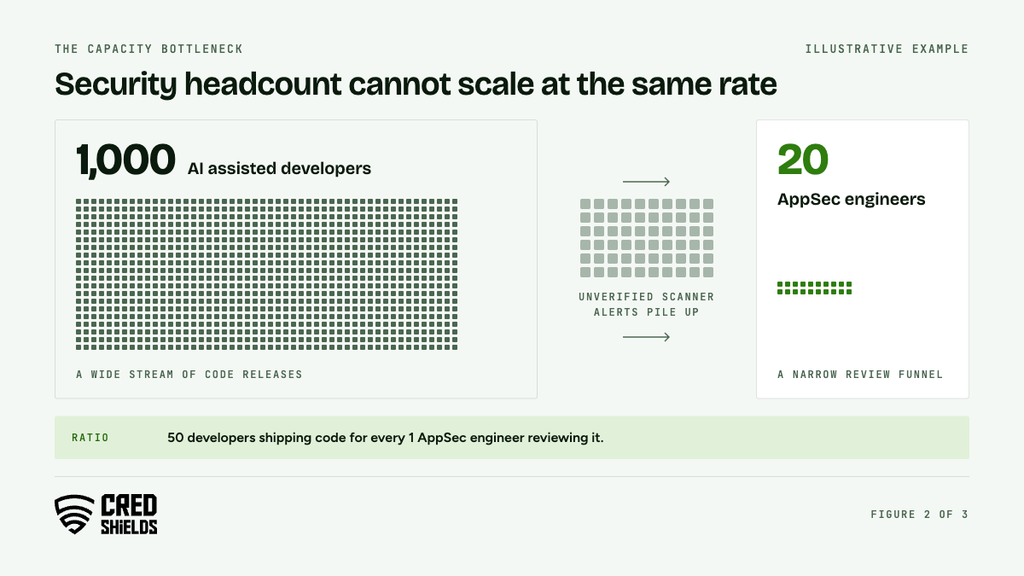
Here is where the bottleneck hits hardest for a CISO or Head of AppSec. Imagine an enterprise with 1,000 developers shipping code with AI assistance, supported by a dedicated team of 20 AppSec engineers. When those 1,000 developers double their code output, your security team does not double in size. Security budgets and specialist talent simply do not scale at a one to one ratio with engineering growth.
Relying on traditional security tools only makes the backlog worse. Data from the National Institute of Standards and Technology shows that static scanners can produce false positive rates as high as 78% in complex codebases. The OWASP Benchmark Project found a similar pattern, with legacy tools hitting false alarm rates up to 82%.
When a scanner flags hundreds of potential issues, someone on your team still has to investigate them. The Ponemon Institute notes that security staff spend 50% to 80% of their time just sorting through alerts, trying to reproduce bugs, and proving whether a flaw actually matters. That manual triage drains your most experienced engineers.
Meanwhile, external penetration tests happen only once or twice a year. They are structured as slow, periodic events. An application tested six months ago looks completely different from the one running in production today. Your security team gets trapped in the middle, caught between fast engineering cycles, noisy scanners, and slow manual audits.
4. Autonomous agents give defenders equal leverage
You cannot solve an automated problem by simply hiring more people. To keep pace with fast developers and fast attackers, your security team needs offensive testing that scales like software.
Autonomous AI agents give your existing team that exact leverage. Unlike a basic vulnerability scanner that only checks for static code patterns, autonomous agents perform the active work of a skilled penetration tester.
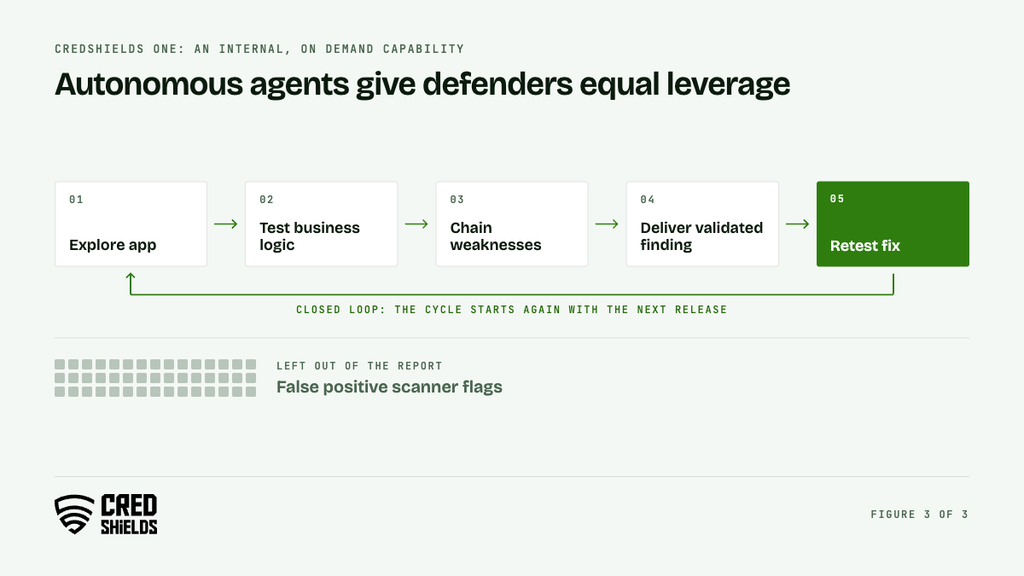
Given an application and a clear scope, autonomous agents explore your attack surface, inspect how APIs interact, and test business logic across different user roles. They do not stop at guessing whether a flaw exists. They attempt safe exploitation, chain minor weaknesses together, and verify whether an attacker could actually steal data or escalate privileges.
Instead of handing your team a list of 100 unverified warnings, the agents deliver validated findings backed by clear reproduction steps and evidence. Your AppSec team does not waste hours chasing false alarms, and your developers get exact proof of what needs to be fixed. When an engineer pushes a patch, the agents retest the code right away to confirm the fix holds.
Penetration testing stops being a rare outsourced event and becomes an internal capability your team can run whenever code changes.
Keeping pace with both sides
AI makes attackers faster and makes developers faster. Your security team needs to move at that exact same speed. You do not need to slow engineering down to keep your applications safe, and you do not need to double your AppSec headcount to cover new releases.
When you bring autonomous offensive testing inside your organization, you turn scarce security expertise into scalable software. You give your defenders the leverage they need to validate real risk, clear the triage bottleneck, and protect every release at the speed of modern development.