

What Would It Take to Get Zero False Positives From Your Security Testing?
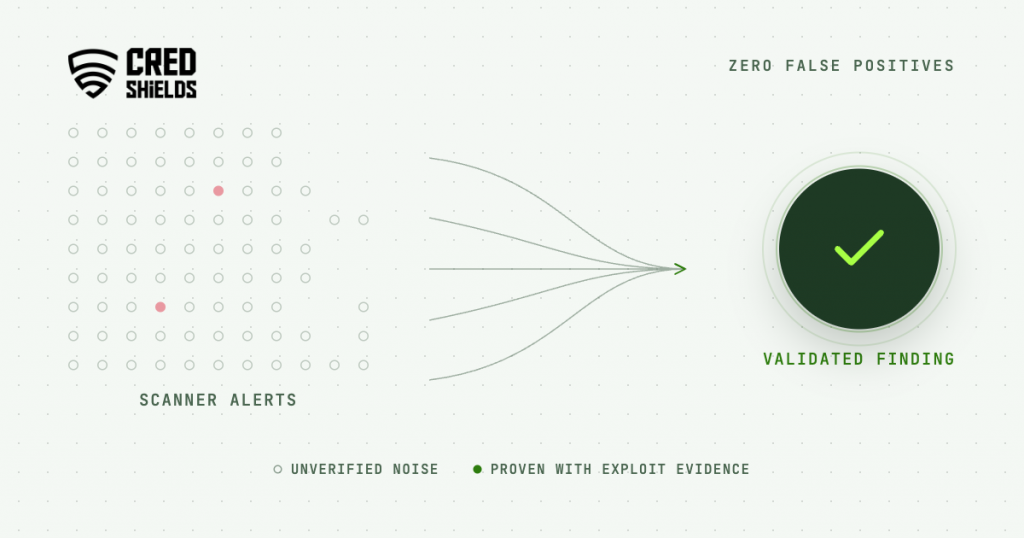
Zero false positives is a reporting standard in which a security test only reports a vulnerability after it has exploited it in your environment and recorded what the attacker gained. Each finding arrives with its reproduction steps, the observed impact, and a fix. Teams reach it through exploit validation, which moves the proof step from the analyst’s desk into the test itself.
Most application security programs already hold more findings than they can investigate. Detection scaled years ago, and the bottleneck now sits in the hours between a scanner flagging something and an engineer agreeing it is worth fixing. This guide explains where alert noise comes from, what it costs, what proven exploit evidence should contain, and how to move a program toward zero false positives without losing coverage.
What Zero False Positives Means in Security Testing
Zero false positives describes the output of a security test in which every reported vulnerability has been demonstrated against the live target. A finding exists because the test reproduced an exploit and observed the result, such as reading another tenant’s records or changing an account’s privileges. Unconfirmed suspicions stay out of the report.
The term needs a precise definition because “false positive” means different things to different people. To a tool author, a false positive is a flag raised on code or behavior that contains no flaw. The engineer receiving the ticket works with a wider definition. Google’s static analysis team, writing in Communications of the ACM, counts an issue as an “effective false positive” whenever developers take no positive action after seeing it, including cases where the flaw was real and the report failed to make it understood.
That wider definition is the one that governs outcomes. A real vulnerability buried in a list of 400 unverified alerts behaves, operationally, like a false positive, because nobody acts on it. Zero false positives therefore covers two problems at once. It removes flags that were never real, and it gives the real ones enough evidence that engineering acts on them the first time.
Recommended read: If you or your team are planning to decide between a red team engagement and a penetration test, this article on red teaming vs. pentesting services is a great place to start.
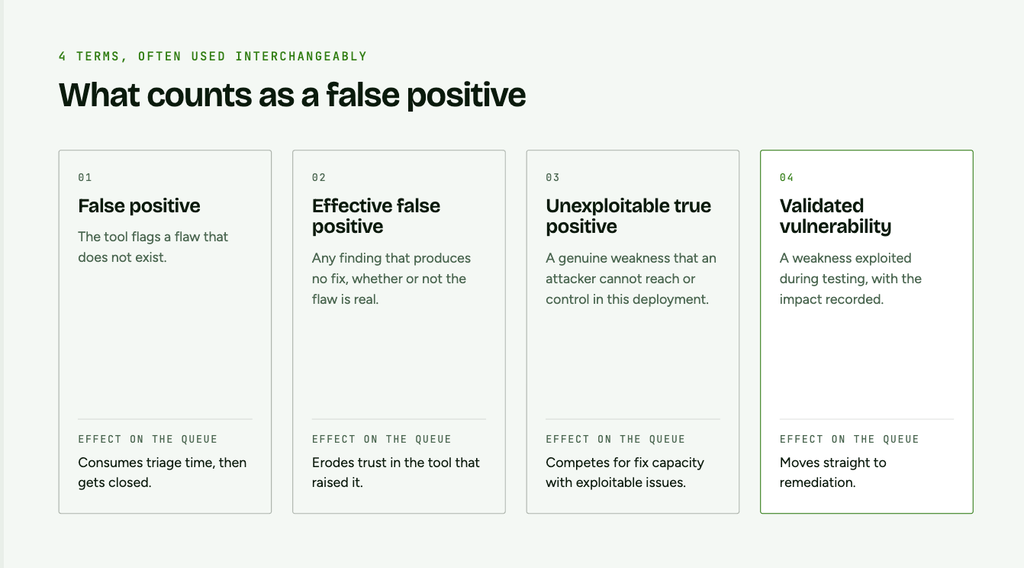
Four related terms often get used interchangeably, and separating them makes the rest of this guide easier to apply.
| Term | Meaning | Effect on the queue |
|---|---|---|
| False positive | The tool flags a flaw that does not exist | Consumes triage time, then gets closed |
| Effective false positive | Any finding that produces no fix, whether or not the flaw is real | Erodes trust in the tool that raised it |
| Unexploitable true positive | A genuine weakness that an attacker cannot reach or control in this deployment | Competes for fix capacity with exploitable issues |
| Validated vulnerability | A weakness exploited during testing, with the impact recorded | Moves straight to remediation |
Table of Contents
Where Alert Noise Comes From in Vulnerability Scanning
False positives in vulnerability scanning are a structural property of how detection tools reason. Each tool class works from partial information about the running application, so each one has to guess when the information runs out. Vendors generally tune those guesses toward reporting more, since a missed vulnerability is the failure customers notice first.
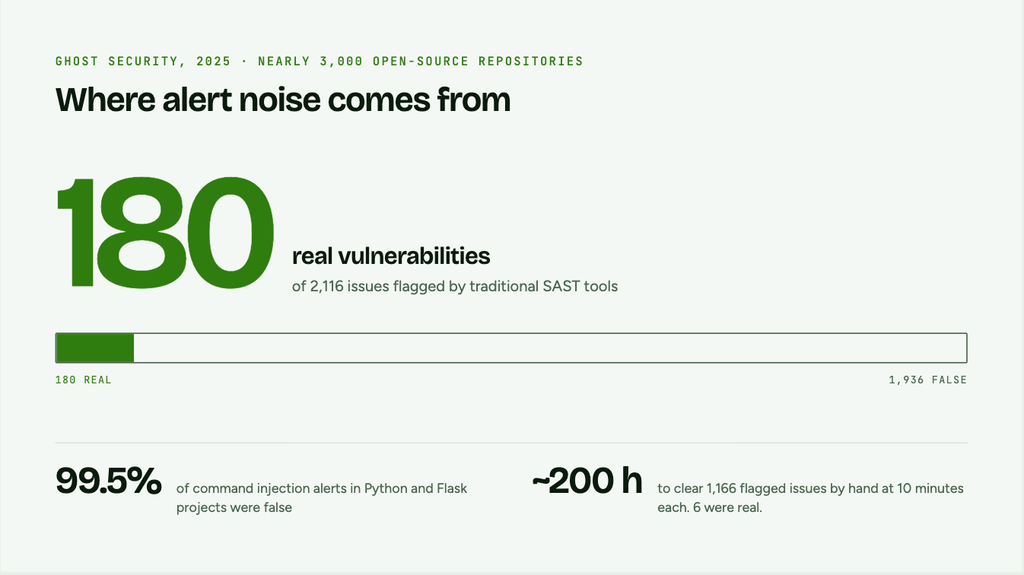
Static analysis (SAST) sees a dangerous function, such as a database query built from a variable, and often cannot tell whether that variable is attacker-controlled or already sanitized upstream. Help Net Security’s coverage of Ghost Security’s 2025 study of nearly 3,000 open-source repositories reports that of 2,116 issues flagged by traditional SAST tools, 180 were real vulnerabilities. For command injection checks in Python and Flask projects, 99.5% of alerts were false.
Dynamic scanning (DAST) observes responses from the outside and infers a flaw from patterns, such as an error string or a reflected payload. A reflected payload is evidence of reflection. Whether it executes in a victim’s browser depends on encoding, content type, and policy headers that the signature may never check.
Software composition analysis (SCA) matches dependency versions against advisories. A vulnerable version may be present in the build while the vulnerable function is never called. The finding is an accurate inventory record that says little about exploitability until someone traces whether that code path runs.
Severity scoring compounds the volume problem. A CVSS base score describes a vulnerability in the abstract, and teams that sort by it treat every 9.8 as urgent. Exploitation data narrows the picture sharply. NIST CSWP 41 cites research showing that about 5% of vulnerabilities have been observed exploited in the wild, while organizations remediate around 16% of their open vulnerabilities each month. That remediation gap is visible in live incidents: three weeks after Microsoft patched CVE-2026-62911, more than 21,000 Exchange servers remained exposed while working exploit code circulated.
Each of these tools answers a narrower question than the one engineering asks. A scanner asks whether something could be a vulnerability. Engineering needs to know whether an attacker can use it today, against this deployment. The difference between a pentest and a scan sits in the distance between those two questions, and that distance is where alert fatigue starts and where the case for zero false positives begins.
What False Positives Cost Security and Engineering Teams
The cost of false positives compounds over time. It starts as lost analyst hours and ends, in the worst cases, as an attack that was detected and still missed. Each stage is measurable, and each one makes the next more likely.
Hours come first. The Ghost Security research estimated that manual review takes about 10 minutes per finding. In its Python and Flask sample, 1,166 flagged issues contained 6 real vulnerabilities, a list that would have taken close to 200 hours to clear by hand. Alert fatigue in security operations centers follows the same arithmetic. Vectra’s 2023 survey of 2,000 SOC analysts found that teams received an average of 4,484 alerts a day, spent nearly 3 hours a day triaging them, and could not get to 67% of them.
Trust erodes next, and it erodes in the engineering team that receives the tickets. During a companywide fix-it week in 2009, Google engineers reviewed 3,954 warnings from the FindBugs analyzer and filed bug reports on 1,746 of them, yet only 640 were fixed, according to the team’s account in Communications of the ACM. The team wrote that its developers were strongly inclined to ignore static analysis results, and that any false positive handed them a reason to do nothing. Its response was to measure analysis tools by defects corrected and to disable any analyzer that developers marked unhelpful in more than 10% of their responses.
Missed attacks are the final cost. A US Senate Commerce Committee analysis of the 2013 Target breach found that the company’s malware detection system raised alerts as attackers installed their tools, and that those alerts did not lead to a response. Data from 40 million payment cards and personal details of up to 70 million customers were exposed. By Google’s definition, those alerts became effective false positives: real detections that produced no action.
The capacity math is getting harder. AI coding tools let engineering teams ship more code per sprint, while AppSec headcount grows slowly. When every scanner finding needs a person to triage, investigate, reproduce, validate, and explain it before engineering will act, vulnerability triage becomes the bottleneck in the release path. Zero false positives moves that work into the test.
Why Proof of Exploit Sets the Standard for Zero False Positives
Proof of exploit means the test itself carries out the attack, within agreed scope and safety limits, and records the outcome. A finding built this way documents an event that occurred during testing. Its accuracy no longer depends on a reviewer’s judgment about whether a pattern looks dangerous.
Google’s tooling offers a precedent from a different domain, described in the same CACM paper. Checks that surface as comments in code review may carry up to 10% effective false positives, because reviewers expect to weigh suggestions. Checks promoted to compiler errors must produce no effective false positives at all, because they stop the build. The accuracy bar rises with the consequence of the signal.
Security findings follow the same rule. Once a finding blocks a release or starts a remediation clock, it has to be right every time, or teams learn to route around it. Public vulnerability claims face the same test, as the breakdown of what is verified in the HardBreacher zero-day claim against Kaspersky Endpoint Security shows. Exploit validation is the method that lets a security test meet the compiler-error bar and deliver zero false positives on the findings that gate releases.
CVSS v4.0 shows the industry moving in the same direction. As defined in FIRST’s CVSS v4.0 specification, its threat metrics now center on a single factor, Exploit Maturity, which records whether a vulnerability has been attacked, has public proof-of-concept code, or neither. That metric describes threat activity across the internet. Proof of exploit adds the local answer for your deployment: whether the attack worked here.
What Proven Exploit Evidence Contains
A validated vulnerability is only as useful as the evidence attached to it. The record below is the minimum that lets an engineer reproduce the issue, understand the impact, and verify the fix without returning to the security team for context.
| Evidence element | What it records | Why engineering needs it |
|---|---|---|
| Scope and preconditions | Target, environment, account role, and any state required before the attack | Confirms the finding applies to a real user path |
| Reproduction steps | The exact requests, payloads, or actions, in order | Lets an engineer replay the issue in minutes |
| Observed outcome | What the test achieved, such as data read, privilege gained, or state changed | Shows the impact was demonstrated during testing |
| Business impact | What an attacker could do with that outcome at scale | Sets priority in terms product owners recognize |
| Root cause | The control or code path that failed | Directs the fix to the failing control |
| Remediation guidance | A specific fix for this codebase and framework | Shortens the time from ticket to pull request |
| Retest result | Whether the same attack fails after the fix | Closes the finding on proof |
Consider a subscription application. A scanner might flag an access control configuration on the billing API as potentially insecure. A validated finding goes further: a test account was created, the membership workflow was manipulated, the account granted itself a paid plan without payment, and the application accepted the change. If a second weakness let users edit their own approval status, the test checks whether the two chain into something larger. The engineer receives a record of what an attacker achieved, with the requests that prove it.
Recommended read: If you or your team are planning to understand how access control flaws are proven and disclosed, this article on CVE-2026-10753, a broken access control flaw CredShields found in Google’s Site Kit, is a great place to start.
How Exploit Validation Works in Practice
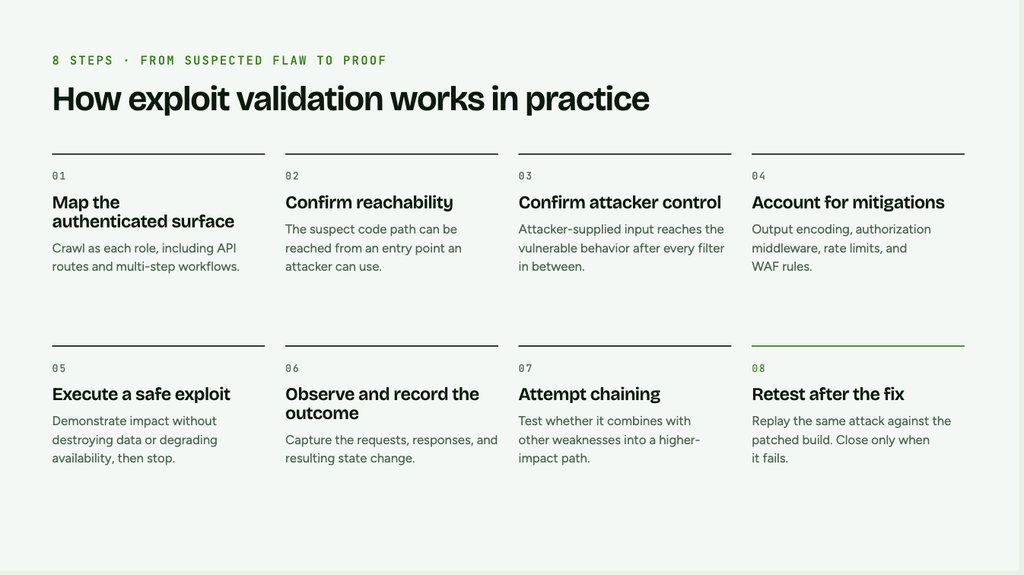
Exploit validation follows the reasoning a skilled tester applies to a suspected flaw, then completes it with a controlled attack. The Ghost Security research framed the first checks as questions every finding must pass: whether the vulnerable code is reachable in real execution, whether user-controlled input drives the risky behavior, and whether mitigations make the flaw non-exploitable. Full validation adds the steps that turn those checks into proof.
- Map the authenticated surface. Crawl the application as each role it supports, including API routes and multi-step workflows, so tests run where real users and attackers operate.
- Confirm reachability. Establish that the suspect code path or endpoint can be reached from an entry point an attacker can use.
- Confirm attacker control. Show that input the attacker supplies reaches the vulnerable behavior after every transformation and filter in between.
- Account for mitigations. Check for compensating controls such as output encoding, authorization middleware, rate limits, and web application firewall rules.
- Execute a safe exploit. Attempt the attack with payloads designed to demonstrate impact without destroying data or degrading availability, and stop once impact is shown.
- Observe and record the outcome. Capture the requests, responses, and resulting state change that prove the attack succeeded.
- Attempt chaining. Test whether the finding combines with other weaknesses into a higher-impact path, such as an information leak that enables an account takeover.
- Retest after the fix. Replay the same attack against the patched build and close the finding only when it fails.
Two categories of vulnerability depend on this sequence. Business logic flaws, such as a money transfer function that never checks whether the source account belongs to the authenticated user, give a scanner no suspicious pattern to match. They surface only when something exercises the workflow the way an attacker would. Chained findings, where two medium-severity issues combine into a critical one, stay invisible to any tool that evaluates findings one at a time. Cloud environments are full of these paths, as the guide to how attackers move through AWS, Azure, and GCP infrastructure explains.
CredShields One runs this sequence with AI carrying out the offensive work. It explores the application, attempts exploitation, validates what is actually exploitable, and returns each finding with evidence, remediation guidance, and a retest path. Teams get zero false positives on the validated queue and can run the same test whenever the application changes, without waiting for the next scheduled engagement.
Recommended read: If you or your team are planning how quickly to validate and patch after a critical disclosure, this article on the wp2shell crisis and why this WordPress core RCE changes the timeline for enterprise defense is a great place to start.
Where Zero False Positives Has Limits
Zero false positives is a precision standard. It guarantees that every reported finding is real. Coverage, meaning what the test reached and what it missed, needs its own measure. A test that reports nothing also has a false positive rate of zero, so any program that adopts the standard needs a coverage metric beside it.
Several limits deserve explicit treatment in how you scope a test and read its results.
- Coverage and false negatives. Validation only proves what the test reached. Track which roles, endpoints, and workflows were exercised, including iOS and Android clients, and treat untested areas as unknown. Detection tools have the same blind spots, as this look at what EDR misses against malware-as-a-service in Singapore shows.
- Scope and safety constraints. Some attacks cannot be demonstrated safely in production, such as destructive writes or denial of service. Findings in these areas may need a staging environment or a documented partial proof.
- Real risk without a demonstrable exploit. Weak cryptographic settings, missing security headers, and outdated components sometimes carry genuine risk that no single request can prove. Keep them in a separate hygiene queue with its own service levels, so they stay visible and the validated queue stays clean.
- Point-in-time results. A clean result applies to the build that was tested. The next release can reintroduce the flaw, which is why retesting on change carries as much weight as the first test.
Read this way, zero false positives describes the validated queue, the list engineering is asked to act on with urgency. Everything else remains visible and labeled for what it is.
How to Move From Alert Noise to Proven Exploit Evidence
Moving a program toward zero false positives is mostly a change in what the organization accepts as a finding. Tooling supports that change, and policy keeps it in place. The sequence below works for teams that already run scanners and periodic penetration tests.
- Measure your current false positive rate. Sample 50 to 100 recent findings from each tool, record how many were confirmed, closed as invalid, or left untouched, and count the untouched ones as effective false positives.
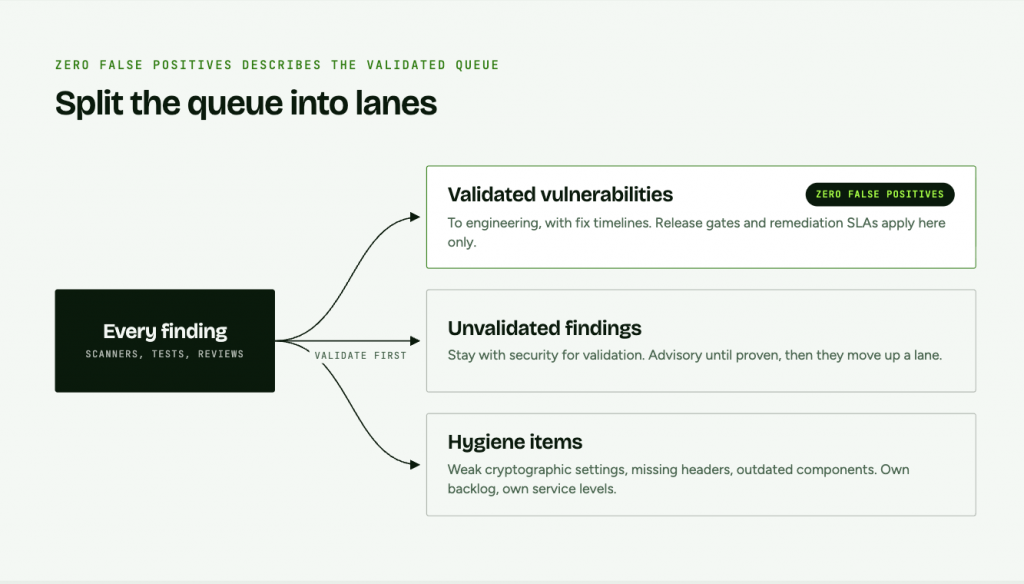
- Split the queue into lanes. Validated vulnerabilities go to engineering with fix timelines. Unvalidated findings stay with security for validation. Hygiene items get their own backlog and review cadence.
- Require evidence for anything that gates a release. If a security result can block a deploy or start an SLA clock, it should carry proof of exploit. Unvalidated results stay advisory until they are validated.
- Validate before ticketing. Move exploit validation ahead of ticket creation, so engineering receives findings it can reproduce on the first read.
- Close findings on retest. Mark a vulnerability resolved only when the original attack fails against the patched build.
- Feed results back to detection. Use validation outcomes to tune or retire scanner rules that repeatedly produce unexploitable findings, the same discipline Google applied to its analyzers.
- Report proven risk upward. Brief leadership, auditors, and insurers on validated vulnerabilities, time to fix, and retest results, so security metrics describe risk removed. Regulators and underwriters increasingly expect controls to be proven, a shift covered in the guides to MAS TRM 2026 audit readiness and cyber insurance attestations in Singapore.
Test frequency belongs in the same plan. A pentest that happens once a year produces evidence about an application that has since changed. Running validation on each significant release, as part of continuous application security testing, keeps the evidence current with the code customers actually use.
Recommended read: If you or your team are planning to present validated testing evidence to an auditor, this article on SOC 2 penetration testing and what you should expect before an audit is a great place to start.
Metrics That Show Zero False Positives Is Working
The right metrics track whether findings turn into fixes. A count of findings is a weak signal on its own, since a noisier tool always looks more productive by that measure. The measures below show whether the move toward zero false positives is reducing triage load and real exposure, and they slot into a broader AppSec maturity model if you already benchmark your program.
| Metric | How to calculate it | What it tells you |
|---|---|---|
| Validated precision | Validated findings confirmed real, divided by validated findings sent to engineering | Whether the validated queue is holding to zero false positives |
| Effective false positive rate | Findings that produced no fix or formal risk acceptance, divided by findings delivered | Whether engineering trusts and acts on security output |
| Fix rate | Validated findings remediated within their target window | Whether evidence is shortening the path to a fix |
| Severity-adjusted time to remediate | Median days from validation to a passed retest, by severity | How quickly proven risk leaves production |
| Retest pass rate | Fixes that hold on the first retest | Whether remediation guidance is specific enough |
| Coverage | Roles, endpoints, and workflows tested, as a share of the inventory | Whether precision is coming at the expense of reach |
| Triage hours per release | Security hours spent investigating findings before handoff | Whether the capacity bottleneck is easing |
Zero False Positives Readiness Checklist
Use this checklist to see how close your current testing program is to delivering zero false positives on the findings that reach engineering.
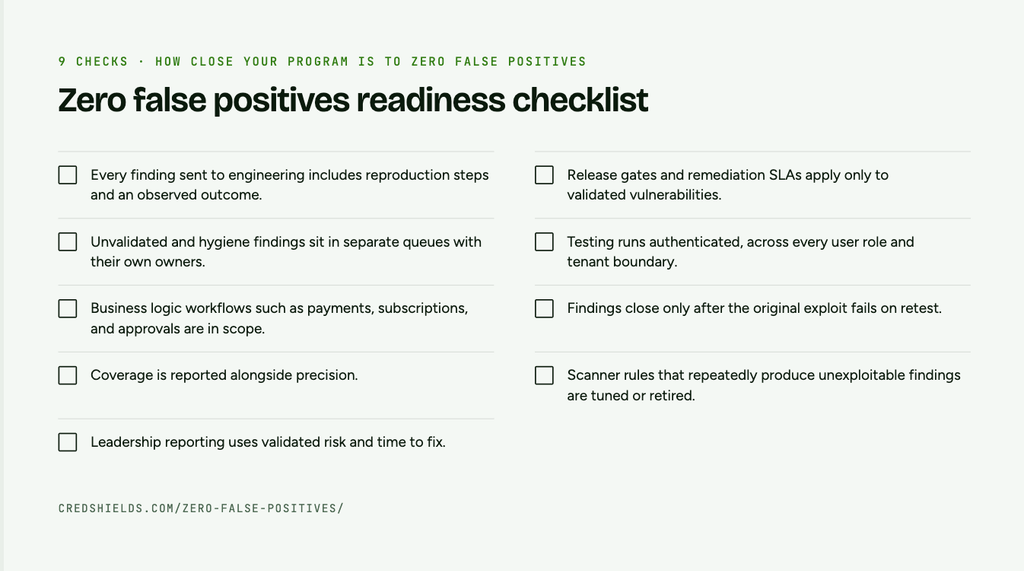
☐ Every finding sent to engineering includes reproduction steps and an observed outcome
☐ Release gates and remediation SLAs apply only to validated vulnerabilities
☐ Unvalidated and hygiene findings sit in separate queues with their own owners
☐ Testing runs authenticated, across every user role and tenant boundary
☐ Business logic workflows such as payments, subscriptions, and approvals are in scope
☐ Findings close only after the original exploit fails on retest
☐ Coverage is reported alongside precision
☐ Scanner rules that repeatedly produce unexploitable findings are tuned or retired
☐ Leadership reporting uses validated risk and time to fix
Frequently Asked Questions (FAQs) About Zero False Positives in Security Testing
These answers cover the questions security and engineering leaders ask most often when evaluating validated testing.
Q1. What does zero false positives mean in penetration testing?
It means every vulnerability in the report was exploited during testing, with the steps and observed impact recorded. Suspected issues that could not be demonstrated are excluded from the validated findings, so engineering receives only proven, reproducible vulnerabilities.
Q2. Is zero false positives realistic for automated security testing?
Yes, for the findings a test reports as validated. A test reaches zero false positives by attempting exploitation and reporting only what succeeds. The standard covers precision, so teams still need a separate coverage measure to understand what the test did not reach.
Q3. What is the difference between a false positive and an effective false positive?
A false positive is a flagged flaw that does not exist. An effective false positive, a term from Google’s static analysis research, is any finding that produces no fix, including real flaws that were poorly explained or buried in noise.
Q4. How does exploit validation reduce alert fatigue?
Exploit validation removes invalid and unexploitable findings before they reach an analyst or engineer. Teams spend their time on vulnerabilities with demonstrated impact, which shortens vulnerability triage and rebuilds trust in security output.
Q5. What should proof of exploit include?
Proof of exploit should include scope and preconditions, exact reproduction steps, the observed outcome, business impact, root cause, remediation guidance, and a retest result showing the attack fails after the fix.
Q6. Can exploit validation run safely against production?
Most validation uses non-destructive payloads that demonstrate impact and then stop. Attacks that risk data loss or downtime belong in staging or are documented as partial proof, under scope and safety limits agreed before testing begins.
Q7. Does zero false positives replace vulnerability scanning?
Scanners remain useful for broad, fast detection and for inventory. Exploit validation sits on top of them and decides which detections become validated vulnerabilities, which is how teams cut false positives in vulnerability scanning output before it reaches engineering.
See What Validated Findings Look Like for Your Application
A CredShields researcher can walk you through how CredShields One tests your application across roles and workflows, which findings it validates with proof of exploit, and how retesting fits your release cycle. To scope a test for your own application, start with CredShields One or explore CredShields penetration testing services.