

6 Core Capabilities: Agentic Pentesting vs. Traditional Security Scanners
The pace of cybersecurity is changing fast, and honestly, everyone feels it. Developers now push out code, APIs, and infrastructure updates at lightning speed, thanks to AI tools like GitHub, Copilot and Cursor. At the same time, attackers are also getting smarter, using AI to automate recon, spot vulnerabilities, and launch exploits quicker than ever. That means the window between discovering a zero day and seeing it exploited just keeps shrinking.
Here is the reality. Legacy security approaches are slipping behind. Old school vulnerability scanners simply cannot catch up, and manual pentesting? It is thorough, yes, but it doesn’t scale. Every new release makes last month’s pen test obsolete.
The rise of AI coding tools means developers are pushing out code faster than ever. But AppSec teams are not keeping pace, it is still just one security engineer for every 50 to 100 plus developers. The gap keeps widening.
AI is also not just helping the good guys. Attackers are moving faster, too, and they do not need to be experts anymore. AI makes it easy for them to scan for weak spots, hitting more targets including smaller organizations that used to hide behind obscurity. Now, nobody is invisible.
Agentic Pentesting steps in here. By harnessing autonomous, multi agent AI systems that actually reason, plan, execute real exploits, and validate vulnerabilities on the fly, agentic pentesting transforms offensive security from a sporadic, outsourced event to something you can run continuously, in house.
Let us break down the six capabilities that make agentic pentesting stand out.
Table of Contents
1. Active Exploit Validation vs. Passive Pattern Matching
| Capability Dimension | Traditional Security Scanners | Agentic Pentesting |
|---|---|---|
| Detection Methodology | Static signatures, regex rules, and version banners | Autonomous payload execution and state verification |
| Primary Deliverable | List of “potential” vulnerability flags | Proven Proof-of-Concept (PoC) exploit |
| False-Positive Rate | High (30% to 78% per NIST/OWASP benchmarks) | Near Zero (Filtered via active execution) |
| Triage Burden | High (Requires manual human reproduction) | Low (Findings arrive pre validated) |
Traditional Scanners:
Most scanners use signatures, version checks, and regex to flag “potential” issues. If they spot an outdated library or a risky parameter, they toss out a flag, but they never actually prove you’re at risk. AppSec teams end up chasing hundreds of alerts, building scripts, and checking if an exploit path really exists or is blocked.
Agentic Pentesting:
Agentic tools do not just spot patterns, they test them. AI agents build attack hypotheses, craft payloads, execute them safely, and check the app’s actual response. If an agent thinks it found a SQL injection or RCE, it does not just hand off a theory, it tries to break in (safely), checks what happened, and confirms if real data or permissions were breached. If the exploit fizzles because of filters or controls, it drops the finding. No more wasted triage.
2. Multi Step Weakness Chaining vs. Isolated Vulnerability Identification
Traditional Scanners:
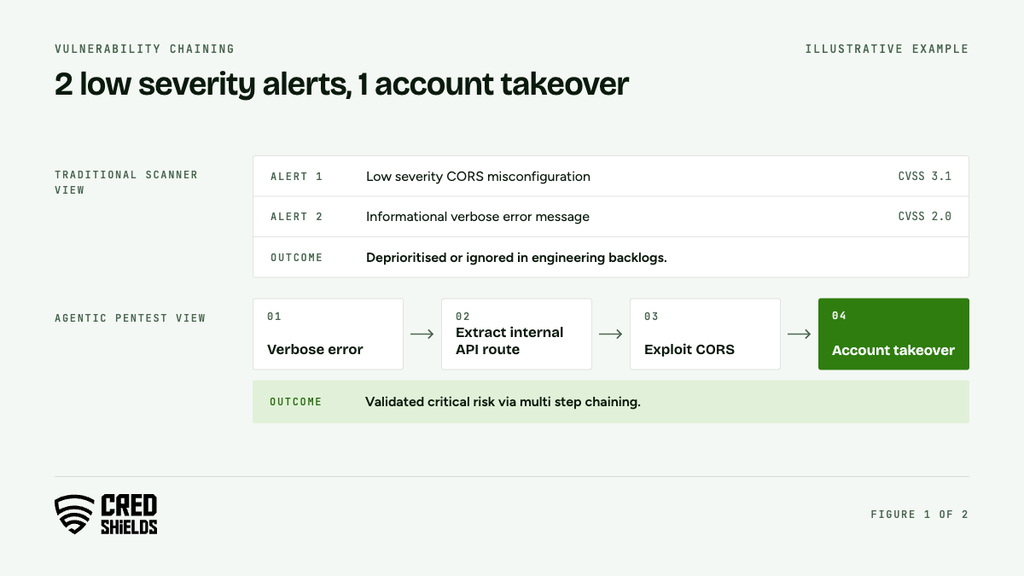
Old scanners work one flag at a time: an irrelevant CORS misconfig here, an exposed CSRF token there. Each gets labeled as “low risk,” then ignored.
Agentic Pentesting:
Attackers blend minor weaknesses to pull off major breaches. Agentic systems replicate that, keeping context, connecting dots. They’ll use a leaked token to escalate privileges step by step, chaining weaknesses until they hit pay dirt (like full account takeover). That is how they find the risks scanners cannot see, by emulating real adversary methodology.
3. Deep Business Logic and Authorization Testing vs. Fixed Technical Checklists
Traditional Scanners:
The nastiest web app flaws, think BOLA, BFLA, or tricky business logic manipulations, fly under the scanner radar. Scanners do not understand roles, workflows, or what “should” happen in an app. Run as a single, unauthenticated or single role entity, they miss logic violations that only show up when users act outside their boundaries.
Agentic Pentesting:
These platforms leverage LLMs and planning engines to actually understand role dynamics and workflows. Given multiple credentials (Guest, User, Admin), agents systematically try privilege escalation, alter workflow states, and manipulate parameters. Payment flows, resets, database mutations, every move gets tested to see if logic holds, not just if technical rules are met.
4. Dynamic Attack Surface Exploration vs. Pre Defined Scoping
Traditional Scanners:
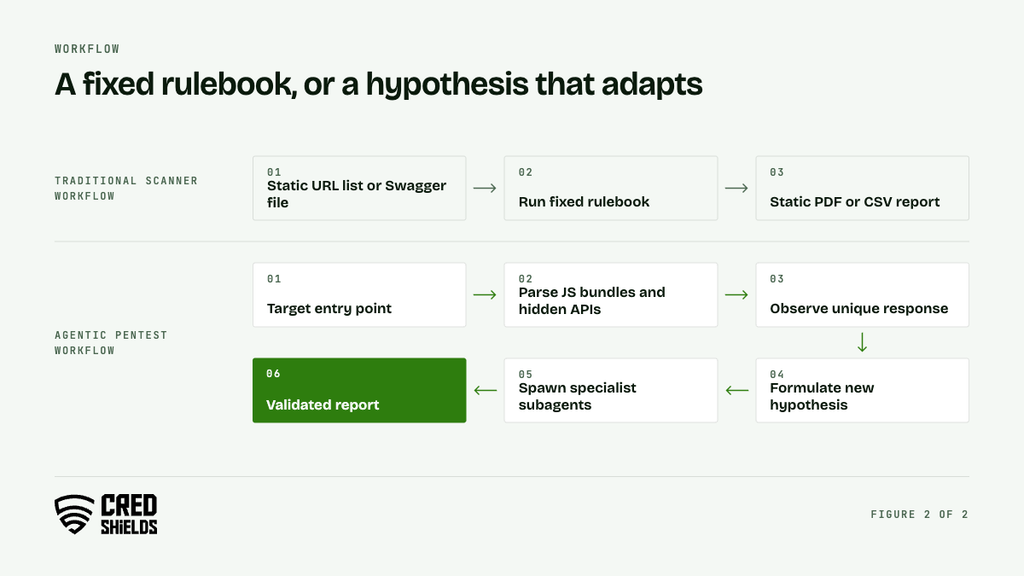
You tell the scanner what to look at. It obediently runs through hardcoded URLs, sticks to fixed rules, and spits out a report. Any endpoints outside your scope? They go undetected.
Agentic Pentesting:
Agentic agents crawl like humans. They tear apart JS bundles, map out hidden APIs, hunt for undocumented endpoints, and adapt to real-time responses. If something weird pops up, an odd header or error, the agent pivots, tests deeper, and branches off. The attack surface gets explored dynamically, not just where you told it to look.
5. Actionable Engineering Proofs and Remediation vs. Noisy Triage Backlogs
Traditional Scanners:
Security teams drown under scanner noise. Hundreds of “potential” issues with vague CVSS scores, no clear exploit path, nothing reproducible. Developers waste hours triaging or fighting dubious findings, slowing releases.
Agentic Pentesting:
Every finding comes with real evidence, a working PoC, exact request/response trails, and clear attack path visuals. Developers see the context, impact, and get tailored remediation advice, not recycled fix suggestions. That is more clarity, less friction, and faster patching.
6. Continuous On Demand Retesting vs. Point in Time Audits
Traditional Scanners and Manual Pentests:
Scanners can run in CI/CD, but the flood of false positives makes them easy to ignore. Manual penetration testing delivers depth, but runs on a quarterly or yearly schedule. With code changing daily, traditional approaches leave big security gaps.
Agentic Pentesting:
Agentic platforms give you the best of both worlds: speed and depth. Runs auto trigger on CI/CD events, instantly retest patches, and scale across hundreds of services. No need to ramp up human headcount; continuous coverage keeps up with fast moving deployments.
Recommended read: 5 Signs Your Startup Has Outgrown Periodic Pentesting
Summary Comparison
| Evaluation Criteria | Traditional Security Scanners | Manual Human Pentesting | Agentic Pentesting |
|---|---|---|---|
| Testing Cadence | Continuous / Scheduled | Quarterly / Annual | Continuous / On Demand |
| Active Exploit Validation | Limited / Theoretical | Full | Full and Autonomous |
| Business Logic and BOLA Detection | Poor | High | High |
| Multi-Step Attack Chaining | Minimal | High | High |
| False-Positive Burden | High (30% – 78% per NIST) | Near Zero | Near Zero (Pre Validated) |
| Engineering Triage Friction | High (Alert Fatigue) | Low | Low (Executable PoCs) |
| Scalability Across Apps | High | Constrained by Headcount | High (Autonomous Scale) |
Security as an On Demand Capability
If software delivery keeps speeding up, relying on old school pattern matching scanners or infrequent, expensive pen tests leaves you exposed, or slows your team down.
Agentic Pentesting is the next evolution. By embedding autonomous, intelligent agents into your development workflow, security teams can proactively validate vulnerabilities, cut scanner noise, and scale offensive testing right alongside engineering. This way security keeps pace with innovation, instead of holding it back.