

Why Vulnerability Scanners Fall Short: 5 Things Only Offensive Validation Can Do

Traditional security scanners have a clear job in modern application security. They scan code, check network ports, and flag known patterns or outdated packages. That kind of automated detection is useful as a baseline.
The problem starts when teams treat scanner output like proof of real risk. Finding a potential flaw is not the same thing as proving an attacker can break into your app. Traditional scanners produce massive amounts of noise. Data from the National Institute of Standards and Technology shows that static scanners can hit false positive rates as high as 78% in complex codebases. The OWASP Benchmark Project found a similar trend, with legacy tools reaching false alarm rates up to 82%.
Because of that noise, human security engineers still have to triage, reproduce, and validate every alert before a developer can fix it. The Ponemon Institute reports that security and engineering staff spend 50% to 80% of their security hours just sorting through alerts.
Offensive validation changes how this works. Instead of guessing at patterns, autonomous AI agents act like skilled penetration testers. They explore your application, test real attack paths, and prove what can actually be exploited.
Here are five things offensive validation does that traditional vulnerability scanners simply cannot do.
Table of Contents
1. Proving whether a vulnerability is actually exploitable
A vulnerability scanner reads signatures and configuration rules. If it sees an outdated library or a missing security header, it throws up an alert. It never checks if a firewall, a login rule, or an input filter already blocks the attack in your live app. You end up with a long list of theoretical issues that may pose zero real risk.
Offensive validation tests the flaw directly. Autonomous agents form an attack hypothesis, send safe exploit payloads, and observe how your application responds. If a control blocks the attempt, the agent drops the finding. Your team does not waste time chasing dead ends. You only see validated vulnerabilities that an attacker could actually exploit in production.
Additional Read: 6 Core Capabilities: Agentic Pentesting vs. Traditional Security Scanners
2. Testing complex business logic and user workflows
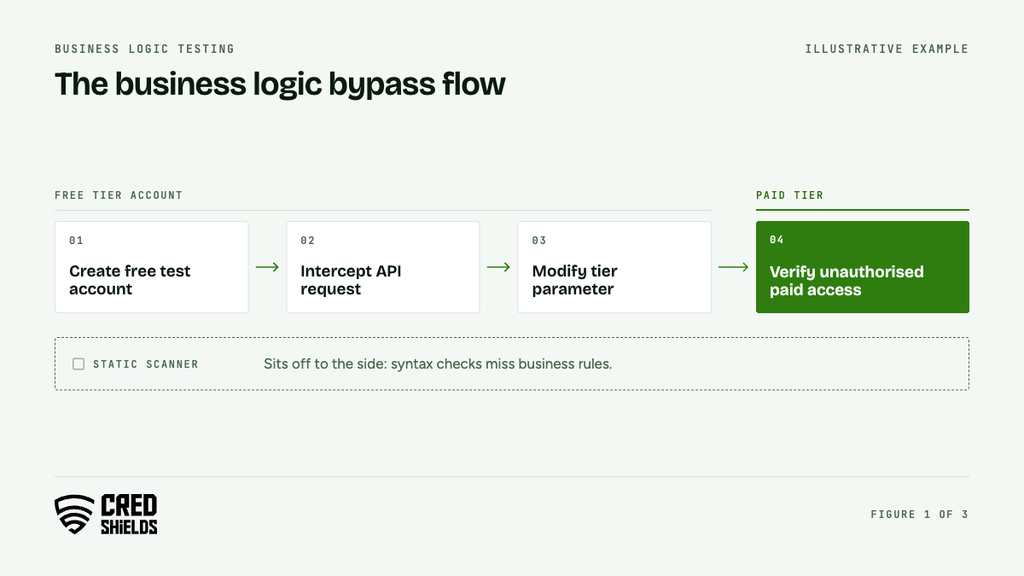
Scanners look at code syntax and known technical patterns. They have no idea how your business actually operates. They do not know what a free user should access versus what a paying subscriber should see. That blind spot leaves major flaws wide open. In fact, the OWASP API Security Top 10 ranks Broken Object Level Authorization as the single biggest threat to modern APIs, largely because pattern scanners miss it.
Autonomous agents test your app the way a real user or a real attacker would. Imagine an application with a paid membership system. An agent can create a test account, walk through your API workflows, and try to alter the membership status to get a paid plan without paying. If the app accepts that unauthorized change, the agent verifies the breach and reports exactly how it happened.
3. Chaining small weaknesses into high impact attacks
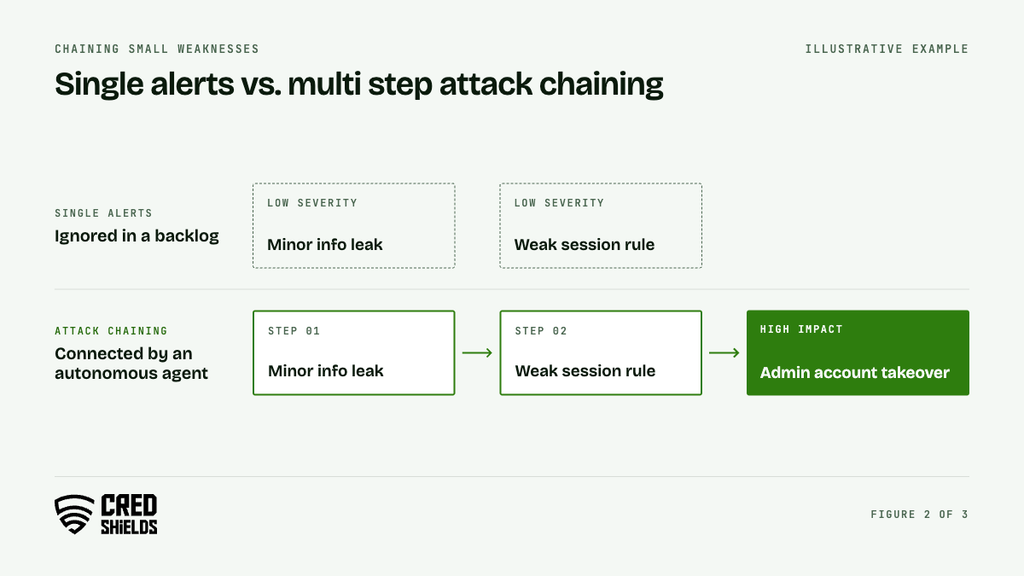
Traditional scanners evaluate every alert in isolation. They might flag a minor information leak on one endpoint and a weak session setting on another. Because each flaw looks small on its own, both alerts get marked as low severity and sit in the backlog for months. Research from Veracode in its State of Software Security Report shows that the average time to fix a flaw in traditional workflows stretches to 298 days.
Real attackers rarely rely on just one big bug. According to the Verizon Data Breach Investigations Report and the MITRE ATT&CK framework, breaches happen when attackers chain multiple small weaknesses together. Autonomous agents replicate that exact mindset. If an agent finds a way to leak a user token and spots a separate flaw in your approval logic, it investigates whether those two weaknesses can be combined to take over an admin account. It shows you the full attack chain, not just disconnected fragments.
4. Delivering reproducible evidence instead of raw triage lists
When a scanner finishes a run, it dumps hundreds of vague warnings onto your security team. Someone has to read each flag, figure out what it means, write a reproduction script, and convince a busy developer that the bug is real. That manual handoff slows down engineering releases and creates friction between teams.
Offensive validation removes that triage bottleneck. Instead of handing your team a list of 100 potential issues to investigate, autonomous agents deliver clear, reproducible proof. Every validated finding shows how the control was bypassed, what an attacker could achieve, and the exact steps required to reproduce the exploit. Your engineers get actionable remediation guidance right away so they can patch the flaw and move on.
5. Retesting fixes on demand as your code changes
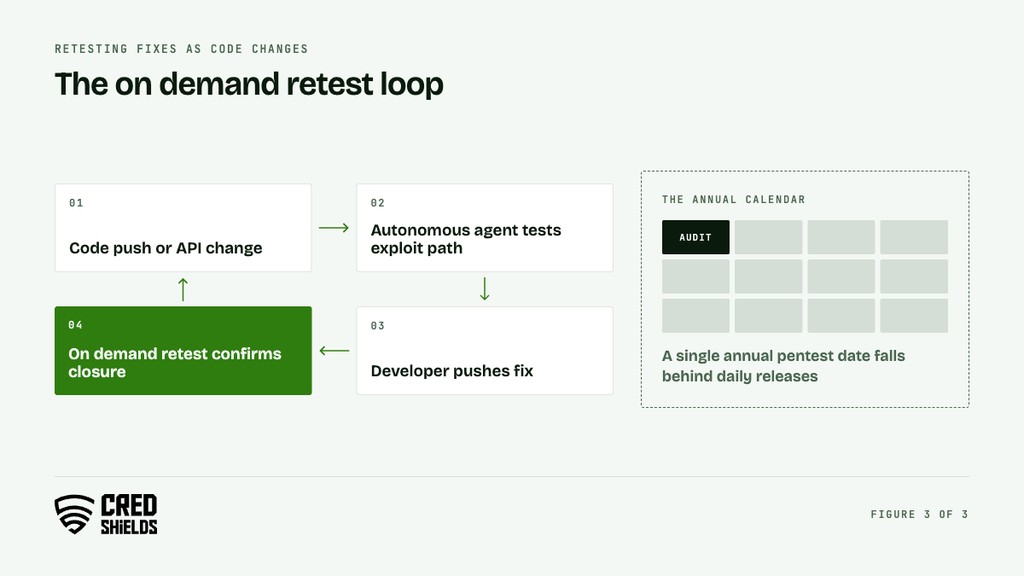
Scanners can run fast, yet their noisy output trains developers to ignore them. On the other hand, hiring human pentesters gives you deep validation, yet you can usually only afford that once or twice a year. DORA research shows that high performing teams deploy code multiple times a day. An application six months after a manual pentest is completely different from the app that was tested.
Offensive validation brings penetration testing inside your engineering workflow as an on demand capability. Autonomous agents run whenever your teams ship new features, update APIs, or change authentication flows. Once an engineer pushes a fix for a validated bug, the agent retests the patch on the spot to confirm the attack path is closed. You keep pace with fast development cycles without waiting months for an outside report.
Moving from detection to validation
Detection alone is no longer enough to secure fast moving software. When attackers use AI to automate their recon and developers use AI to ship code daily, your security team cannot afford to drown in scanner false positives. By shifting from passive pattern scanning to autonomous offensive validation, you give your teams proven findings, clear evidence, and continuous confidence in every release.