

5 Signs Your Startup Has Outgrown Periodic Pentesting
Most early stage startups treat cybersecurity like a checkbox, something to deal with only when it is required. The usual approach is pretty barebones: run some automated vulnerability scans, draft up a few security policies, and schedule a big penetration test right before that crucial fundraising round or when a potential enterprise customer starts poking around.
But things have changed, fast. AI powered engineering tools like GitHub Copilot, Cursor, and Claude Code have dramatically sped up how teams write and ship code. Now, even a small team can crank out new features, tinker with authentication, spin up microservices, and push new APIs at a pace that only big tech used to pull off.
Unfortunately, hackers have not been sitting around either. They are unleashing their own AI bots, scanning the public internet nonstop, sniffing for any unpatched vulnerabilities, misconfigurations, or weird logic errors. The window between launching new code and someone finding a security hole has pretty much disappeared.
If your startup still relies on yearly or twice yearly outsourced pentests, you are probably flying blind most of the time. That leaves huge gaps almost the whole year where serious risks can go unnoticed, right as your code is changing faster than ever. Here are five obvious signs that it is time to move beyond periodic pentesting, backed up by hard data and real world industry standards.
Table of Contents
1. Your Engineering Velocity Outpaces Your Audit Cadence
The Problem
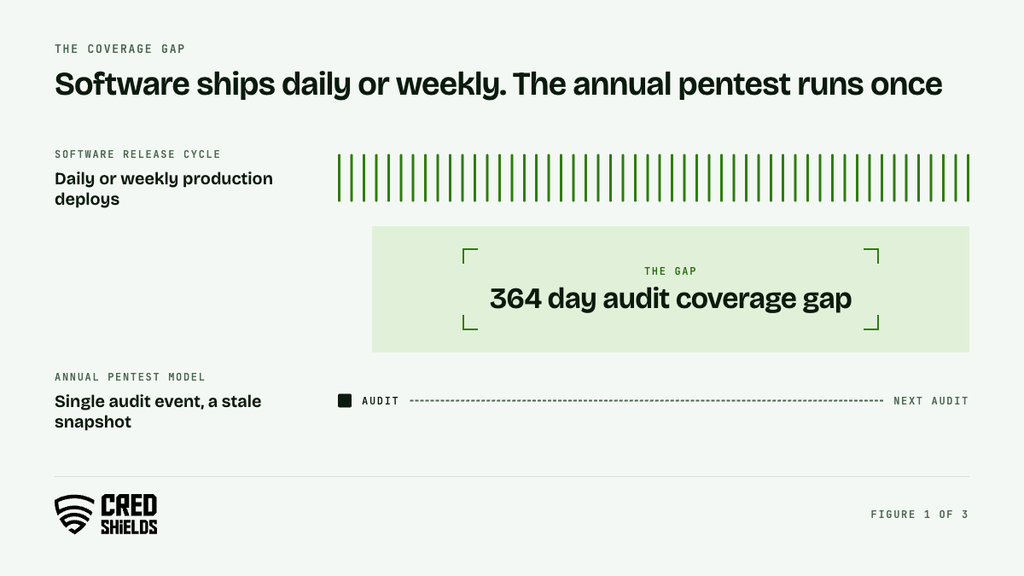
If your team ships code daily or weekly, an annual or quarterly penetration test gives you a snapshot of an application state that is gone within days. Those findings are accurate on the day of testing and out of date almost immediately after.
DORA’s data on high performing software teams shows deployments several times a day and lead time from commit to production under a day. Features, payment integrations and access controls keep changing at that pace, so a report delivered six months ago says nothing useful about the code running now.
The Impact
Drift risk: OAuth parameters, tenant-isolation rules and database permission checks change well after the pentest report is filed away, and nothing in the report tracks those changes.
False sense of security: A team can pass a pentest in Q1, then ship architectural changes through Q2 and Q3 with no offensive testing at all.
2. Enterprise Sales Deals Are Delayed by Security Questionnaires
The Problem
Startups moving upmarket hit vendor risk management (VRM) during enterprise sales, and security review is where those deals slow down. Enterprise CISOs and procurement teams will not accept a static executive summary from an annual pentest done 10 months ago.
Modern procurement standards ask for continuous proof of application security, vulnerability management that reflects the code as it runs today, and evidence that new features went through offensive testing.
The Impact
Deals stall when prospects want proof of testing for API endpoints released after your last formal audit. Surveys of enterprise SaaS procurement rank vendor security validation among the top reasons contracts are delayed in B2B deals. A traditional audit report describes how secure your product was on a specific date; it says nothing about the build customers are running now.
3. Your Engineers Waste Time Triaging Scanner Noise
The Problem
Startups that test infrequently often add SAST (static application security testing) or DAST (dynamic application security testing) tools to their CI/CD pipelines to cover the gap between penetration tests.
Static and dynamic scanners do not understand application logic, so their findings arrive without the context needed to judge them. NIST and the OWASP Benchmark Project both publish false positive rates for these tools, and the range runs from 30% to over 70% depending on the language and how complex the framework is.
The Impact
Alert fatigue: Developers with no security background end up investigating hundreds of vulnerability flags, things like raw regex matches or unverified library warnings, that nobody can actually exploit.
The triage tax: Security and DevOps staff spend 20% to 30% of their working hours on invalid scanner alerts, reproducing them, then dismissing them. Industry research is the source for that range, though the study itself is not named here.
Engineering friction: Sending raw scanner output straight to developers costs the security team trust, and when a real alert arrives it gets deprioritized along with the noise.
4. Architectural & Business Logic Changes Occur Between Audits
The Problem
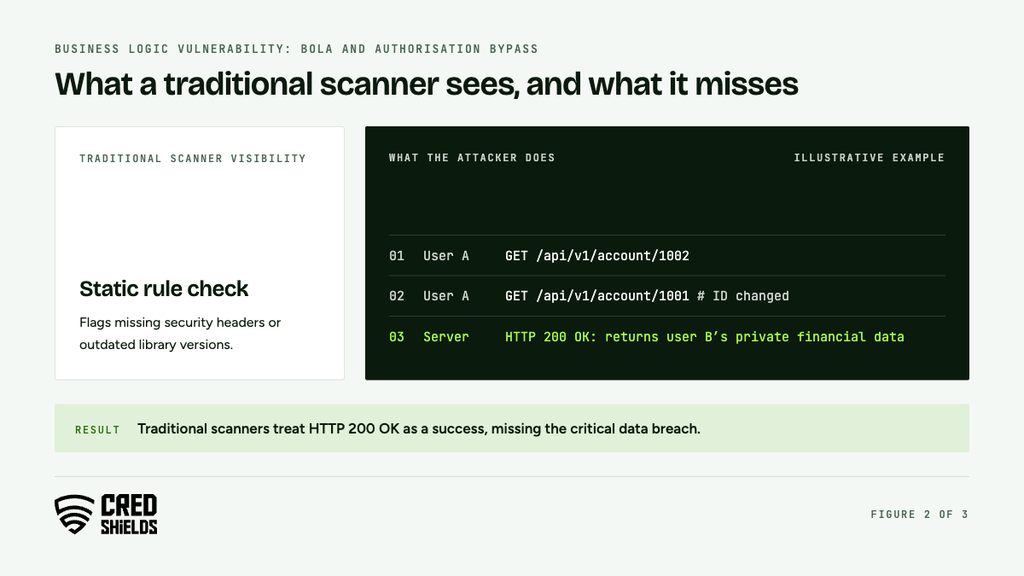
BOLA (broken object level authorization) and BFLA (broken function level authorization) are among the most damaging flaws in APIs. BOLA holds the #1 spot on the OWASP API Security Top 10.
Traditional security tools cannot detect BOLA or business logic flaws because they do not understand user roles, workflow dependencies or authorization boundaries. Finding these flaws used to mean hiring outside penetration testers.
The Impact
Blind spots: Subscription tiers, tenant boundaries and permission workflows change between annual pentests, and vulnerability scanners will not flag the logic flaws that come out of those changes.
Cost: Hiring a specialized pentesting firm every time an engineer touches access control or billing logic is too expensive for most startups at that stage.
5. You Lack Dedicated In-House Offensive Security Expertise
The Problem
Offensive security expertise is scarce and expensive. Startups in the early and mid stages rarely have the budget for a full time penetration tester, a principal AppSec engineer or an offensive security researcher, and rarely need one.
Developers ship quickly. Nobody on the team, though, has the attacker’s habit of testing logic, chaining small weaknesses into something exploitable, probing API parameters and building a proof-of-concept (PoC) exploit.
The Impact
Attackers run automated tools across your whole attack surface. Your team cannot test your own applications the same way, so the work only happens when you commission it externally.
Testing also waits on someone else’s calendar. A firm has to scope a proposal and schedule the work before anyone looks at your code, and that turnaround runs on their time, not yours.
The Solution: Transitioning to Continuous Agentic Pentesting
The traditional binary choice either relying on noisy automated scanners or waiting for infrequent manual pentests is no longer sufficient for modern, high velocity engineering organizations.
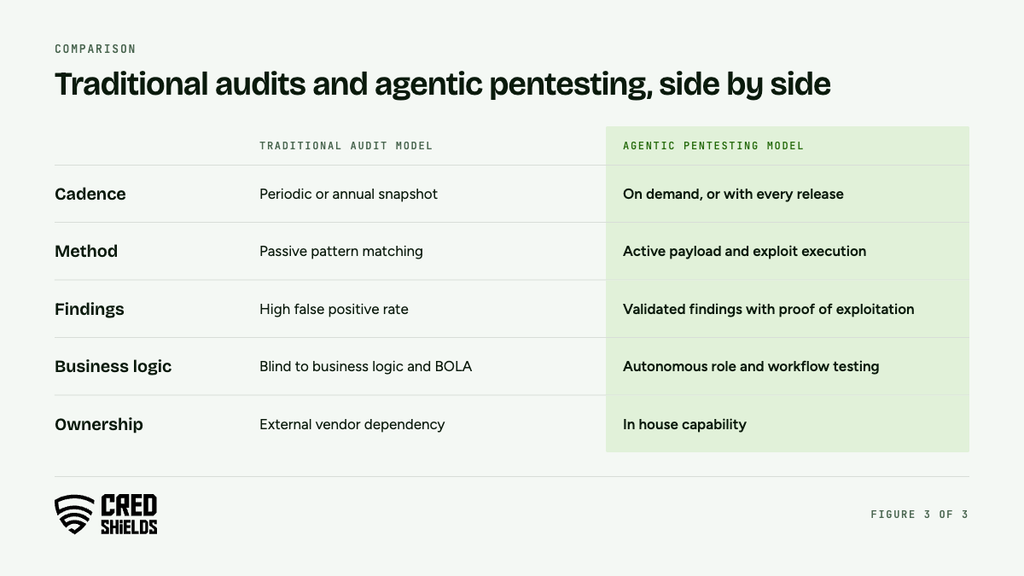
Agentic Pentesting fills this strategic void by deploying autonomous AI agents that emulate the reasoning, planning, and attack methodology of experienced security researchers:
- Continuous On Demand Testing: Run offensive audits directly within CI/CD pipelines whenever major features, API endpoints, or auth structures are merged.
- Active Validation over Scanner Noise: Agents do not just flag potential bugs, they safely attempt controlled exploitation to confirm whether a flaw is reachable and exploitable, eliminating triage noise.
- Deep Logic and Authorization Auditing: By operating across multiple authenticated user contexts, autonomous agents proactively uncover BOLA, privilege escalation, and workflow bypasses before code reaches production.
- Actionable Engineering Evidence: Findings arrive with reproducible execution paths, HTTP request/response logs, and contextual remediation steps allowing developers to patch vulnerabilities immediately.
By shifting from pentesting as an outsourced annual event to pentesting as a continuous internal capability, startups can scale development velocity while maintaining enterprise grade security assurance.