

You Hand an Agent Scope and Credentials. Then What?
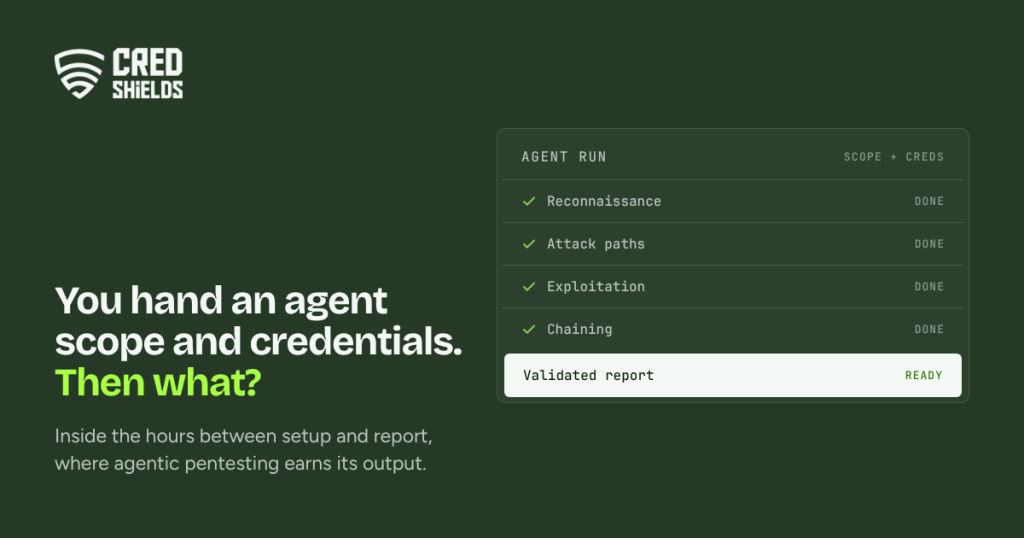
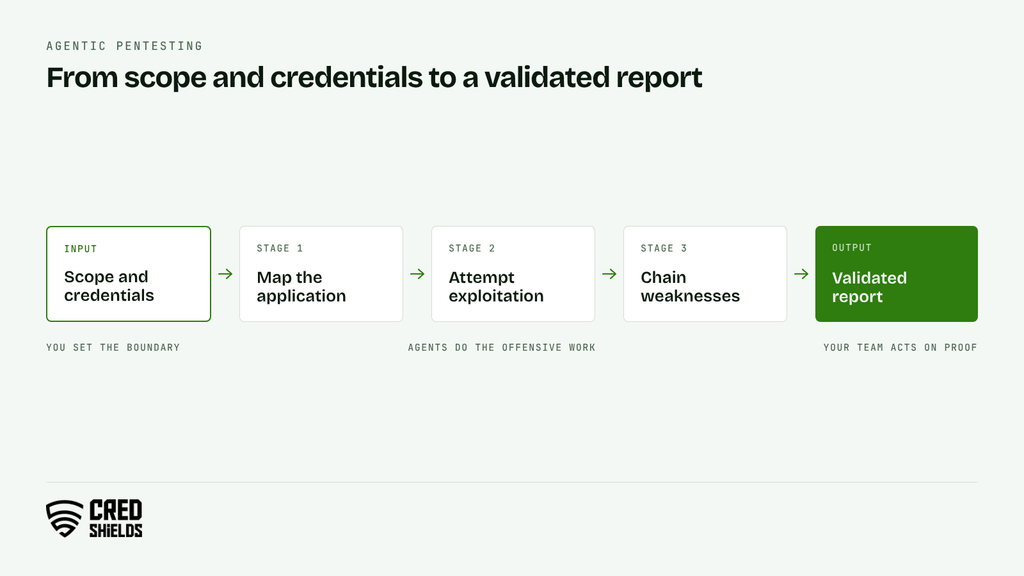
Agentic pentesting works in stages once you provide scope and credentials: the agents map the application, identify attack paths, attempt exploitation, chain weaknesses, confirm what is actually exploitable, and return findings with reproduction evidence. Scope sets the boundary of what gets tested. Credentials let the agents test as real users and roles, which is where the serious flaws live. The output is a validated, retestable report your team can act on directly.
Most buyers understand that agentic pentesting attacks an application. Far fewer have seen what the agents actually do in the hours between setup and report, which is exactly the part that determines whether the output is worth acting on. This guide opens that box in detail. It is written for AppSec leads, engineering managers, and security buyers who want to understand how agentic pentesting operates, what it can and cannot reach, and how to prepare an application so the test reaches as deep as possible.
Table of Contents
What Agentic Pentesting Is
Agentic pentesting is penetration testing carried out by AI agents that perform the offensive work themselves: exploring the application, attempting exploitation, testing logic, chaining weaknesses, and validating findings. The agents do the attacking, so a human reviews proven results instead of running each test by hand.
The defining step is validation. An AI-assisted scanner still matches responses to known patterns and leaves a person to confirm whether each candidate is real. In agentic pentesting, the agent forms a hypothesis about a weakness, attempts to exploit it against the running application, reads the actual result, and keeps the finding only if the exploit worked. That shift, from detection to validated exploitation, separates agentic pentesting from a faster scanner, and it explains why the stages below exist.
The approach also differs from fully automated pentesting of the older kind, which chained preset tools and scripts in a fixed order. Those tools could not reason about an unfamiliar workflow or decide that an unusual response was worth pursuing. The agents build a model of the specific application in front of them and adapt their attempts to it, which is what lets them reach authorization and business logic flaws that scripted automation walked straight past.
Why Scope and Credentials Decide the Depth of the Test
Two inputs set the ceiling on what agentic pentesting can find: the scope you authorize and the credentials you provide. Everything the agents do happens inside those two boundaries, so the quality of the test is decided before the first request is sent.
Scope Keeps Testing Safe, Legal, and Focused
Scope defines which applications, domains, APIs, and environments the agents may test, and which they must leave alone. A precise scope does three things at once. It keeps the engagement legal, since testing systems you do not own or control is not authorized. It keeps the test safe, by excluding fragile third-party integrations or production systems that should not receive attack traffic. And it concentrates effort on the assets that carry real business impact.
A good scope is specific about inclusions and exclusions. It names the web application and its APIs, lists the subdomains in bounds, states whether mobile backends are included, and flags any endpoint that triggers real-world side effects such as sending emails, charging cards, or notifying customers, so the agents can treat those carefully or avoid them.
Credentials Decide How Deep the Agents Can Reach
Credentials decide how far the test goes. Unauthenticated testing sees only what an anonymous visitor sees, which is a small fraction of most applications. The weaknesses that cause the most damaging breaches sit behind a login and span multiple roles, and reaching them requires testing as real users. The OWASP Top 10:2025 keeps broken access control in first place, with every tested application showing some form of it, and confirming an access control flaw means logging in as one user and trying to reach another user’s data.
The amount of access you provide maps directly to the depth of coverage you get.
| Access level provided | What the agents can test | What stays hidden |
|---|---|---|
| Unauthenticated only | Public pages, login and registration flows, exposed endpoints | Everything behind authentication, which is most of the application |
| Single user role | That role’s workflows, data access, and input handling | Cross-role access, privilege escalation, tenant boundaries |
| Multiple roles | Access control between roles, function-level authorization, privilege escalation paths | Little that a logged-in attacker with an account could not reach |
| Multiple roles and tenants | Access control across roles, tenants, and workflows end to end | Very little that is reachable through the application layer |
The practical lesson is that providing a single low-privilege account tests a sliver of the application, while providing accounts in every role and, for multi-tenant products, in separate tenants lets the agents test the authorization boundaries where real breaches start. For a product that separates customer data by tenant, two tenant accounts are the difference between a test that confirms isolation holds and a test that never touches it.
Recommended read: If you or your team are planning a credentialed API assessment, this case study on a fintech startup’s API security overhaul is a great place to start.
The Stages of an Agentic Pentest
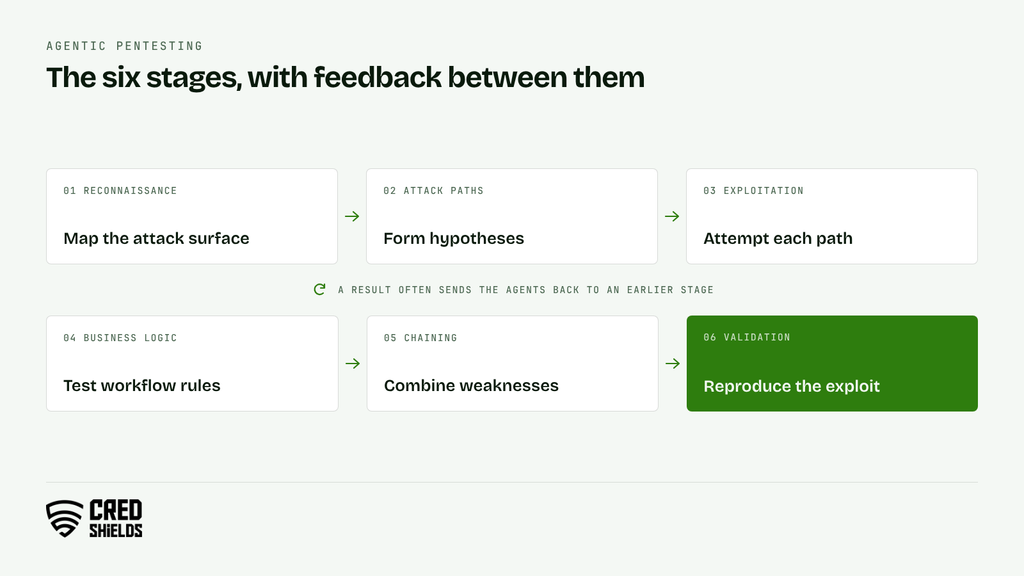
Once scope and credentials are set, agentic pentesting proceeds through stages that mirror how a skilled attacker works. The agents move back and forth between these stages rather than running them strictly in order, because a result in one stage often sends them back to an earlier one with a new idea.
Reconnaissance and Attack Surface Mapping
The agents explore the application within scope. They crawl pages, enumerate API endpoints, read client-side JavaScript, inspect request and response structures, and note the roles, parameters, object identifiers, and data flows the application exposes. Reading the client code matters more than it sounds: front-end code and API schemas often reveal endpoints, parameters, and object references that are never linked in the visible interface, and those unlinked paths are frequently where weak authorization hides.
The output of this stage is a working model of what the application does, where its sensitive actions are, and which requests touch money, personal data, or privileged functions. That model is what every later stage reasons against.
Attack Path Identification
From the model, the agents form hypotheses about where weaknesses are likely to exist. An endpoint that returns a record by numeric identifier invites an object-level access control test. A multi-step checkout invites a sequence test. An update endpoint invites a test for fields the user should not be allowed to set. A role switch in the interface invites a function-level authorization test. Each hypothesis becomes a concrete thing to attempt, prioritized by how much impact it would carry if it held.
Exploitation Attempts
The agents try each attack path against the running application. They send the request that would expose another user’s data, attempt the action a lower-privileged role should not perform, supply the value that should be rejected, or replay the token that should be single-use, and then read the actual response. This is the step a scanner cannot perform, because confirming the result requires understanding what the response means in context, beyond whether it matches a signature.
Business Logic and Workflow Testing
Using their credentials, the agents move through multi-step workflows and test whether the application’s own rules hold. They try skipping a required step, repeating a single-use action, reordering a sequence, supplying an out-of-range or negative quantity, or editing a value the application assumed only it controlled. The OWASP Web Security Testing Guide states plainly that automated tools cannot detect whether a user circumvented a process flow, and that business logic abuse remains a manual art that depends on understanding the full process. Agentic pentesting reaches this class of flaw precisely because the agents hold session state and reason about what each workflow is for, which is the capability that older automation lacked.
Weakness Chaining
The agents test whether separate weaknesses combine into something larger. A leaked user identifier plus a missing ownership check can become full account takeover. A self-service role field plus a trusting approval step can become privilege escalation. Chaining is where findings that each look low severity on their own reveal their real impact, and it is one of the clearest advantages of an agent that reasons across the whole application over a tool that reports each issue in isolation.
Exploit Validation
Before anything reaches the report, the agent confirms it. A finding survives only when the agent has reproduced the exploit and observed the result: data from another account returned, a privileged action completed, a payment step bypassed, a control defeated. This validation step is what lets the security team treat the report as a list of proven problems.
A Worked Example: Chaining a Membership Bypass
A concrete example shows the stages working together on a single application with a paid membership tier.
- During mapping, the agent notes the subscription workflow, the endpoint that sets account status, and an approval field in the account update request.
- It creates a test account using its credentials and works through the normal upgrade flow to learn how a legitimate upgrade behaves.
- It attempts to set its own account to the paid tier without completing payment, then reads the response to see whether the application accepted the change.
- Finding that a second weakness lets it alter its own approval status, it tests whether the two combine, using the approval change to make the unpaid upgrade stick.
- It confirms the chained result by logging back in and checking that the account now holds paid access it never paid for.
- It reports a reproduced bypass with the full request sequence, the responses at each step, and the business impact: any user could grant themselves paid access, which is direct revenue loss.
The output of that sequence is a demonstrated bypass with the evidence to reproduce it, and that evidence is the point of agentic pentesting. A report that says an access control issue may exist leaves the real work undone. A report that shows the exact steps an attacker would take tells engineering precisely what to fix and lets them confirm the fix against the same steps.
How Agentic Pentesting Stays Safe During the Test
Buyers reasonably worry about letting agents attack a live application. Agentic pentesting manages that risk through scope, environment choice, and careful handling of destructive actions.
Scope is the first control, since the agents only test what you authorize. The second is environment: testing against a staging or pre-production environment that mirrors production gives realistic results without putting live customer data or live transactions at risk, which is why a faithful staging environment is one of the most useful things a team can provide. When testing has to run against production, the engagement flags endpoints with real-world side effects so the agents avoid actions that would charge a customer, send mail, or delete data, and confirm exploitability through safer signals instead. Good agentic pentesting proves a weakness is reachable without causing the harm the weakness would allow.
What the Report Contains and Why Retesting Matters
Agentic pentesting produces a report built for engineering to act on directly. Each finding carries the attack narrative, the exact requests and responses, the business impact stated in terms a non-specialist can act on, and remediation guidance. Because every finding was validated, the security team reviews proven issues and spends its time on decisions.
The report is also retestable, which is where agentic pentesting earns its place in a fast-moving program. When engineering ships a fix, the agents rerun the exact attack path that proved the finding and record whether it still works. Applications change constantly, so a fix that holds today can be reopened by next week’s refactor, and a weakness that was closed can return through a later change. Running the stored attack path again on every fix and every significant release keeps the report an accurate picture of the application as it stands today. Programs that tie this cycle to the release pipeline through continuous AppSec turn a point-in-time report into a standing measurement.
Recommended read: If you or your team are planning how automated and manual testing should share the workload, this article on manual versus automated penetration testing is a great place to start.
Where Human-Led Testing Still Fits
Agentic pentesting covers broad, frequent, authenticated testing well, and it does so at a pace no human team can match on a per-release basis. Some engagements still call for human specialists: deeply bespoke systems with unusual trust models, novel business logic that rewards human intuition, physical or social-engineering components, and assessments that a regulator or enterprise customer requires to be independent third-party work. CredShields provides those through its penetration testing services and red team engagements. The strongest programs run agentic pentesting continuously for coverage and bring in human specialists for the engagements that most reward judgment, so the two reinforce each other.
Recommended read: If you or your team are planning whether a red team or a pentest fits your maturity, this article on red teaming versus pentesting services is a great place to start.
Agentic Pentesting Readiness Checklist
Use this checklist to prepare for an agentic pentest and get the deepest coverage from it.
- Scope lists every application, domain, and API to test, and names anything out of bounds.
- Test accounts exist for each role, and for multi-tenant products, in at least two separate tenants.
- A staging environment mirrors production closely enough for realistic results.
- Endpoints with real-world side effects, such as payments and outbound email, are flagged.
- Workflows that move money or expose data are identified as priorities.
- An owner is ready to receive validated findings and route them to engineering.
- A retest step is planned for after each fix is deployed.
- Significant releases are set to trigger a new test so coverage tracks change.
Frequently Asked Questions (FAQs) About Agentic Pentesting in 2026
These answers cover the questions buyers ask most often about agentic pentesting, from how it works to how it fits a program.
What is agentic pentesting?
Agentic pentesting is penetration testing performed by AI agents that explore an application, attempt exploitation, test business logic, chain weaknesses, and validate findings themselves. The agents do the offensive work and return reproduced findings with evidence and remediation guidance, so a human reviews proven issues instead of running each test by hand.
How is agentic pentesting different from automated pentesting?
Older automated pentesting chained preset tools and scripts in a fixed order and could not reason about an unfamiliar workflow. Agentic pentesting uses agents that build a model of the specific application and adapt their attempts to it, which lets them reach authorization and business logic flaws that scripted automation misses.
How is agentic pentesting different from a vulnerability scanner?
A scanner matches responses to known patterns and reports candidates for a person to confirm. Agentic pentesting attempts the exploit against the running application and keeps only what it reproduces, so the output describes proven exploitability.
Why do I need to provide credentials for an agentic pentest?
Credentials let the agents test as real users and roles. Most serious weaknesses, including broken access control and business logic flaws, sit behind authentication and across roles, so unauthenticated testing alone sees only a small part of the application and misses the flaws that cause the worst breaches.
How many user accounts and roles should I provide?
Provide an account for each distinct role, since cross-role testing is how privilege escalation and function-level authorization flaws are found. For multi-tenant products, provide accounts in at least two separate tenants so the agents can test whether one customer can reach another customer’s data.
Is agentic pentesting safe to run against production?
It can be, with care. Scope limits what the agents test, endpoints with real-world side effects are flagged so destructive actions are avoided, and exploitability is confirmed through safer signals. Testing against a faithful staging environment is often the better option, since it gives realistic results without risk to live data or transactions.
Does agentic pentesting need source code?
No. Agentic pentesting tests the running application from the outside, as an attacker would, using scope and credentials. Source code review and static analysis are a separate, complementary layer that reads the code directly, and many programs run both.
How long does an agentic pentest take?
It depends on the size and complexity of the scope, but because agents work in parallel and at machine speed, an authenticated test of a typical application completes far faster than an equivalent human engagement. The more important property for a fast-moving product is that it can be rerun on demand, on every significant release.
Can agentic pentesting find business logic vulnerabilities?
Yes, when the agents can authenticate, hold state across multi-step workflows, and compare what different roles can do. Those capabilities let agents reason about the rules a workflow is meant to enforce and test whether they hold, which is the class of flaw that scanners miss entirely.
How does agentic pentesting avoid false positives?
Every finding is validated by reproducing the exploit and observing the result before it is reported. Because the agent confirms the weakness against the running application, the report describes exploits that were demonstrated.
Can an agentic pentest be rerun after a fix?
Yes. The agents store the attack path that proved each finding and rerun it after a fix is deployed, recording whether the exploit still works. This retesting can be tied to every fix and every significant release, which keeps the report current as the application changes.
Can agentic pentesting replace human pentesters?
It replaces the broad, frequent, repeatable testing that consumes most human hours, which frees specialists for the work that rewards judgment. Human-led testing remains essential for deeply bespoke systems, novel business models, physical or social-engineering components, and assessments a regulator or customer requires to be independent.
Is agentic pentesting accepted for compliance?
It depends on the specific requirement. Many frameworks accept thorough, documented testing with validated findings and retesting, while some require an independent human-led assessment for certain controls. Confirm which of your obligations require independent third-party testing before relying on any single model.
Where to Start With Agentic Pentesting
Agentic pentesting goes as deep as the scope and credentials behind it. CredShields One takes the workflows where a breach would cost your business most, signs in with the roles and tenants you provide, and runs the authenticated test on demand. Each validated finding arrives with the request sequence that proves it and the fix that closes it, so your team knows exactly where its real exposure sits and can retest each fix once it ships.