

The Flaws Your Scanner Will Never Flag, and Why Attackers Love Them
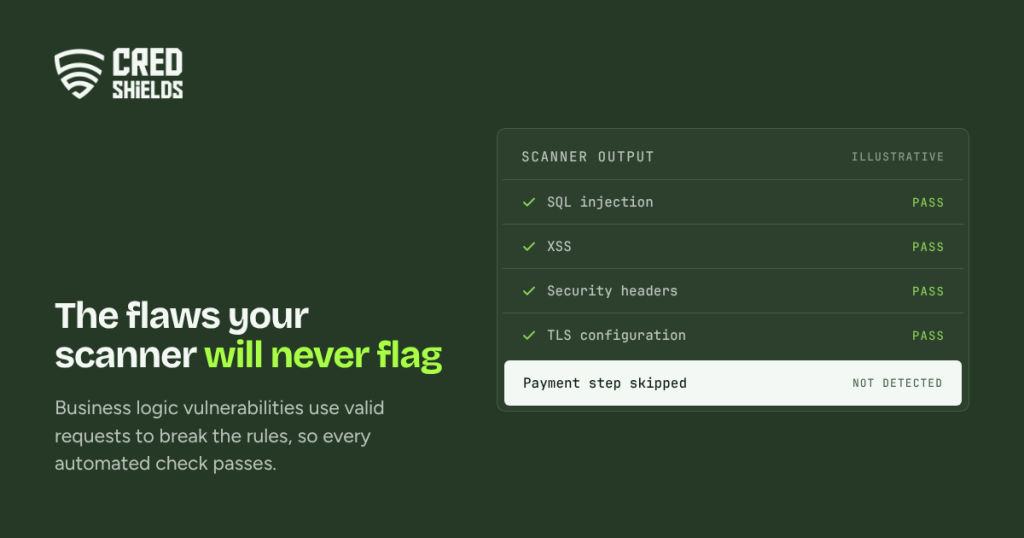
Business logic vulnerabilities let a user break the rules of an application using requests that are completely valid. Applying a discount twice, approving your own refund, and skipping a payment step are all business logic vulnerabilities built from well-formed input. Scanners miss them because every request looks legitimate. Testing them takes an attacker, or an agent, that understands what each workflow is supposed to prevent.
These flaws rarely make headlines, yet they drain revenue and expose data in ways that pass every automated check. This guide is for AppSec engineers, product security teams, and technical founders who want to understand business logic vulnerabilities and test for them at the speed their applications change.
Table of Contents
What a Business Logic Vulnerability Is
A business logic vulnerability is a flaw in the rules that govern how an application is meant to behave, exploited through legitimate functionality used in an unintended way. The input is well formed, the user may be authenticated, and the request passes validation. The problem is that the application allowed an action its own business rules should have refused.
The OWASP Web Security Testing Guide is direct about why these resist automation: tools cannot detect whether a user circumvented a process flow, and business logic abuse remains a manual art that relies on the tester’s knowledge of the full process and its rules. A scanner has no concept of what a workflow is for, so it cannot tell when the workflow achieves something it never should.
Why Scanners Cannot See Business Logic Vulnerabilities
Scanners work by pattern matching. They send inputs designed to trigger known vulnerability classes, then compare responses against signatures of insecure behavior. That model finds injection and misconfiguration well, and misses logic entirely, for structural reasons. Because the signals a scanner relies on are absent, business logic vulnerabilities pass straight through.
| Scanner assumption | Why business logic vulnerabilities defeat it |
|---|---|
| Malicious input looks abnormal | Logic abuse uses valid, well-formed input |
| One request reveals the flaw | The flaw appears across a sequence of valid steps |
| The tool knows the correct response | Only the business knows what each workflow should refuse |
| Rules are visible in the code or traffic | Intended behavior lives in the product’s design |
Common Classes of Business Logic Vulnerabilities
Business logic vulnerabilities take different shapes in different applications, but several classes appear again and again. The examples below are illustrative and use no client data.
Authorization and Access Control Logic
Much of what looks like a logic flaw is an authorization gap. A request to view invoice 1002 succeeds for the user who owns invoice 1001, because the application checks that the user is logged in but not that the invoice is theirs. The OWASP Top 10:2025 keeps broken access control in first place, with every tested application showing some form of it. On APIs the same pattern appears as broken object level authorization, the top risk in the OWASP API Security Top 10.
Recommended read: If you or your team are planning an authorization review of a plugin or API, this article on CVE-2026-10753, a broken access control flaw CredShields found in Google’s Site Kit is a great place to start.
Workflow and Sequence Flaws
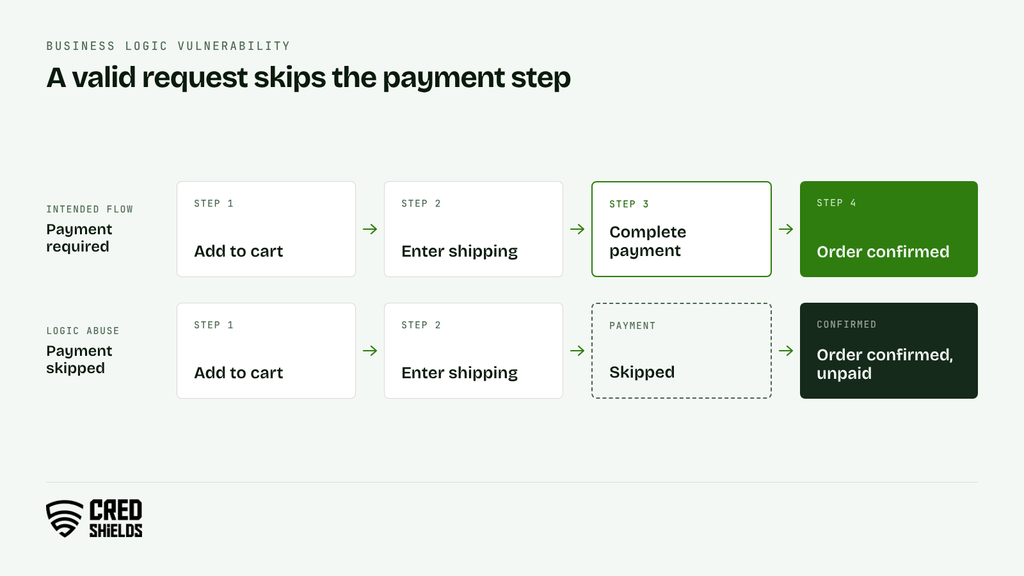
Multi-step processes assume steps happen in order. If a user can reach the confirmation step without completing payment, or resubmit an approval they already used, the sequence has a logic flaw. OWASP’s guidance frames this as circumvention of the intended workflow.
Quantity, Limit, and Price Manipulation
Applications enforce limits: one voucher per order, a maximum withdrawal, a fixed price. Logic flaws appear when a negative quantity credits an account, a race lets two requests both pass a single-use check, or a client-supplied price is trusted on checkout.
State and Integrity Manipulation
Some flaws let a user change state they should not control, such as editing an order total after approval, or flipping an account flag from pending to active. The request is valid; the state change should not have been permitted.
How AI Agents Test for Business Logic Vulnerabilities
For years, business logic testing was the clearest line between what a scanner could do and what required a human. Agentic pentesting narrows that line by giving agents the context and persistence that logic testing demands.
An agent that performs business logic testing does the following:
- Builds a model of the application’s workflows, roles, and intended rules by exploring it, much as a human tester would.
- Authenticates as a real user and holds session state across multi-step flows.
- Forms hypotheses about which rules could be bent, such as reordering steps, replaying tokens, or supplying out-of-range values.
- Attempts each one and checks what the application actually did, beyond the status code it returned.
- Repeats flows as a second user or role to test whether one account can reach another’s data or actions.
- Reports only what it reproduced, with the request sequence and the resulting impact.
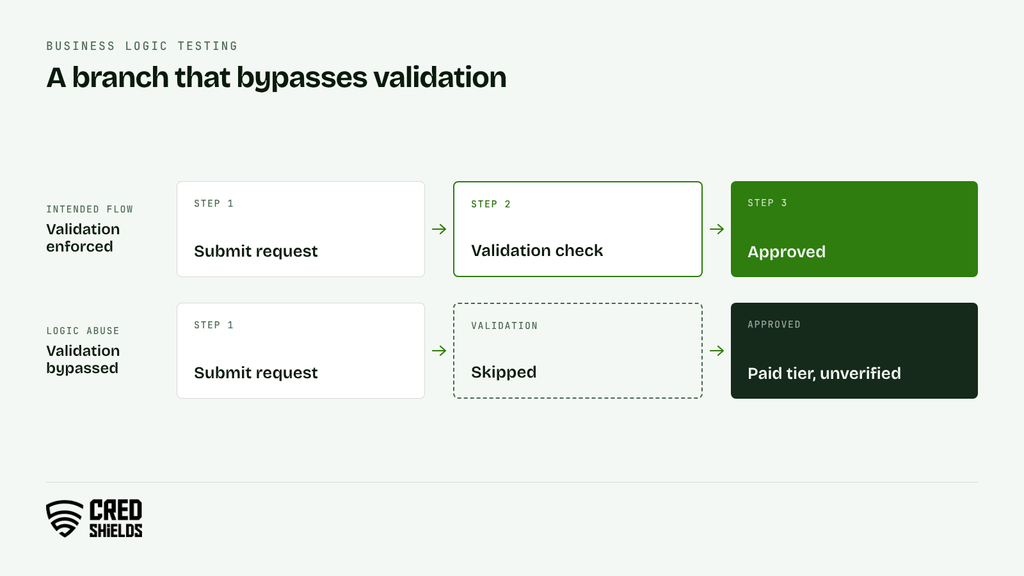
A membership workflow makes this concrete. An agent creates a test account, works through the subscription workflow, attempts to grant itself a paid tier without payment, and then confirms whether the application accepted the unauthorized change. If a second weakness lets it alter its approval status, the agent tests whether the two chain into a larger compromise. The result is a reproduced bypass with evidence, which engineering can act on without a separate investigation.
Recommended read: If you or your team are planning to compare automated and manual coverage of business logic vulnerabilities, this article on manual versus automated penetration testing is a great place to start.
Where Human Testers Still Lead
Agents extend testing for business logic vulnerabilities, and specialists stay part of the model. Deeply bespoke workflows, novel business models, and assessments that a regulator or customer requires to be independent still benefit from human-led engagements, and CredShields provides those through its penetration testing services. The practical model is agents running broad, frequent logic testing across every release, with specialists focused on the cases that most reward human judgment.
Recommended read: If you or your team are planning whether a red team or a penetration test fits your stage, this article on red teaming versus pentesting services is a great place to start.
Business Logic Vulnerabilities Checklist
Use this checklist to see whether your testing actually covers business logic vulnerabilities.
- Every object-returning endpoint is tested for access by a user who does not own the object.
- Multi-step workflows are tested with steps skipped, repeated, and reordered.
- Single-use actions, such as vouchers and approvals, are tested for replay and race conditions.
- Client-supplied values like price and quantity are tested with out-of-range and negative inputs.
- Role boundaries are tested by attempting each role’s actions as a lower-privileged user.
- Findings include the full request sequence and the business impact.
- Logic tests run on each significant release as well as at the annual checkpoint.
Recommended read: If you or your team are planning an API security assessment where object-level authorization matters most, this case study on a fintech startup’s API security overhaul is a great place to start.
Frequently Asked Questions (FAQs) About Business Logic Vulnerabilities in 2026
These answers cover the questions security teams ask most often about business logic vulnerabilities.
What is a business logic vulnerability?
A business logic vulnerability is a flaw in an application’s rules that lets a user achieve an unintended outcome using valid functionality, such as skipping payment, approving their own request, or reaching another user’s data.
Why do scanners miss business logic vulnerabilities?
Scanners detect abnormal input and known patterns. Business logic abuse uses valid input across valid steps, and the correct behavior is defined by the product’s design, which a scanner has no way to know.
Are business logic vulnerabilities in the OWASP Top 10?
They overlap most with insecure design and broken access control in the OWASP Top 10:2025, and OWASP’s Web Security Testing Guide devotes a full section to business logic testing.
Can AI agents find business logic vulnerabilities?
Yes, when agents can explore the application, authenticate, hold state across workflows, and compare what different roles can do. Those capabilities let agents reason about intended rules and test whether they hold.
How often should business logic testing run?
Logic testing should run on every significant release, because new workflows, roles, and integrations introduce new rules to break. Agentic pentesting makes that frequency practical.
Where to Start With Business Logic Testing
Business logic vulnerabilities live in the workflows only your team knows well. CredShields One tests those workflows as each of your user roles, attempts the misuse cases that matter to your business, and reports the business logic vulnerabilities it reproduced with the full request sequence attached, so engineering can fix them without a separate investigation.