

AI Platform or Outsourced Pentest Vendor? A Buyer’s Checklist
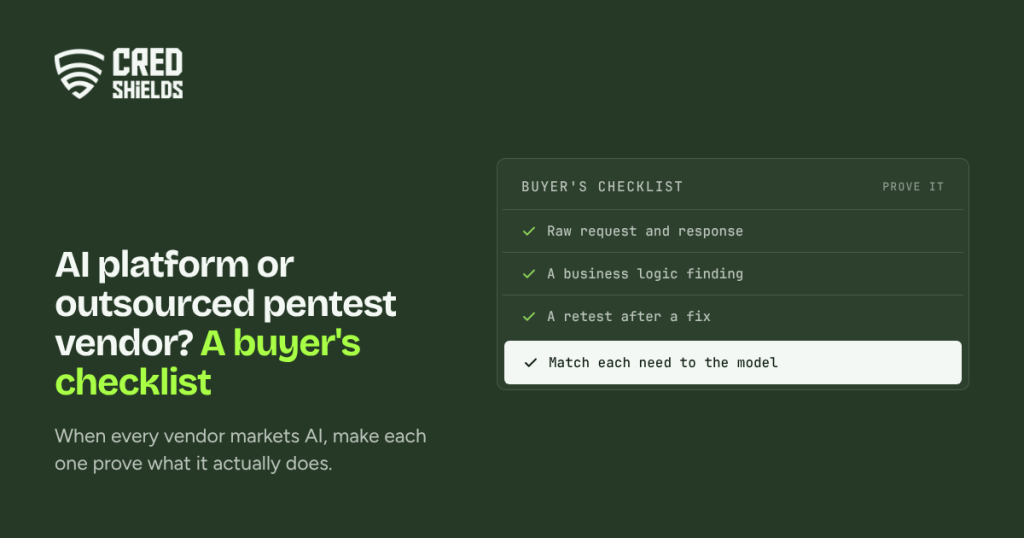
Choosing between an AI security platform and an outsourced pentesting vendor comes down to what you need tested, how often, and with what evidence. An AI security platform gives you on-demand, repeatable testing that scales with releases. An outsourced vendor gives you independent, human-led depth for bespoke or compliance-required work. The strongest programs use both, so the real task is matching each need to the right model.
Vendor claims now sound alike, with AI attached to almost every product, which makes a confident choice harder than it used to be. A scanner with an AI summary layer and a platform whose agents actually attack an application can describe themselves in nearly identical language. This checklist cuts through that overlap by asking each option to prove what it does. It is written for CISOs, AppSec leads, and procurement teams comparing an AI security platform against an outsourced pentesting vendor, or deciding how to combine them.
Table of Contents
What Each Model Is Built For
An AI security platform and an outsourced pentesting vendor solve different parts of the same problem, and understanding each one’s purpose is what prevents an expensive mismatch.
An AI security platform runs AI agents that test an application on demand: exploring it, attempting exploitation, testing logic, chaining weaknesses, and returning validated findings with evidence. Its strengths are frequency, repeatability, and coverage that scales with how often the application changes, which is what a fast-moving product needs most.
An outsourced pentesting vendor supplies human specialists for a scoped engagement. Its strengths are judgment on novel systems and unusual trust models, depth on bespoke architectures, and the independence that many compliance frameworks and enterprise customers require from a third party.
| Dimension | AI security platform | Outsourced pentesting vendor |
|---|---|---|
| Core strength | Frequent, repeatable, on-demand testing | Human judgment and independence |
| Coverage over time | Scales with every release | Point-in-time per engagement |
| Best for | Fast-changing products, continuous coverage | Novel systems, bespoke depth, independent assessments |
| Validation | Agents reproduce findings | Testers reproduce findings |
| Retesting | Built in and automatic | Scoped or scheduled |
| Independence for compliance | Varies by requirement | Strong, third-party |
Why Evaluation Has Become Harder
The difficulty is that almost every vendor now markets AI, and the labels blur real differences in what the products do. A scanner that adds an AI layer to summarize and rank its output is a better scanner, and it does different work from a platform whose agents log in and attempt exploits. Both may say they use AI to find vulnerabilities. For a buyer, the deciding question is whether the product proves exploitability or reports candidates for your team to confirm, and marketing language rarely makes that clear.
The stakes behind getting this right have risen. The Verizon 2026 DBIR found vulnerability exploitation behind 31% of breach initial access, the leading vector for the first time, and AI coding tools are increasing the volume of code to test, with Veracode’s October 2026 GenAI Code Security Report finding flaws in 38% of AI-generated code samples. A wrong choice leaves more code untested for longer, against attackers who exploit faster than patch cycles assume. A sound evaluation therefore rests on evidence the vendor demonstrates against your own application.
The Buyer’s Checklist
Use the criteria below to evaluate any AI security platform or outsourced vendor. Each one asks for proof, and each can be checked in a demo or a proof of concept.
Validation and Evidence
- Does every finding include the exact requests, responses, and resulting impact?
- Are unconfirmed candidates labeled separately from reproduced findings?
- Can the vendor show a business logic or authorization finding in the demo, alongside injection and misconfiguration?
- Does the vendor’s sample report demonstrate the evidence standard you would receive?
Depth of Testing
- Does testing authenticate and cover multiple roles and, for multi-tenant products, multiple tenants?
- Are business logic and workflow abuse tested alongside input handling?
- Are chained attack paths reported as single findings with combined impact?
- The OWASP Top 10:2025 keeps broken access control first, so confirm the model tests it directly.
Coverage and Cadence
- Can testing run on demand and on every significant release, or only on a fixed schedule?
- Is retesting of fixes built in, and is it automatic?
- Does coverage scale with how often the application changes, or is it a single point in time?
Independence and Compliance
- Does the engagement satisfy the specific independence your framework or customers require?
- Can the vendor provide the methodology and tester qualifications a standard demands?
- Note that some frameworks require independent human testing; confirm which of your obligations do before relying on either model alone.
Remediation and Fit
- Do findings include remediation guidance a non-specialist engineer can act on?
- Does the vendor support the application types you run, such as web, mobile, and API?
- Is scope control strong enough to keep testing within exactly what you authorize?
Recommended read: If you or your team are planning to evaluate AI-based testing providers specifically, this article on what to know before choosing an AI penetration testing vendor is a great place to start.
How to Run the Evaluation in a Demo
The checklist is most useful when you make the vendor demonstrate it against something real. Three asks separate a platform that attacks from a scanner that reports. First, ask to see the raw request and response behind a single finding, because a product that validates exploitation can show exactly what it sent and what came back, while a scanner can only show that a pattern matched. Second, ask to see a business logic or authorization finding specifically, since those are the classes pattern-based tools cannot confirm, and a vendor that cannot produce one is reporting what a scanner reports. Third, ask to see a retest result, where a fix was deployed and the same attack path rerun, because that proves the loop from finding to verified fix actually closes. A vendor that can show all three is doing the work; one that deflects to roadmap or marketing is not yet.
How to Decide, or Combine
The checklist usually points toward using both models, and the useful question is which need each model serves. The guide below maps common needs to the better fit.
| Your need | Better fit |
|---|---|
| Frequent coverage of a fast-changing product | AI security platform |
| Validated findings on every release, with retesting | AI security platform |
| Independent third-party test for compliance | Outsourced human-led vendor |
| Deep assessment of a novel or bespoke system | Outsourced human-led vendor |
| Broad, continuous coverage plus occasional specialist depth | Both, combined |
In practice, a strong program runs an AI security platform for continuous, release-linked coverage and brings in human-led testing for the independent or bespoke engagements that require it. CredShields provides the first through continuous AppSec, while its penetration testing services and red team engagements provide the second. The AppSec maturity model helps decide the balance for your stage, and the two layers reinforce each other.
Recommended read: If you or your team are planning how automated and manual testing should divide the work, this article on manual versus automated penetration testing is a great place to start.
How Cost Fits the Decision
Compare the two models on cost per unit of coverage over a year. An AI security platform prices ongoing coverage across releases, while an outsourced engagement prices a scoped event. For a fast-changing product, continuous coverage usually buys more of the year’s changes for a comparable commitment, whereas for a static application tested once for compliance, a single engagement may be the economical choice. The cost drivers that move either quote, scope, depth, complexity, specialist time, and frequency, are what to read before comparing totals, since a cheap quote is often cheap because it is shallow.
Recommended read: If you or your team are planning a SOC 2 audit that will scrutinize your testing choice, this article on SOC 2 penetration testing and what to expect before an audit is a great place to start.
Buyer’s Evaluation Checklist
Use this short checklist to run any AI security platform or outsourced vendor through the essentials.
- Findings show exact requests, responses, and impact, with candidates labeled separately.
- The demo includes a business logic or authorization finding as well as injection.
- Testing authenticates across roles and tenants and reports chained paths.
- Retesting of fixes is built in and demonstrated in the demo.
- The independence your compliance and customers require is confirmed.
- Coverage maps to how often your application changes.
- The vendor supports your application types and controls scope tightly.
Frequently Asked Questions (FAQs) About Choosing an AI Security Platform in 2026
These answers cover the questions buyers ask most often when comparing an AI security platform with an outsourced pentesting vendor.
What is an AI security platform?
An AI security platform uses AI agents to test an application on demand: exploring it, attempting exploitation, testing business logic, chaining weaknesses, and returning validated findings with evidence and remediation guidance, repeatably and on each release.
Is an AI security platform better than an outsourced pentesting vendor?
Neither is universally better; they serve different needs. A platform provides frequent, repeatable coverage that scales with releases, while an outsourced vendor provides independent human depth for bespoke or compliance work. Most strong programs use both for the needs each fits.
How do I evaluate an AI security platform?
Ask for demonstrated evidence: validated findings with exact requests and responses, a business logic or authorization finding, multi-role coverage, built-in retesting, and the independence your compliance requires. Treat marketing claims as unproven until demonstrated in a demo.
How can I tell an AI security platform from a scanner with an AI layer?
Ask to see the raw request and response behind a finding, a business logic or authorization finding, and a retest result. A platform that attacks can show all three; a scanner with an AI layer reports candidates for your team to confirm and cannot produce a validated business logic finding.
Can an AI security platform satisfy compliance requirements?
It depends on the requirement. Some frameworks accept thorough, documented platform-based testing with validated findings and retesting; others require an independent human-led assessment for certain controls. Confirm which of your obligations require independent third-party testing before relying on either model alone.
Should I combine an AI security platform with an outsourced vendor?
Often, yes. A platform gives continuous, release-linked coverage, and an outsourced vendor gives independent or bespoke depth. Combining them covers both frequency and the engagements that require human specialists, which is how most mature programs are structured.
What questions should I ask an AI pentesting vendor in a demo?
Ask to see a finding’s raw evidence, a business logic or authorization finding, a chained attack path reported as one finding, a retest of a fixed issue, and how scope is controlled. Ask how coverage maps to your release cadence and which compliance requirements the model satisfies.
Does an outsourced pentest give better coverage than an AI platform?
It gives deeper point-in-time coverage and independence, but only for the dates it runs. An AI platform gives broader coverage over time because it reruns on every release. For a fast-changing product, the platform covers more of the year; for a one-time independent assessment, the human engagement is the right tool.
How often should each model be used?
Run the AI security platform continuously, on each significant release and after each fix, so coverage tracks change. Bring in the outsourced vendor for the periodic independent or bespoke assessments your compliance and customers require, which is typically annually or at a specific milestone.
What is the biggest mistake buyers make choosing between them?
Choosing on the AI label without demonstrated evidence, and treating it as an either-or decision. The costly errors are buying a scanner that reports candidates while believing it validates exploits, and buying one model for a need the other fits better. The checklist and a hands-on demo prevent both.
Does an AI security platform replace my security team?
No. It carries the repeatable testing and validation, so the team reviews proven findings and spends its time on architecture, threat modeling, and the judgment work automation cannot do. The platform changes what the team spends its hours on.
Where to Start With Your AI Security Platform Evaluation
Choosing an AI security platform is easier when you can test it against your own application. CredShields One meets the three demo asks in this checklist: raw evidence behind every finding, business logic and authorization coverage across your real roles, and a recorded retest once a fix ships. For the work that calls for independent or bespoke assessment, CredShields’ penetration testing services cover human-led engagements, so you can match each need to the right model with one partner.