

Why Company Size Is the Wrong Metric for Assessing Application Risk
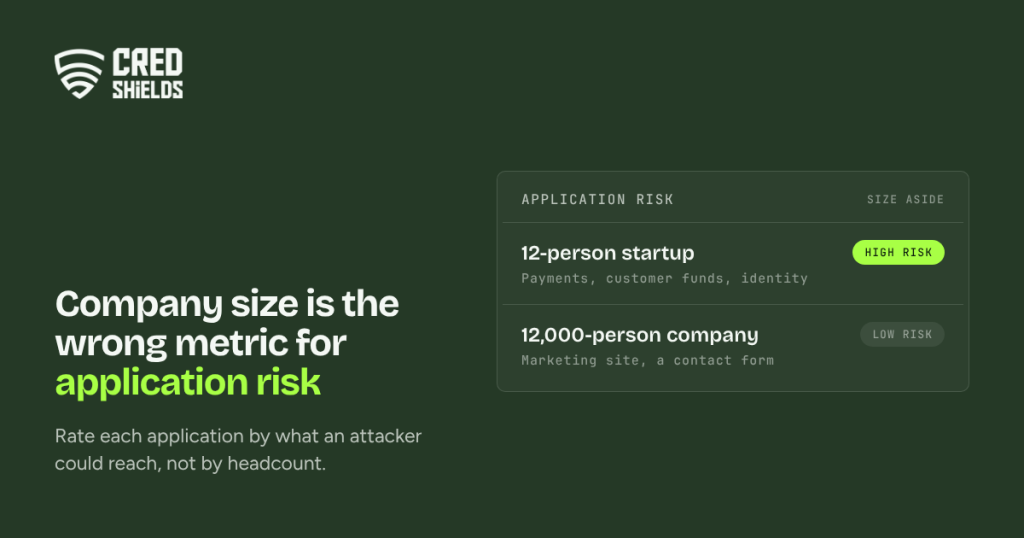
Company size measures how many people work somewhere. An application risk assessment has to measure what an attacker could do through the application: the data it holds, the money it moves, the privileges it grants, and the customers who depend on it. A 12-person payments startup can carry more application risk than a 12,000-person company’s marketing site, and AI has made small targets cheaper to attack. Rate each application by business impact, then set its testing cadence to match.
Size is often the first filter in security planning, budget requests, vendor reviews, and insurance applications. This guide is for CISOs, founders, CTOs, and risk leads who decide which applications get tested first and how often. It explains where size misleads, which factors drive application security risk, how to run an application risk assessment without headcount, and what PDPA, GDPR, PCI DSS, MAS, and DORA say about size. It ends with a checklist and an exercise you can run this week.
Table of Contents
What Is an Application Risk Assessment?
An application risk assessment estimates how likely an application is to be compromised and how much harm a compromise would cause, so a team can decide how much testing and control each application needs. It looks at the application itself: what it stores, what it can change, who can reach it, and who depends on it.
It works at a finer level than an organization-wide cyber risk assessment, which rates the business as a whole. A company can have a modest overall risk profile and still run one application, such as a payout service or an admin console, that carries most of its exposure. A sound application risk assessment weighs the six factors in the table, and each one is a property of the application and the business it supports.
| Factor | What It Measures | Question to Ask | Why Headcount Does Not Predict It |
|---|---|---|---|
| Data sensitivity and volume | Personal, financial, health, or credential data held or processed | What could an attacker read or export? | A 10-person health app can hold more sensitive records than a 1,000-person manufacturer’s website |
| Money movement | Payments, payouts, balances, refunds, and credit | What could an attacker move, issue, or redirect? | Payment logic carries the same consequences at any company size |
| Privilege and tenancy | Roles, admin functions, and boundaries between customers | Could one user act as another, or one tenant reach another? | One multi-tenant platform can expose every customer at once |
| Exposure | Internet-facing endpoints, APIs, and integrations | What can an unauthenticated or low-privilege user reach? | Exposure follows architecture choices made in a product’s first months |
| Dependents | Customers, partners, and systems that trust the application | Who else is harmed if this application is compromised? | A small vendor can hold access to much larger customers |
| Obligations | Regulatory, contractual, and audit requirements | What must we report, notify, or prove after an incident? | Data protection laws apply to small organizations too |
What Company Size Actually Tells You About Application Risk
Headcount is a fair proxy for some things. It hints at the size of the security budget and at how many people are available to respond to an incident. Neither number describes what a single application exposes, and that exposure is what an attacker is after.
So a size-based rating can mean any of four different things.
- The company is large, and its applications hold large volumes of sensitive data.
- The company is large, and the application in question is a marketing site with no customer data.
- The company is small, and its application holds no sensitive data or funds.
- The company is small, and its application moves customer money or holds regulated data.
A size-based model rates the second reading as high risk and the fourth as low, which puts them in the wrong order. The fourth reading describes almost every early-stage fintech, health technology, insurtech, or payments company. A better starting question for any application risk assessment is the one size cannot answer: what happens to the business if someone successfully exploits this application?
Why Smaller Companies No Longer Fall Below the Attacker’s Threshold
For years, smaller companies benefited from attacker economics. Researching a target, mapping its application, finding a flaw, and writing an exploit all took time, so attackers spent that time where the payoff was largest. A small or obscure application could go unnoticed without being secure.
That constraint is weakening. In a report published in November 2025, Anthropic described a state-sponsored campaign against roughly 30 organizations in which an AI coding tool carried out an estimated 80 to 90 percent of the tactical work, from reconnaissance to data extraction. Verizon’s 2026 data for small and medium-sized businesses found that in the median case, threat actors researched or used generative AI to help with 15 distinct attack techniques.
Illustrative attacker threshold: the same 8 applications under manual and AI-assisted attack costs.
In the illustration, each dot is an application and its height is what a successful attack would be worth. When each attempt costs less, the threshold falls, and applications that sat below it become worth an attacker’s time.
Breach data shows where the pressure lands. In the 2025 Verizon DBIR, ransomware was present in 88% of breaches at small and medium-sized businesses, compared with 39% at large organizations. Verizon’s 2026 Breach Impact Study found that in the most severe 2.5% of cases, losses from a breach exceeded 7% of an SMB’s revenue.
So, do hackers target small businesses? They target whatever is reachable and worth the effort, and the effort keeps falling. For small business cybersecurity, that moves the planning question from whether anyone will look to what they would find, which is the question an application risk assessment answers.
Recommended read: If you or your team are planning to secure a protocol’s web front end, this article on the Aerodrome and Velodrome front-end breach is a great place to start.
Which Factors Actually Drive Application Risk?
Application risk comes from what an exploit could reach. The drivers below sit inside the application and the business it serves, and an application risk assessment scores each one separately before combining them.
Drivers of application risk: six factors set by what an exploit could reach.
Headcount appears nowhere in that picture. It affects how quickly a company can find and fix a weakness, which is a separate question from how much damage the weakness could do.
The comparison below rates two illustrative applications on the same drivers. One belongs to a 12-person payments startup, and the other is the marketing site of a 12,000-person manufacturer.
| Driver | Payments Startup (12 People) | Manufacturer Marketing Site (12,000 People) |
|---|---|---|
| Data held | Customer identity documents and bank account details | Contact form submissions |
| Money movement | Initiates payouts and refunds | None |
| Privilege and tenancy | Merchant admins, support staff, and a tenant per merchant | One content editor role |
| Exposure | Public API called by merchants’ own systems | Public pages and one form |
| Dependents | Every merchant and their customers | Prospective buyers |
| Obligations | Data protection law, payment licensing, enterprise contracts | Data protection law for form data |
| Application risk | High | Low |
Both applications are illustrative. The startup’s application carries far more risk, and its headcount gives it far less capacity to find problems first, which is the combination a size-based model misses.
Recommended read: If you or your team are planning an API security review for a fintech product, this case study on taking a fintech startup’s APIs from vulnerable to SOC 2 ready is a great place to start.
Small Vendors Can Become Entry Points to Large Customers
Size also misleads when one company’s application holds access to another’s. In the 2013 Target breach, attackers first entered Target’s network with credentials stolen from Fazio Mechanical Services, a refrigeration and HVAC contractor, and went on to steal data from 40 million payment cards. In February 2025, attackers compromised a developer machine at Safe{Wallet} and used that foothold to steal $1.5 billion from Bybit, which relied on Safe’s multisig wallet.
Third-party risk now features in nearly half of breaches. Verizon’s 2026 data found third-party involvement in 48% of breaches, up 60% from the previous year. A vendor’s application risk assessment should therefore reflect the access it holds and the customers it serves, which together set the blast radius of its application.
Recommended read: If you or your team are planning to check what a compromised dependency could reach, this article on the Shai Hulud npm supply chain attack is a great place to start.
How Can Teams Run an Application Risk Assessment Without Using Headcount?
The method scales from a single application to a portfolio of hundreds. These 7 steps replace headcount with evidence about what each application does, and they produce an application risk assessment you can defend to a board, an auditor, or a customer.
1. List the applications and what each one is for. Include internal tools, admin consoles, partner portals, and APIs, each with a named owner. A crown jewel analysis starts here: mark the applications whose compromise would stop the business or trigger a regulatory notification.
2. Classify the data each application touches. Reuse the data classification your privacy program already maintains, and record volume as well as type, since 10 records and 10 million records carry different consequences.
3. Map where money and privilege move. Note every function that pays out, refunds, issues credit, changes balances, grants roles, or crosses a tenant boundary. These functions deserve testing before anything else.
4. Record exposure and dependents. List what an unauthenticated user can reach, which partners integrate through APIs, which internal systems trust the application, and which customers would be affected if it failed or leaked data.
5. Score business impact before likelihood. A business impact analysis asks what a successful exploit would cost in money, data, regulatory exposure, and customer trust. Score impact first, since likelihood shifts quickly as attacker costs fall.
6. Validate the riskiest assumptions with testing. A score stays a hypothesis until someone attempts the exploit. Test the highest-impact functions first, authenticated and across roles, and record which weaknesses were reproduced and which held.
7. Re-rate after significant change. New payment flows, integrations, data types, and customer segments all change the rating. Review the register each quarter and after every release that touches a step 3 function.
Keep the results in one register, so the application risk assessment for each system stays current as the product changes.
What Regulators Say About Size and Security Obligations
Where regulators mention size, they mostly use it to scale penalties, paperwork, or the depth of assurance. The duty to protect data and systems follows the activity, as the table shows.
| Framework | Who It Covers | Where Size Appears | What Sets the Obligation |
|---|---|---|---|
| Singapore PDPA | All private organizations handling personal data in Singapore | Maximum penalty of 10% of Singapore turnover above S$10 million, otherwise S$1 million | The personal data held and the security arrangements protecting it |
| GDPR | Controllers and processors handling EU residents’ personal data | Article 30(5) exempts organizations under 250 people from record-keeping, unless processing is likely to create risk, is not occasional, or involves special category data | Risk to individuals; the exemption falls away for regular or risky processing |
| PCI DSS | Every merchant that accepts payment cards | Merchant levels set by annual transaction volume, which decide how compliance is validated | Card data handled; Visa can place any merchant at Level 1 to reduce risk to its system |
| MAS TRM Guidelines | All financial institutions regulated by MAS | Applied in light of each institution’s scale, nature, and complexity | Criticality of each system and the risk it is exposed to |
| DORA (EU) | EU financial entities | Microenterprises and entities on the simplified framework sit outside threat-led testing | Impact, financial stability concerns, ICT risk profile, and maturity decide which entities face advanced testing |
Across all five, size changes how compliance is demonstrated or how large a fine can be. What has to be protected, and how well, follows the data, the money, and the function. The PDPC has gone further, noting that handling large volumes of personal data can be an aggravating factor when it sets a penalty, which ties the consequence to the data held.
Singapore applies the same logic to critical systems. Whether a system falls under the expanded Cybersecurity Act depends on the essential service it supports, and an application risk assessment is a practical way to find the candidates early.
Recommended read: If you or your team are planning for designation under Singapore’s expanded cybersecurity law, this article on navigating the expanded scope of Singapore’s Cybersecurity (Amendment) Act is a great place to start.
How to Set Testing Cadence by Application Risk
Once each application has an impact rating from its application risk assessment, that rating sets its testing cadence. This is risk-based penetration testing, and it applies the same way to a 12-person startup and a 12,000-person enterprise. The tiers below are a suggested starting point, to be adjusted to the minimums your frameworks set.
| Risk Tier | Typical Applications | Suggested Testing Cadence | What Testing Must Cover |
|---|---|---|---|
| Tier 1, critical | Payments, payouts, customer funds, identity, admin consoles, multi-tenant platforms | Each significant release, plus an independent test at least once a year | Business logic, access control across roles and tenants, chained weaknesses |
| Tier 2, high | Customer portals with personal data, partner APIs, internal tools with production access | Each major release, and at least twice a year | Authentication, authorization, data exposure, integration abuse |
| Tier 3, moderate | Applications with limited personal data and no money movement | At least once a year and after significant change | Authentication, authorization, input handling |
| Tier 4, low | Static marketing sites with no user data | Scheduled scanning, plus a test after major redesigns | Configuration, exposed services, third-party scripts |
The hardest tier for a small team is Tier 1 at release speed, because a five-person engineering team rarely includes an offensive security specialist. Agentic pentesting narrows that gap. It lets a team run penetration tests against its own applications and receive validated findings with evidence and remediation guidance, without first building an offensive security team. For an enterprise, the same capability adds testing capacity across hundreds of applications without hiring specialists at the pace engineering grows.
Enterprise customers ask the same questions of their vendors. A security questionnaire wants to know what data you hold, who can reach it, how you test it, and how you respond to incidents, and our guide to SOC 2 penetration testing covers how auditors and buyers read that evidence. Your application risk assessment gives the answers a structure.
Application Risk Assessment Readiness Checklist
Use this list before your next planning cycle, vendor review, or audit. Each item can be checked by someone on your team this week, and any unchecked item shows where a size-based assumption is still standing in for an application risk assessment.
- Every application, API, and admin console is listed with a named owner and a stated purpose.
- Each application records the types and volumes of data it handles.
- Functions that move money, grant privilege, or cross tenant boundaries are listed for each application.
- Vendors and integrations with access to your systems are listed with the access they hold.
- Each application has an impact rating built from data, money, privilege, exposure, dependents, and obligations.
- Tier 1 applications are tested at each significant release, authenticated and across roles.
- Every reproduced finding has evidence, an owner, and a retest result on file.
- Ratings are reviewed each quarter and after changes to data, payments, or integrations.
- Your notification duties under PDPA, GDPR, or sector rules are mapped to the applications they apply to.
Frequently Asked Questions (FAQs) About Application Risk Assessment in 2026
These answers are written to stand alone, so each one can be shared or quoted without the rest of the article.
What is an application risk assessment?
An application risk assessment estimates how likely an application is to be compromised and how much harm a compromise would cause. It weighs the data the application holds, the money it moves, the privileges it grants, its exposure, and the customers and partners who depend on it, then uses the result to set controls and testing.
Why is company size a poor measure of application risk?
Size describes the organization, and risk depends on what a single application can expose. A small payments startup can hold customer funds and identity data, while a large company’s marketing site may hold nothing an attacker can use.
Are small companies really targeted by attackers?
Yes. In the 2025 Verizon DBIR, ransomware was present in 88% of breaches at small and medium-sized businesses, compared with 39% at large organizations. AI tools are also lowering the cost of reconnaissance and exploitation, which widens the set of targets worth attacking.
What factors should an application risk assessment include?
Data sensitivity and volume, money movement, privilege and tenancy, internet exposure, dependent customers and partners, and regulatory or contractual obligations. Score business impact first, then validate the highest-impact functions with testing.
How is an application risk assessment different from a cyber risk assessment?
A cyber risk assessment rates the organization’s overall exposure across people, processes, technology, and suppliers. An application risk assessment rates individual applications, so a team can decide which ones need testing first and how often.
Do data protection laws apply to small companies?
Generally, yes. Singapore’s PDPA applies to private organizations handling personal data in Singapore, with a maximum penalty of S$1 million where Singapore turnover is S$10 million or less. GDPR’s record-keeping exemption for organizations under 250 people falls away when processing is regular, risky, or involves special category data.
How often should a high-risk application be penetration tested?
Test it after each significant release, with an independent assessment at least once a year, which matches the floor PCI DSS sets for in-scope systems. Applications that move money or hold regulated data justify the shorter cadence at any company size.
Can a small team test high-risk applications without hiring penetration testers?
Yes. Agentic pentesting platforms let a small engineering team run penetration tests against its own applications and receive validated findings with evidence and remediation guidance. The team still owns scoping, test credentials, and fixes.
How much does an application risk assessment cost?
It is scoped per engagement. The main cost drivers are the number of applications, the number of user roles and tenants, the complexity of payment and business workflows, the testing cadence each tier needs, and any compliance reporting format required.
Start With One Application
Pick the application your business could least afford to lose, usually the one that holds customer funds, identity data, or admin access. List every function in it that moves money or grants privilege. Next to each function, write what the business would lose if an attacker exploited it tomorrow, in money, data, notifications, and customer trust. Test the costliest function first as 2 users in different roles, and use what you find to set the application’s tier.
An application risk assessment is most useful when the testing that follows it matches each tier. CredShields One lets you test your highest-impact applications in-house, on demand, starting with the ones your assessment ranked first. Every finding is reproduced with evidence and every fix is retested once it ships, so your team can show which risks are closed.