

How Much Should You Actually Pay for a Penetration Test?
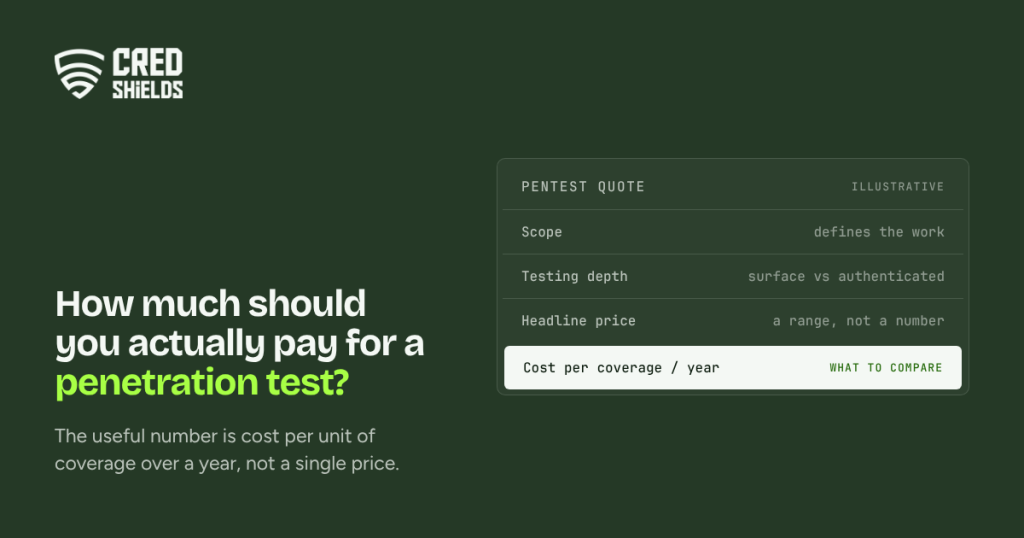
Penetration testing cost is set by scope, testing depth, and delivery model. A traditional engagement is scoped per application, with fees driven by the size of the target, the depth of testing, and the specialist time involved, then repeated months later. A continuous agentic model prices coverage across the release cycle. The most useful comparison is cost per unit of coverage over a year, because coverage is what you are actually buying.
Buyers often ask for a single number and get a range instead, and the range is the honest answer. This guide explains what actually drives penetration testing cost, why a single price tells you little, how traditional and continuous models differ in what they charge for and what they deliver, and how to compare quotes fairly. It is written for founders, security leads, and buyers planning a testing budget who want to spend it where it buys the most real coverage. Every CredShields engagement is scoped per engagement, so this guide covers the drivers behind a quote and leaves figures out.
Table of Contents
What Penetration Testing Cost Depends On
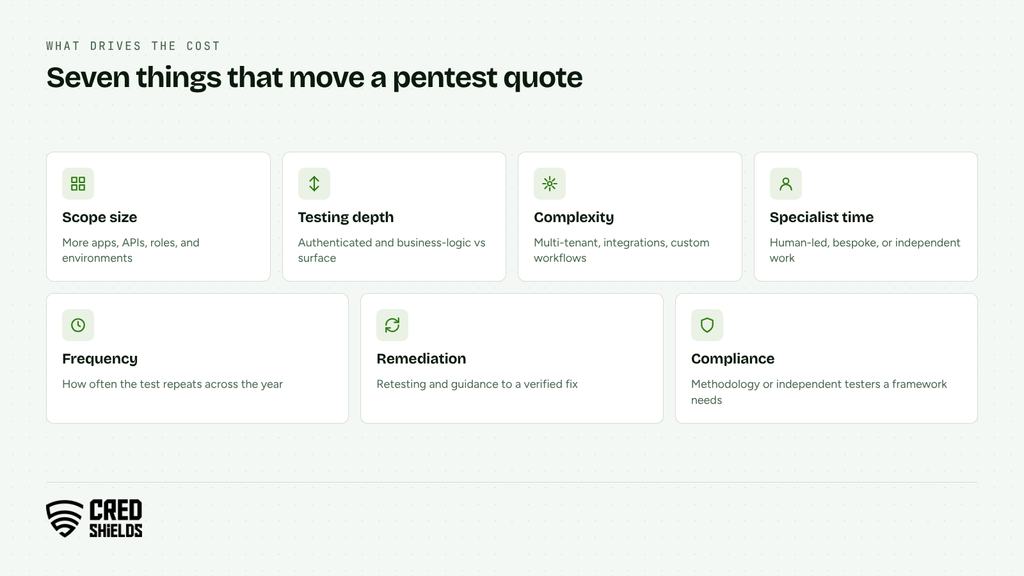
Penetration testing cost reflects the work involved, and the work varies widely between engagements because no two applications present the same amount of it. There is no universal price for the same reason there is no universal price for building a house: the answer depends entirely on what is being built. The cost drivers below are what move a quote up or down.
| Cost driver | What increases the cost |
|---|---|
| Scope size | More applications, APIs, user roles, and environments to test |
| Testing depth | Authenticated testing, business logic, and chaining versus surface checks |
| Application complexity | Multi-tenant architecture, many integrations, and custom workflows |
| Specialist time | Human-led, bespoke, or independently required assessments |
| Frequency | How often the test must be repeated across the year |
| Remediation support | Retesting and guidance through to a verified fix |
| Compliance requirements | Specific methodologies or independent testers a framework demands |
Two quotes can differ several-fold on scope and depth alone. A surface check of one brochure website and an authenticated, business-logic test of a multi-tenant payments platform are different kinds of work, and the penetration testing cost reflects that difference. Knowing which drivers apply to your application lets you read a quote line by line and see what its total actually covers.
Why Scope and Depth Move the Price Most
Of all the drivers, scope and depth move the number most, and they are also the two a buyer can shape. Scope is how much is tested: more applications, APIs, roles, and environments mean more work. Depth is how hard each thing is tested: an unauthenticated surface scan is a fraction of the effort of an authenticated test that logs in as every role, walks the business workflows, and chains weaknesses. A quote that looks cheap is often cheap because it is shallow, testing only what an anonymous visitor can see and missing the authorization and logic flaws that cause the worst breaches. Reading a quote starts with knowing which depth it covers.
Why Penetration Testing Cost Is Best Measured Across a Year
Asking about penetration testing cost without a scope is like asking what a vehicle costs: the answer depends on whether you need a bicycle or a truck. A more useful question is cost per unit of coverage over the period you actually care about, which for most teams is a year.
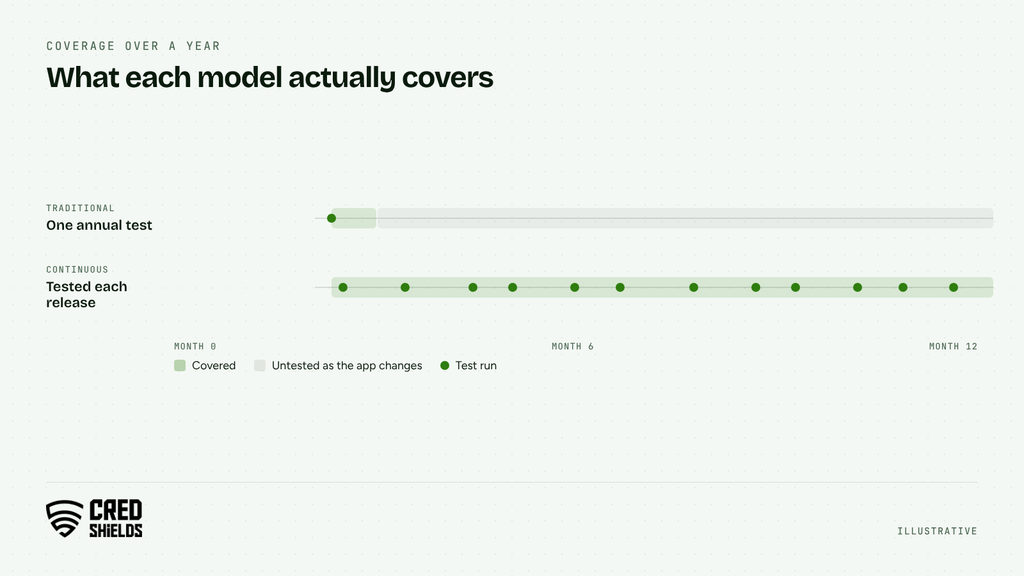
Applications rarely hold still. The Stack Overflow 2025 Developer Survey found 84% of developers using or planning to use AI tools, with 51% of professionals using them daily, which raises how often an application changes and therefore how often it needs testing to stay covered. A single annual price buys one snapshot of a target that may look very different three months later, so the application spends most of the year holding changes the test never saw. Penetration testing cost is best judged against the coverage it buys across the whole year.
Traditional Penetration Testing Costs
Traditional penetration testing is priced per engagement. A firm scopes the target, assigns testers, runs the assessment over days or weeks, and delivers a report. The model has real strengths and a clear cost shape.
The strengths are depth and independence. Human specialists bring judgment to novel systems and unusual trust models, and an independent third-party report satisfies many compliance and enterprise-customer requirements that a platform alone may not. The cost shape follows from relying on scarce human time: the engagement is a discrete, scoped event, usually repeated on a yearly cycle, and retesting of fixes is sometimes billed separately or deferred to the next engagement.
The limitation is coverage over time. A report reflects the application on the testing dates, and the application keeps changing after the testers leave. For a product that ships weekly, a yearly test leaves most of the year’s changes untested, which raises the effective penetration testing cost per unit of coverage even when the invoice itself looks fixed and predictable. An annual test is strong on depth for one moment and silent on everything that ships after it.
Recommended read: If you or your team are planning a compliance-driven test and want to know what to expect, this article on SOC 2 penetration testing and what to expect before an audit is a great place to start.
Continuous Agentic Pentesting Costs
Continuous agentic pentesting prices ongoing coverage. AI agents test the application on demand and on each significant release, returning validated findings and retesting fixes. Both the cost model and what it buys differ from the traditional one.
Because the agents carry the repeatable testing and the validation that would otherwise consume specialist hours per engagement, continuous coverage does not scale with human time the way per-engagement work does. That changes the shape of the cost: a team pays for ongoing coverage that tracks the release cycle. This model runs against the scope and credentials a team provides, and continuous AppSec ties it to the pipeline so testing follows releases.
The practical effect shows up in cost per unit of coverage. Testing on every significant release, with automatic retesting of fixes, covers far more of the year’s changes than a single annual test for a comparable commitment, which is the reason to price coverage across the year. The same leverage that lets a small team get this coverage affordably lets enterprises raise coverage without raising headcount, because the repeatable load moves off people in both cases.
Comparing Penetration Testing Cost Models on Coverage
The fair comparison sets what each model covers across a year side by side. The table compares the models, and actual pricing is scoped per engagement.
| Dimension | Traditional per-engagement | Continuous agentic |
|---|---|---|
| Pricing basis | Per scoped engagement | Ongoing coverage across the release cycle |
| Coverage over a year | The application on the test dates | Each significant release, continuously |
| Retesting | Often billed separately or deferred | Built in, automatic after each fix |
| Finding validation | Done by testers | Done by the agents, reported as validated |
| Best fit | Independent, bespoke, or compliance-required assessments | Fast-changing products needing frequent coverage |
| Effect on cost per coverage | Higher when the product changes often | Lower when the product changes often |
Many programs use both, and the choice is rarely all-or-nothing: continuous agentic testing for frequent coverage, and human-led engagements for the independent or bespoke assessments that require them. CredShields’ guide to vulnerability scanning versus penetration testing and the AppSec maturity model help place each one in a program and decide the balance.
Recommended read: If you or your team are planning how automated and manual testing should divide the budget, this article on manual versus automated penetration testing is a great place to start.
How to Avoid Overpaying or Underbuying
Two mistakes cost the most. Overpaying happens when a buyer commissions a deep, independent human engagement for a routine, fast-changing application that would be better covered continuously, so most of the spend buys depth at one moment and nothing for the rest of the year. Underbuying happens when a buyer takes the cheapest quote without checking its depth, and pays for a surface scan that never touches the authorization and business logic flaws where real breaches start. Both are avoided the same way: by matching the testing model to how the application changes and what a breach would cost, and by reading every quote for its depth and its coverage over time.
Penetration Testing Cost Checklist
Use this checklist to compare quotes on the coverage each one buys.
- The scope is written down: applications, APIs, roles, and environments included and excluded.
- Testing depth is specified, including authenticated testing and business logic.
- Retesting of fixes is included or priced explicitly in the quote.
- The comparison is cost per unit of coverage over a year.
- How often the application changes is factored into how often it needs testing.
- Compliance or independence requirements that only human-led testing satisfies are identified.
- Validated findings with reproduction evidence are part of what the penetration testing cost covers.
Recommended read: If you or your team are planning to decide between a pentest and a broader risk assessment first, this article on penetration testing versus security risk assessment is a great place to start.
Frequently Asked Questions (FAQs) About Penetration Testing Cost in 2026
These answers cover the questions buyers ask most often about penetration testing cost.
How much does a penetration test cost?
There is no single price. Penetration testing cost depends on scope size, testing depth, application complexity, specialist time, frequency, and compliance requirements. The useful figure is cost per unit of coverage over a year, and most providers scope per engagement rather than publishing a list price.
What drives penetration testing cost?
The main drivers are the number of applications, APIs, and roles in scope, how deep the testing goes, how complex the application is, how much specialist human time is required, how often the test is repeated, and any compliance methodology a framework demands. Scope and depth move the number most.
Why can’t a provider just give me a price upfront?
Because no two applications present the same amount of work, and a responsible provider scopes the target before quoting. A surface check of one website and an authenticated test of a multi-tenant platform are very different engagements, so a price given before scoping would be a guess.
Is continuous pentesting cheaper than an annual test?
It depends on how often the application changes. For a fast-moving product, continuous agentic testing covers far more of the year’s changes for a comparable commitment, which lowers cost per unit of coverage even if the headline number looks different. For a static application tested once for compliance, a single engagement may be enough.
Should I use continuous or traditional penetration testing?
Many programs use both. Continuous agentic testing suits fast-changing products that need frequent coverage, while human-led engagements suit independent, bespoke, or compliance-required assessments. The two complement each other, so the question is usually the balance between them.
Why is one pentest quote so much cheaper than another?
Usually because of depth and scope. A cheap quote often covers an unauthenticated surface scan of a small scope, while a higher quote covers authenticated testing across roles and tenants with business logic and chaining. Comparing the two on price alone compares different kinds of work.
Does a penetration test include retesting the fixes?
It depends on the provider and model. Traditional engagements sometimes bill retesting separately or defer it to the next engagement, while continuous agentic testing typically includes automatic retesting after each fix. Since compliance often requires verifying corrections, confirm how retesting is priced.
How often do I need a penetration test?
At minimum, many frameworks require testing at least once every 12 months and after any significant change. For a product that changes often, testing should follow the release cadence, which is what makes continuous coverage cost-effective for fast-moving applications.
Does company size determine how much I should spend on pentesting?
No. Spend should follow what a breach would cost the business and how often the application changes. A small company with a payments application can carry more risk, and need more testing, than a large company whose main site only publishes brochures.
What should I look for in a pentest quote beyond the price?
A written scope with inclusions and exclusions, the testing depth including authenticated and business-logic testing, whether retesting is included, whether findings are validated with reproduction evidence, and how coverage maps to how often your application changes. Those determine what the penetration testing cost actually buys.
Is agentic pentesting cheaper because it uses less human time?
It changes the shape of the cost. Because agents carry the repeatable testing and validation, the cost scales with coverage across releases, which lowers cost per unit of coverage for products that change often.
Where to Start With Penetration Testing Cost
A penetration testing cost you can plan against starts with a scope that matches your real application. CredShields scopes each engagement to your application, names the cost drivers that apply to your application and why, and shows the coverage a continuous model and a traditional engagement each buy across a year, so you can compare them on cost per unit of coverage. CredShields One covers continuous, on-demand agentic pentesting with retesting built in, and CredShields’ penetration testing services cover specialist and independent engagements.