

Are You Really Too Small to Be a Target? Rethinking Application Security Risk
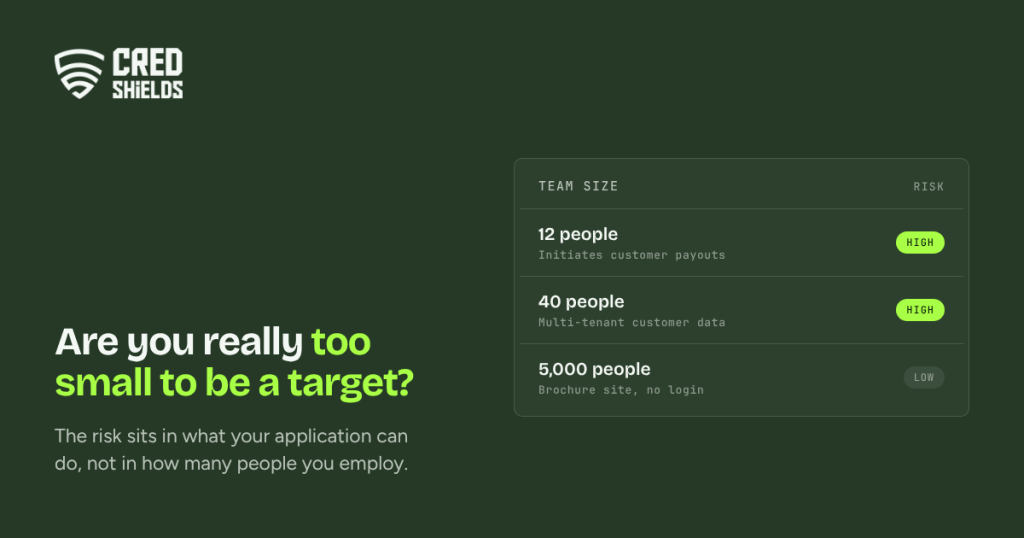
Application security risk is set by what an attacker could achieve through your application, measured in business impact. A 15-person payments startup can carry more application security risk than a 5,000-person manufacturer whose website only publishes brochures. Headcount and funding stage describe the company. The risk sits in the money the application moves, the data it holds, the workflows it exposes, and who can reach them.
Security programs have long scaled testing to company size: a yearly pentest for the enterprise and a scanner for everyone else. That habit made sense when attacker time was scarce and small targets were rarely worth the effort. This guide is for founders, CTOs, CISOs, and AppSec leads who want to size testing effort to the application security risk they actually carry.
Table of Contents
What Application Security Risk Measures
Application security risk is the likelihood that a weakness in an application will be exploited, combined with the business impact if it is. Both halves can be estimated, and neither depends on how many people the company employs.
Likelihood starts with whether weaknesses exist, and the evidence says they almost always do. In the OWASP Top 10:2025, broken access control holds the first position, and every application tested showed some form of it. A two-person team and a two-thousand-person team write the same kinds of authorization checks, with the same kinds of gaps.
Impact is where companies differ, and it is the half that company size describes worst. An application security risk review should ask what an attacker could do once a weakness is found: transfer funds, read another customer’s records, approve their own loan, or take over an administrator account.
Why Company Size Became the Default Proxy
Company size became shorthand for application security risk because it was easy to measure and loosely correlated with the things that mattered. Larger firms held more records, attracted regulators, and could afford specialist testing. Several forces kept the proxy in place.
- Budgets scale with revenue, so testing scope followed the budget line.
- Compliance frameworks and enterprise procurement questionnaires tended to reach larger companies first.
- Pentesting vendors packaged services by tier, which nudged buyers to think in company bands.
- Attackers once had limited hours and spent them on the largest, most visible targets.
The last of these assumptions has changed fastest, and it undermines the other three.
Where the Size Proxy Breaks Down
The size proxy understates application security risk at small companies with high-value workflows and overstates it at large companies with low-impact applications. The illustrative profiles below show how far headcount and exposure can drift apart.
| Organization (illustrative) | Headcount | What its main application can do | Application security risk |
|---|---|---|---|
| Payments startup | 12 | Initiates customer payouts through a public API | High |
| B2B SaaS vendor | 40 | Stores enterprise clients’ customer data across tenants | High |
| Healthtech provider | 800 | Serves patient records and prescriptions | High |
| Industrial manufacturer | 5,000 | Publishes product brochures with no login | Low |
Four shifts explain why the gap keeps widening.
Attackers No Longer Ration Their Time
Vulnerability exploitation has become the leading way breaches begin. The Verizon 2026 Data Breach Investigations Report found exploitation of vulnerabilities behind 31% of initial access, ahead of credential abuse and phishing for the first time. Automated reconnaissance and AI-assisted exploit development let an attacker test thousands of applications for the same flaw in the time it once took to study one.
Small business cybersecurity planning should therefore assume that any reachable weakness will be found. The economics behind this shift are covered in our article on why small targets are no longer safe from AI cyberattacks.
Small Teams Now Build Large-Company Software
AI coding tools let a team of five ship payment flows, partner APIs, and multi-tenant dashboards that once needed a team of fifty. The Stack Overflow 2025 Developer Survey reports that 84% of developers use or plan to use AI tools, with 51% of professional developers using them daily. The application security risk of that software follows its features, whatever the size of the team that wrote it.
Consequences Do Not Scale Down With Headcount
A breach that drains customer wallets or exposes medical records costs the same trust whether the company has 20 employees or 20,000. Smaller companies usually have less runway to absorb incident response, legal costs, and lost contracts, so the same incident can be existential for one company and survivable for another.
Recommended read: If you or your team are planning a review of where patient data can leave your systems, this article on what ASEAN health data breaches teach about EHR and healthcare data security is a great place to start.
Customers and Regulators Apply the Same Standard
Enterprise buyers send the same security questionnaire to a 30-person vendor as to a 3,000-person one, and insurers ask for the same attestations. A small company selling into banks or hospitals inherits their expectations on day one, which raises its application security risk through contractual exposure as well as technical exposure.
Recommended read: If you or your team are planning a cyber insurance renewal, this article on the attestations underwriters now expect for 2026 and 2027 policies is a great place to start.
Six Factors That Set Application Security Risk
A useful application risk assessment scores each application on the factors an attacker would care about. These six factors predict application security risk far better than employee count, and each can be scored in an afternoon.
| Factor | What to ask | Higher-risk signal |
|---|---|---|
| Value reachable | Can the application move money, issue credits, or trigger payouts? | Withdrawals, refunds, rewards, or transfers |
| Data sensitivity | What is the most sensitive record a user can reach? | Payment data, health records, identity documents, credentials |
| Privilege model | How many roles, tenants, and permission layers exist? | Multi-tenant SaaS, delegated admin, partner access |
| Exposure | What can be reached from the internet, and with which credentials? | Public APIs, self-service sign-up, mobile backends |
| Rate of change | How often do workflows, APIs, and authentication flows change? | Weekly releases, AI-assisted development, new integrations |
| Downstream trust | Who depends on this application being secure? | Enterprise customers, regulators, payment partners |
Scored together, these factors usually reshape a portfolio. A company may find that its newest partner API carries more application security risk than the flagship dashboard leadership watches most closely.
How to Run an Application Risk Assessment Based on Business Impact
An impact-led application risk assessment turns those factors into a testing plan. The sequence below works for a seed-stage startup with three applications and for an enterprise with three hundred.
- Inventory every application and API, including internal tools exposed through SSO and partner endpoints that rarely appear in architecture diagrams.
- Write the worst credible outcome for each one in business terms, such as any user reading any invoice, or a free account unlocking paid features.
- Score each application on the six factors and group them into tiers.
- Set testing depth and frequency per tier, with authenticated testing of business workflows for the top tier.
- Require proof of exploitation for findings, so remediation effort goes to weaknesses that are reproduced and reachable.
- Retest after every fix and every significant release, and rescore when features change.
The tiers can then map to testing approaches like these.
| Tier | Typical signals | Suggested testing approach |
|---|---|---|
| Tier 1 | Moves funds, holds regulated data, or serves many tenants | Continuous authenticated penetration testing of workflows, retest on every fix, and specialist manual review where a regulator or customer requires it |
| Tier 2 | Authenticated application with personal data | Penetration test before each significant release, with validated findings and quarterly reassessment |
| Tier 3 | Low-impact or static content | Scanning for known issues and a periodic penetration test |
If the line between those testing types is unclear, CredShields’ comparison of vulnerability scanning and penetration testing sets out what each one proves. The AppSec maturity model helps place each tier against where your program stands today.
What Changes When Testing Follows Business Impact
For a small company with a Tier 1 application, the change is access. Offensive security expertise that once required a specialist firm can now run as an internal capability. Agentic pentesting uses AI agents to explore the application, attempt exploitation, test business logic, and return validated findings with reproduction evidence. That capability can run whenever engineering ships, which suits teams with high application security risk and no dedicated pentester.
For an enterprise, the change is allocation. Testing capacity moves toward the applications with the highest application security risk, so the security team spends its hours on weaknesses that agents have already reproduced. Continuous AppSec programs build on that model by tying penetration testing to the release cycle.
Recommended read: If you or your team are planning which testing method fits each tier, this article on manual versus automated penetration testing is a great place to start.
Application Security Risk Checklist
Use this checklist to test whether your current program measures application security risk by business impact.
- Every internet-facing application and API is listed with a named owner.
- Each application has a written worst credible outcome in business terms.
- Applications are tiered by impact, exposure, and rate of change.
- Tier 1 applications receive authenticated testing of business workflows.
- Findings carry proof of exploitation before they reach engineering.
- Every fix is retested, and every significant release triggers a new test.
- Tiers are reviewed whenever a feature adds payments, new roles, or new data types.
Frequently Asked Questions (FAQs) About Application Security Risk in 2026
These answers cover the questions founders and security leaders ask most often about measuring application security risk.
What is application security risk?
Application security risk is the likelihood that a weakness in an application is exploited, combined with the business impact of that exploitation. It depends on what the application can do and who can reach it. Company size has little bearing on either.
Do attackers target small companies?
Yes. Automated scanning and AI-assisted exploitation let attackers test large numbers of applications at low cost, so any reachable weakness can be found. The Verizon 2026 DBIR found vulnerability exploitation behind 31% of breach initial access.
How do you assess application security risk without a security team?
List your applications, write the worst outcome for each in business terms, and score them on value reachable, data sensitivity, privilege model, exposure, rate of change, and downstream trust. Test the highest-scoring applications first.
Does a small company need penetration testing?
A small company needs penetration testing when its application moves money, holds sensitive data, or serves enterprise customers. Agentic pentesting makes authenticated testing available without hiring a specialist.
How is an application risk assessment different from a penetration test?
An application risk assessment estimates where impact and exposure are highest. A penetration test proves which weaknesses an attacker can actually exploit. The assessment decides where to test, and the pentest supplies the evidence.
Where to Start With Application Security Risk
Application security risk is easiest to manage once each application has a tier and a testing depth to match. CredShields One gives your highest-impact applications on-demand agentic pentesting at that depth: it tests them as authenticated users, reports only the findings it reproduced, and retests each fix once it ships, so the applications that move money or hold sensitive data get coverage on every release. CredShields’ penetration testing services cover engagements that call for specialist or independent testing.