

What Happens When Attacking Your Company Costs Almost Nothing?
AI cyberattacks are removing the economic cover small targets once had. Attacks used to cost hours of skilled reconnaissance and exploit work, so attackers focused on the most valuable or visible companies. AI agents now automate much of that work, which makes lower-value targets worth attempting. A smaller company with a reachable, exploitable weakness should plan on someone finding it.
Security at many smaller organizations has quietly relied on being overlooked. That assumption rested on attacker economics, and those economics have shifted within a few years. This article explains the cost model behind AI cyberattacks and the steps founders and security leaders can take in response.
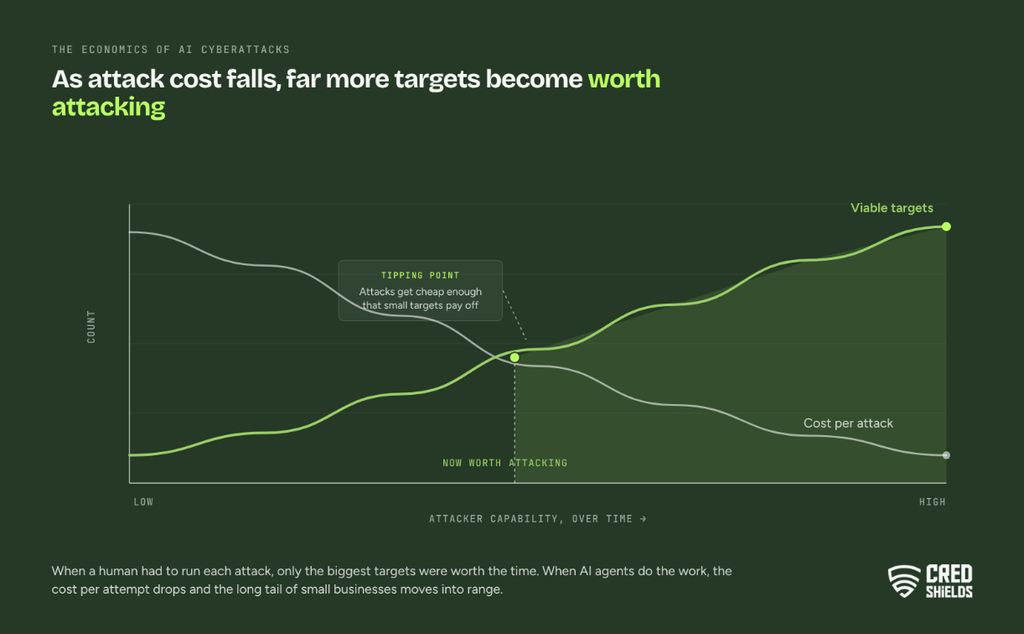
Table of Contents
What Adversarial AI Means
Adversarial AI, in this article, means attackers using AI models and agents to plan and carry out attacks. The same term is also used for attacks against AI systems themselves, such as prompt injection or model poisoning, which are a separate topic.
AI cyberattacks range from AI-written phishing to fully agentic intrusions in which software performs reconnaissance, finds vulnerabilities, writes exploits, and moves through a network with light human direction. The economic effect is common to all of them: each attempt costs the attacker less.
The Old Economics of Attacking Applications
An attacker weighs the expected payoff of a target against the cost of reaching it. For most of the last two decades, the largest cost was skilled human time, and that cost shaped who got attacked.
| Attack stage | Cost when done by skilled humans | Cost with AI agents doing the work |
|---|---|---|
| Target discovery | Manual research and selective scanning | Parallel discovery across very large target lists |
| Reconnaissance and mapping | Hours per application to understand routes, roles, and data | Automated mapping of APIs, client code, and schemas |
| Vulnerability discovery | Expert review of each application | Repeated automated probing and code reading |
| Exploit development | Days for novel exploits | Drafted from advisories and patch diffs, then iterated |
| Failed attempts | Expensive, so attackers abandon marginal targets | Cheap, so attackers keep trying |
| Post-access analysis | Analysts sift stolen data by hand | Models parse and prioritize data at scale |
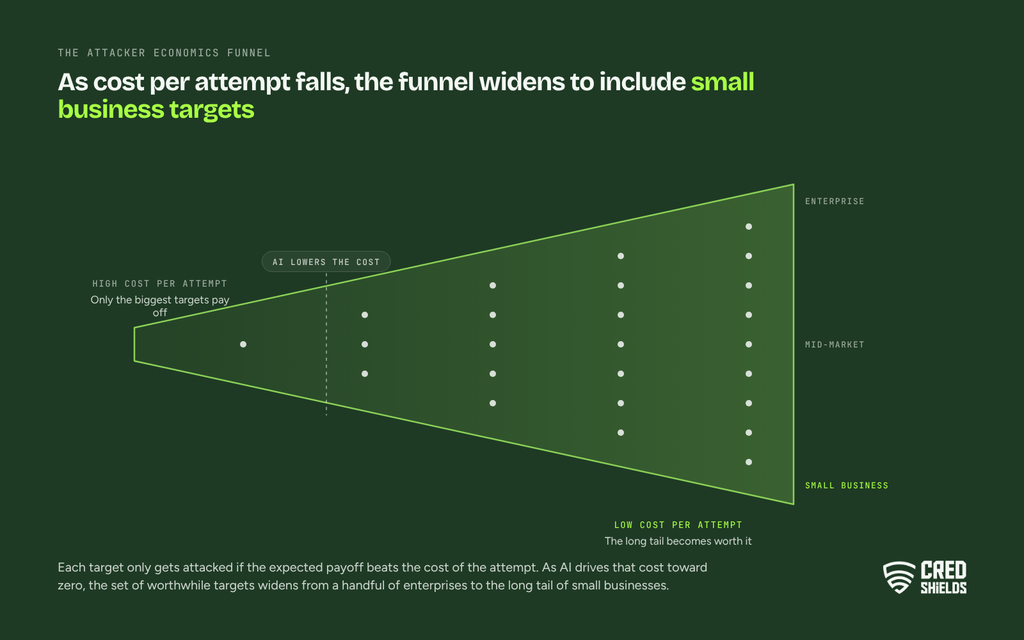
When every row was expensive, a smaller company could go unnoticed because more attractive targets competed for limited attacker attention. Its protection was low priority on someone else’s list.
How AI Cyberattacks Change the Cost Curve
Public evidence now shows AI agents carrying most of the operational load in real attacks, and exploitation arriving faster than patch cycles. Three sources illustrate the shift.
Anthropic’s November 2025 disclosure described a state-sponsored group that turned Claude Code into an attack framework that ran with little human direction. The AI performed roughly 80 to 90% of tactical work across about 30 targets, including reconnaissance, vulnerability discovery, and exploitation, at request rates no human team could sustain.
Exploitation timelines have collapsed in parallel. Google’s Mandiant reported in M-Trends 2026 that average time to exploit fell from 63 days in 2018 to an estimated negative 7 days in 2025, which means exploitation now often begins before a patch is available. The same report found that access handoffs between initial access brokers and follow-on operators had shrunk to seconds.
The Verizon 2026 DBIR recorded vulnerability exploitation as the most common initial access vector for the first time in the report’s history, and its research with Anthropic is the first DBIR attempt to measure AI’s role in real breaches. Taken together, these findings describe AI cyberattacks that cost less per attempt and land sooner after each disclosure.
Recommended read: If you or your team are planning how to respond when a widely used platform is mass-exploited, this article on the wp2shell WordPress core RCE and the new timeline for enterprise defense is a great place to start.
Why AI Cyberattacks Strip Small Targets of Their Cover
Falling attack costs change who is worth attacking. The effects below explain why AI cyberattacks reach companies that previously sat below the line.
The Long Tail Becomes Reachable
When each attempt costs little, the threshold for a worthwhile target drops. Applications that once offered too little payoff for the hours involved now clear the bar, because the hours are no longer human.
Exploitation Runs Breadth-First
Attackers test one flaw across thousands of applications at once. A framework vulnerability or a common authorization mistake gets checked everywhere it might exist, and size plays no part in whether an application is included.
Smaller Payoffs Still Pay
A modest fintech wallet balance, a database of customer records for resale, or a foothold that can be sold to another group all produce a return. With automation, many small returns can outweigh one large one.
Small Vendors Open Doors to Large Customers
A 30-person SaaS provider with enterprise clients can be the shortest route into those clients. AI cyberattacks that compromise a supplier’s application inherit the supplier’s integrations and trust.
Recommended read: If you or your team are planning to measure how many exposed systems still carry a patched flaw, this article on why over 21,000 Exchange servers remained exposed to CVE-2026-62911 is a great place to start.
What Defenders Can Do With the Same Economics
The same shift that cheapens attacks also cheapens testing. Defenders who adopt it can close much of the gap that AI cyberattacks open.
- Test the way an attacker now works. Run authenticated, exploit-validating tests against the workflows that move money or expose data, since those are the paths attackers will automate first.
- Shorten exposure windows. With time to exploit below zero on average, the useful metric is how quickly a fix is deployed and verified. Retesting every fix closes the loop.
- Prioritize by proven reachability. A finding that an agent has reproduced deserves attention before ten theoretical ones.
- Treat every release as new attack surface. New roles, endpoints, and integrations are where AI cyberattacks find fresh weaknesses.
Agentic pentesting applies attacker-style automation on the defender’s side. AI agents explore the application as authenticated users, attempt exploitation, and return validated findings on demand. Teams that want this tied to every release can build it into continuous AppSec, and teams handling payments can start with CredShields’ fintech security guidance.
Recommended read: If you or your team are planning a cyber insurance renewal and expect questions about testing, this article on the attestations underwriters now expect is a great place to start.
Small Target Readiness Checklist for AI Cyberattacks
Use this checklist to test whether your organization is prepared for AI cyberattacks from an attacker who no longer needs a reason to choose you.
- Every internet-facing application, API, and admin panel is inventoried with a named owner.
- Workflows that move money, change permissions, or expose personal data have been tested with authentication.
- Critical patches have a deployment target measured in days, with verification after deployment.
- Every security fix is retested before the ticket closes.
- Findings are ranked by proven exploitability, with reproduction evidence.
- An incident response plan exists and names who acts in the first hour.
- Enterprise customers’ security questionnaires can be answered with current test evidence.
Recommended read: If you or your team are planning to answer enterprise security questionnaires with audit evidence, this article on SOC 2 penetration testing and what to expect before an audit is a great place to start.
Frequently Asked Questions (FAQs) About AI Cyberattacks in 2026
These answers cover what founders and security leaders ask most often about AI cyberattacks and smaller targets.
What are AI cyberattacks?
AI cyberattacks are attacks in which adversaries use AI models or agents to perform parts of the attack, such as reconnaissance, vulnerability discovery, exploit development, phishing, or analysis of stolen data.
Are small businesses targeted by AI cyberattacks?
Yes. AI lowers the cost of each attack attempt, so attackers can test many smaller applications for the same weaknesses. Any reachable, exploitable flaw can be found regardless of company size.
How fast do attackers exploit new vulnerabilities?
Mandiant’s M-Trends 2026 estimated the average time to exploit at negative 7 days in 2025, meaning exploitation often starts before a patch is released. In 2018 the average was 63 days.
Can AI help defenders as much as attackers?
AI gives defenders the same cost advantage when they use it to test. Agentic pentesting lets AI agents attack an application on the defender’s behalf and report validated findings before attackers find them.
What should a small company do first to prepare for AI cyberattacks?
Inventory internet-facing applications, identify workflows that move money or expose data, and run authenticated, exploit-validating tests against them. Then retest every fix and repeat testing after significant releases.
Where to Start Against AI Cyberattacks
AI cyberattacks reward whoever finds a reachable weakness first. CredShields One gives your team that head start: it tests your applications as authenticated users, reproduces each exploitable finding with evidence, and retests the fix once it ships, on whatever schedule your releases follow. A sample pentest report shows the evidence each finding carries, and CredShields’ penetration testing services cover engagements that call for specialist or independent testing.