

SAST and DAST Both Passed. Why Is Your App Still Exploitable?
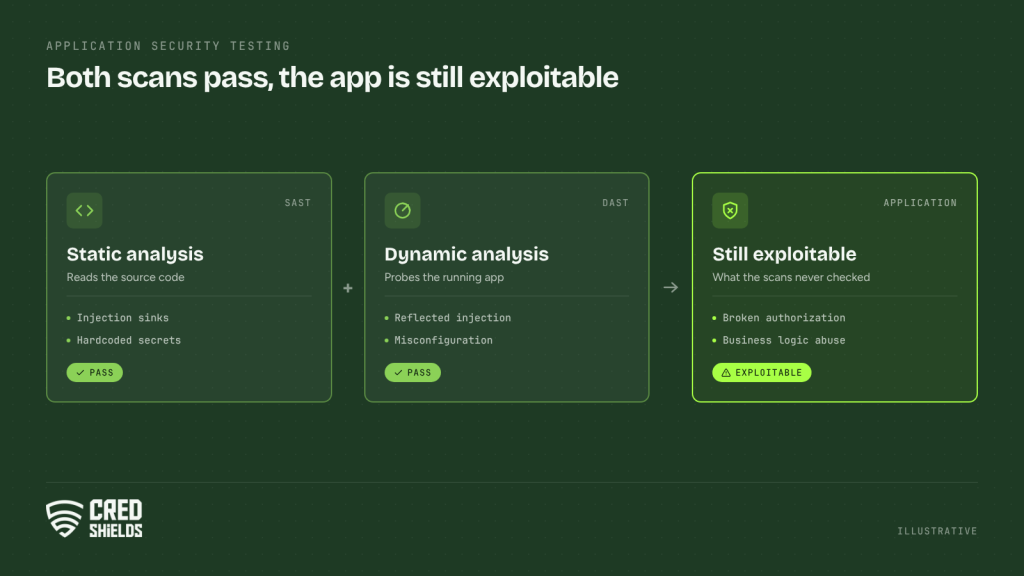
SAST and DAST are necessary layers of application security, and neither is sufficient on its own. Static analysis (SAST) reads source code for insecure patterns. Dynamic analysis (DAST) probes a running application for known vulnerability signatures. Both catch real issues cheaply and continuously. Both miss the flaws that depend on context: authorization gaps, business logic abuse, and chained weaknesses that only appear when someone attacks the application as a real user. Closing that gap takes validated, exploit-based testing layered on top of them.
Many teams treat a clean SAST and DAST run as proof of security, then get breached through a flaw that used only valid requests. Both tools worked as designed, and the flaw sat outside what they were designed to check. This guide explains what each tool actually proves, exactly where both fall short and why, and how to cover the rest. It is written for AppSec engineers, DevSecOps teams, and security leaders designing a testing stack that holds up against how applications are really attacked.
Table of Contents
What SAST and DAST Each Do
SAST and DAST are the two workhorses of automated application security testing, and they look at the application from opposite ends. Understanding what each one examines is the key to seeing where both stop.
SAST: Reading the Code
SAST, static application security testing, analyzes source code or compiled binaries without running the application. It traces how data flows through the code and flags insecure patterns: a user input that reaches a database query without sanitization, a hardcoded secret, an unsafe function, a dangerous deserialization. Because it reads code, it runs early and fits naturally into the pipeline on every commit, catching issues before they ever deploy. Its weakness is that it reasons about code in the abstract, so it produces false positives on paths that cannot actually be reached and cannot confirm whether a flagged pattern is exploitable in the running system.
DAST: Probing the Running Application
DAST, dynamic application security testing, tests a running application from the outside by sending crafted inputs and observing responses. It finds issues that appear at runtime, such as reflected injection and some misconfigurations, without needing the source code. Its weakness is that it works by signature and response pattern, so it sees what looks abnormal and reports candidates for a person to confirm.
Two related layers often sit alongside them. Software composition analysis (SCA) checks third-party dependencies against databases of known vulnerable versions, and interactive testing (IAST) instruments a running application to watch code execution during tests. Both add value, and both share the core limitation below: they reason about known patterns and have no model of what the application is supposed to allow.
| Dimension | SAST | DAST |
|---|---|---|
| What it examines | Source code or binaries | A running application |
| When it runs | Early, on every commit | Later, against a deployed build |
| Strong at | Insecure code patterns, secrets, injection sinks | Runtime injection, some misconfigurations |
| Needs source code | Yes | No |
| Typical output | Flagged code paths, some unreachable | Candidate issues to confirm |
| Confirms exploitability | No | Rarely |
Both belong in a mature program. CredShields offers source code review and SAST and runs these checks inside DevSecOps integration. The useful question is what they structurally cannot cover.
Where Both SAST and DAST Fall Short
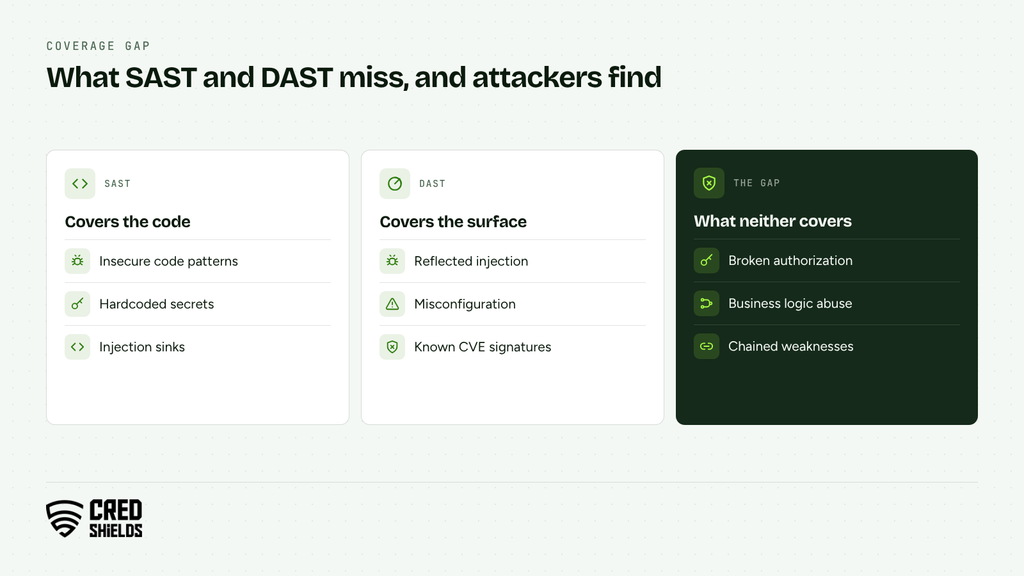
SAST and DAST share one blind spot, and it is a deep one: both reason about patterns and have no view of intent. Neither has any model of what the application is supposed to permit, which is exactly the knowledge needed to catch the flaws that cause the worst breaches. Four classes of weakness sit outside what either can confirm.
Authorization and Access Control
Whether a user is allowed to read invoice 1002 depends on who owns it, which is a fact about the application’s data and permission rules. SAST sees a database query that looks fine. DAST sees a well-formed request that returns a 200 response. Neither knows the current user should not own that record. The OWASP Top 10:2025 keeps broken access control in first place, present in every application tested, which is precisely the class that pattern-based tools confirm least well. An authorization bypass that changes a record identifier is identical in form to a legitimate request, so there is nothing abnormal for a scanner to flag.
Business Logic
Applying a discount twice, skipping a payment step, or replaying a single-use approval uses valid input in an invalid sequence. The OWASP Web Security Testing Guide states that automated tools cannot detect whether a user circumvented a process flow, and that business logic abuse remains a manual art that depends on understanding the full process. SAST and DAST have no model of what a workflow is for, so they cannot tell when a workflow is made to do something it should refuse.
Chained Weaknesses
SAST and DAST report findings one at a time. An attacker combines a leaked identifier with a missing ownership check to take over an account, or a self-service role field with a trusting approval step to escalate privilege. Neither tool reasons across findings to see that two low-severity issues form one critical path, so the most dangerous result, the chain, is the one most likely to be missed.
Unconfirmed Exploitability
DAST output is often a list of potential issues that a security team must reproduce and confirm, and SAST output includes paths that cannot actually be reached. The tools report what might be exploitable, and proving what is exploitable is left to people. A full scan with a long findings list can therefore coexist with an application that is both over-reported and genuinely exploitable, which is why a clean or even a comprehensive scan leaves exploitability unproven.
A Worked Example: Passing the Scans, Failing the Test
Consider an illustrative e-commerce application with a membership upgrade flow. SAST reads the codebase and reports no injection sinks and no hardcoded secrets on the upgrade path, so it passes. DAST probes the running endpoints, finds no reflected injection and no obvious misconfiguration, and passes too. By both measures the feature is clean.
An agent testing as a real user takes a different route. It creates an account, works through the upgrade flow, and sends the account-update request with the paid-tier field set, without completing payment. The server writes the field, and the account now holds paid access it never paid for. Nothing in that sequence is malformed, no signature matched, and no code pattern looked unsafe, which is exactly why SAST and DAST reported nothing. The flaw lived in what the application allowed, and only testing the workflow as a user with validation of the result could surface it.
What the Data Says About the Gap
The gap shows up in breach data, and the trend lines make it more urgent. Breaches increasingly start with exactly the weaknesses that pattern-based tools confirm least well.
The Verizon 2026 DBIR found vulnerability exploitation behind 31% of breach initial access, overtaking credential abuse and phishing for the first time. At the same time, AI coding tools are increasing the volume of code that needs testing: Veracode’s October 2026 GenAI Code Security Report found security flaws in 38% of AI-generated code samples, and that study measured classic weakness types such as injection and cross-site scripting. The same assistants also write the ownership checks and role logic that SAST and DAST confirm least well. As code volume grows and exploitation speeds up, the space that SAST and DAST leave uncovered grows with them.
Recommended read: If you or your team are planning to keep testing in step with AI-assisted development, this article on manual versus automated penetration testing is a great place to start.
What a Complete Application Security Stack Looks Like
SAST and DAST form the base of a stack. A complete program adds exploit-validated testing that reasons about context, and keeps the whole stack on the release cadence so coverage tracks change.
| Layer | What it proves | What it leaves to the next layer |
|---|---|---|
| SAST and dependency scanning (SCA) | Insecure code patterns and vulnerable packages | Whether those patterns are exploitable at runtime |
| DAST | Runtime injection and some misconfigurations | Authorization, logic, and chained weaknesses |
| Agentic pentesting | Exploitable authorization, business logic, and chained flaws, reproduced against the running application | Deeply bespoke cases that reward specialist human judgment |
| Human-led pentesting | Novel, complex, or independently required assessments | Scale and frequency, which the layers above provide |
Agentic pentesting is the layer that covers the SAST and DAST gap at scale. AI agents log in as real users, test authorization and business logic, chain weaknesses, and report only what they reproduce, with the request sequence and the impact. These tests run against the scope and credentials you provide, and continuous AppSec keeps them tied to each release so the coverage stays current. For engagements that require independent human testers, CredShields’ penetration testing services complete the stack.
Recommended read: If you or your team are planning to place your program against a maturity benchmark, the AppSec maturity model and this article on SOC 2 penetration testing are a great place to start.
Application Security Coverage Checklist
Use this checklist to see whether your stack covers the SAST and DAST gap.
- SAST and dependency scanning run on every merge, with named owners for findings.
- DAST runs against a deployed build to catch runtime issues.
- Authenticated testing compares what different roles and tenants can reach.
- Business logic and workflow abuse are tested alongside input handling.
- Chained attack paths are reported as single findings with combined impact.
- Findings carry proof of exploitation before they reach engineering.
- Testing runs on every significant release as well as at the annual checkpoint.
Frequently Asked Questions (FAQs) About SAST and DAST in 2026
These answers cover the questions security teams ask most often about SAST, DAST, and their limits.
What is the difference between SAST and DAST?
SAST analyzes source code without running the application and finds insecure patterns early in development. DAST tests a running application from the outside and finds runtime issues. SAST needs source code and runs on every commit; DAST does not need source and runs against a deployed build.
Are SAST and DAST enough for application security?
No. They catch known patterns well but miss authorization gaps, business logic abuse, and chained weaknesses, which depend on context and require testing the application as a real user. A clean SAST and DAST run confirms that known patterns are absent.
Why do SAST and DAST miss business logic flaws?
Business logic abuse uses valid input in an invalid sequence, and the correct behavior is defined by the product’s design. Neither tool has a model of what a workflow is meant to prevent, so neither can tell when a workflow is made to do something it should refuse.
Why do SAST and DAST miss authorization flaws?
An authorization bypass uses a well-formed request that is identical to a legitimate one. Confirming it requires knowing which user should own which object, which is a fact about the application’s permission model, so neither tool can confirm it.
What is the difference between SAST and SCA?
SAST analyzes your own source code for insecure patterns. Software composition analysis (SCA) checks the third-party dependencies you include against databases of known vulnerable versions. Both belong in the pipeline, and both reason about known issues, with no view of what your application is supposed to allow.
Do I still need SAST and DAST if I use agentic pentesting?
Yes. SAST and DAST provide cheap, continuous coverage of code patterns and runtime issues on every commit and build. Agentic pentesting adds proven authorization, business logic, and chained findings on top. The layers complement each other.
What covers the gap SAST and DAST leave?
Exploit-validated testing that reasons about context. Agentic pentesting logs in as real users, tests authorization and logic, chains weaknesses, and reports reproduced findings, with human-led testing reserved for independently required or highly bespoke work.
Can SAST and DAST be automated in a CI/CD pipeline?
Yes, and they should be. SAST runs on every merge and DAST against each deployed build, both as automated gates. Agentic pentesting then runs on each significant release to add the exploit validation and context those gates cannot provide.
Why does a clean scan not mean a secure application?
Because scans confirm the absence of known patterns and leave exploitability unproven. The most common serious weaknesses, broken access control and business logic abuse, produce no abnormal pattern, so an application can pass every scan and still be one valid request away from a breach.
How do false positives differ between SAST, DAST, and agentic pentesting?
SAST can flag code paths that cannot be reached, and DAST can report candidates that are not exploitable, so both require human triage. Agentic pentesting validates each finding by reproducing the exploit before reporting, so its output describes demonstrated issues.
Where does IAST fit alongside SAST and DAST?
Interactive application security testing instruments a running application to watch code execution during tests, which can reduce false positives on the issues it covers. It still reasons about known vulnerability classes with no model of intended behavior, so it shares the authorization and business logic gap that agentic pentesting fills.
Where to Start Beyond SAST and DAST
SAST and DAST give you the pattern layer, and CredShields One adds the layer they leave open. It tests your application as each role you provide, attempts the authorization, business logic, and chained attacks that pass every scan, and reports only the findings it reproduced, each with the request sequence that proves it and the fix that closes it. Your team sees the real gap between a clean scan and a secure application, measured against your own code. CredShields also provides source code review and SAST for the base of the stack.