

Your Engineers Doubled Their Output. Your AppSec Team Didn’t. Now What?
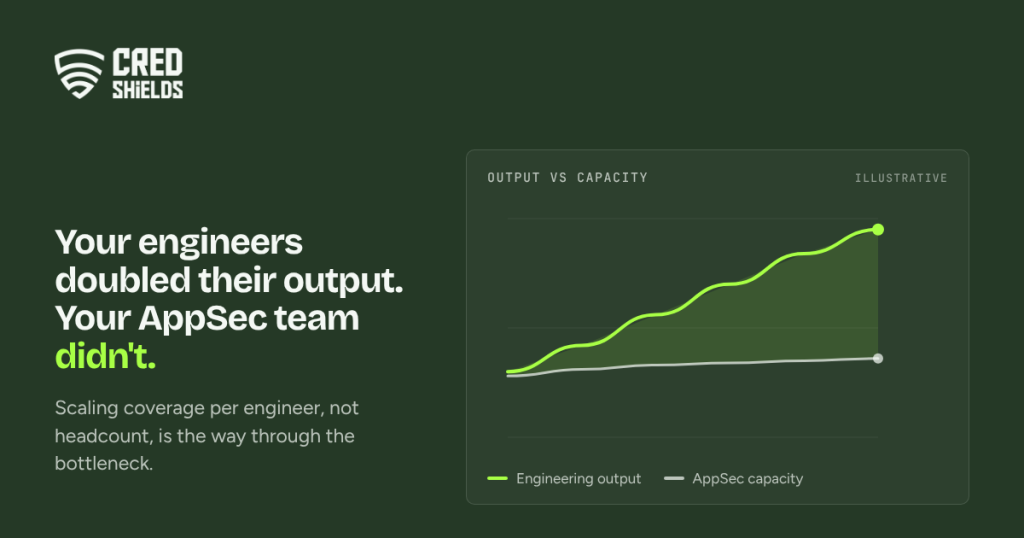
Scaling AppSec without scaling headcount means giving a fixed security team more coverage per person. Engineering throughput has jumped with AI coding tools, while security hiring has not, which opens a widening bottleneck between what engineering ships and what security can test. The way through is leverage: automated pipeline gates, agentic pentesting that returns validated findings, and continuous retesting, so the team reviews proven issues instead of running every test by hand.
Enterprise security teams rarely lack expertise. They lack capacity, and no realistic hiring plan closes a gap that grew through tooling. This guide is written for CISOs and heads of AppSec whose engineering organizations are accelerating faster than their security headcount. It sets out exactly where the bottleneck forms, why hiring cannot close it, and how to relieve it by moving the repeatable work off the team.
Table of Contents
What the Security Bottleneck Is
The security bottleneck is the gap between the rate at which engineering ships code and the rate at which security can test it. When engineering accelerates and security headcount holds steady, more code reaches production per security engineer, and some of it reaches production untested. The bottleneck is a structural mismatch between two functions that now scale by different means.
The problem is capacity. A mature enterprise may already run SAST, DAST, vulnerability management, and external pentests, and still fall behind, because each new application, API, and release adds testing work that a fixed team absorbs on top of everything else it already does. Scaling AppSec is therefore about raising coverage per engineer, which is a different problem from hiring more engineers and has a different solution.
Why Scaling AppSec Has Become Urgent
Three forces are pulling engineering output and security capacity apart, and all three have accelerated in the past two years.
Engineering Throughput Is Rising Fast
The Stack Overflow 2025 Developer Survey found 84% of developers using or planning to use AI tools, with 51% of professionals using them daily. The same headcount now ships more features, more APIs, and more releases than before, and every one of those is testing work that did not exist last year. Engineering scaled its output without scaling its team, which is precisely the move security cannot copy by hiring.
More of That Code Carries Weaknesses
Veracode’s October 2026 GenAI Code Security Report found security flaws in 38% of AI-generated code samples across 18 models, an improvement on earlier editions that still leaves the weakest models passing only 44% to 50% of security tasks. More output at that flaw rate means more weaknesses per quarter to find, validate, and remediate.
Attackers Exploit the Result Faster
The window to test before an attacker does has shrunk. The Verizon 2026 DBIR found vulnerability exploitation behind 31% of breach initial access, the leading vector for the first time, and Mandiant put average time to exploit below zero, meaning exploitation often begins before a patch is available. Every untested weakness is live and reachable for longer than the time an attacker now needs to find it.
| Dimension | What changed | Effect on the bottleneck |
|---|---|---|
| Engineering throughput | AI coding tools raised output per developer | More code to test per security engineer |
| Flaw rate | Roughly half of AI-generated code tasks carry a flaw | More findings to validate and remediate |
| Exploitation speed | Time to exploit fell below zero on average | Less time to test before attackers do |
| Security hiring | Specialist offensive-security talent is scarce and costly | Headcount cannot scale with engineering |
Why Hiring Alone Cannot Close the Security Bottleneck
The instinct is to hire, and for the hardest judgment work that instinct is right. The bottleneck itself needs a different answer. Offensive-security talent is scarce, expensive, and slow to onboard, and even a doubled team does not keep pace with engineering output that grew through tooling. A security function that scales linearly with headcount is trying to match an engineering function that scaled non-linearly with AI, and the arithmetic does not close. Scaling AppSec therefore has to come mostly from leverage, with hiring reserved for the work that leverage cannot replace.
There is also a triage trap. The largest hidden drain on a security team is confirming issues once they are found: investigating scanner output, reproducing candidates, assigning realistic severity, and writing each one up before engineering will act. Adding headcount to a process built on manual triage scales the triage and leaves coverage where it was. Removing the triage is what frees capacity.
How Scaling AppSec Works Through Leverage
Scaling AppSec through leverage means pushing routine, repeatable testing onto automation and reserving human time for decisions and the hardest cases. Four moves do most of the work, and they compound, because each one removes a recurring task from the team’s week.
Automate the Pipeline Floor
SAST and dependency scanning on every merge stop known insecure patterns and vulnerable packages before they reach production, with no per-release human effort. DevSecOps integration makes this the default on every change, which clears the high-volume, low-judgment findings off the team’s plate entirely.
Move Validation Into the Tooling
The largest capacity drain is triage, and agentic pentesting moves that work into the tool. AI agents attack the application, test business logic and authorization as real users, chain weaknesses, and report only what they reproduced. The security team reviews validated findings with evidence attached instead of sifting candidates, which is the single biggest lever on coverage per engineer. This testing runs against the scope and credentials provided, across web applications, APIs, and mobile apps.
Tie Testing to Releases
Testing that runs on each significant release keeps coverage proportional to change without adding staff. Continuous AppSec connects testing and retesting to the pipeline, so coverage scales with the number of releases, which is exactly the decoupling the bottleneck requires.
Verify Fixes Automatically
Continuous retesting reruns the original exploit after each fix, so remediation is confirmed without a human rerunning it, and regressions are caught when a later change reopens an old weakness. This removes the re-litigation of old findings that drains teams at every annual test, where much of the engagement is spent rediscovering whether last year’s fixes held.
Recommended read: If you or your team are planning where automated and manual testing should divide the work, this article on manual versus automated penetration testing is a great place to start.
What Scaling AppSec Frees the Security Team to Do
Leverage frees the security team; it does not replace it. The hours reclaimed from triage, re-litigation, and per-release testing go to the work that most rewards human judgment and that automation cannot carry: threat modeling a new architecture before it ships, reviewing the design of a new authentication or payment system, scoping and overseeing independent assessments, and handling the deeply bespoke or novel cases that need a specialist’s intuition. CredShields provides the independent and specialist layer through its penetration testing services and red team engagements. Scaling AppSec well means spending scarce human hours where judgment matters most and letting agents carry the repeatable load that used to consume them.
Recommended read: If you or your team are planning whether a red team or a pentest fits your maturity, this article on red teaming versus pentesting services is a great place to start.
Recommended read: If you or your team are planning to benchmark your program against a maturity path, the AppSec maturity model and this article on SOC 2 penetration testing are a great place to start.
How to Measure Whether Scaling AppSec Is Working
The wrong metric is tests run per year, which rises with effort but says nothing about coverage of what shipped. Better metrics track coverage against change and the team’s time against judgment work.
| Metric | What it tells you |
|---|---|
| Share of significant releases tested before or at release | Whether coverage is tracking change |
| Exposure window per weakness | How long a new flaw stays live before it is tested and verified |
| Analyst hours on triage versus judgment work | Whether leverage is freeing the team or just adding tools |
| Share of fixes retested and verified | Whether remediation is proven or assumed |
| Coverage per security engineer | Whether coverage is rising without proportional hiring |
Watched together, these show whether scaling AppSec is adding coverage or merely adding effort, which is the distinction the whole exercise turns on.
Scaling AppSec Checklist for CISOs
Use this checklist to see whether your approach to scaling AppSec adds coverage or only adds effort.
- SAST and dependency scanning run on every merge, blocking known insecure patterns.
- Agentic pentesting returns validated findings, so the team reviews proven issues.
- Testing is tied to significant releases as well as the annual calendar.
- Every fix is retested automatically, with the result recorded.
- Human specialists are reserved for threat modeling, novel work, and independent assessments.
- Coverage is measured per application tier and per release.
- Current test evidence can answer an auditor or enterprise customer at any time.
Recommended read: If you or your team are planning to answer enterprise questionnaires or insurer attestations with current evidence, this article on cyber insurance underwriting attestations for 2026 and 2027 is a great place to start.
Frequently Asked Questions (FAQs) About Scaling AppSec in 2026
These answers cover the questions CISOs and heads of AppSec ask most often about scaling AppSec without headcount.
What does scaling AppSec without headcount mean?
It means increasing security coverage per engineer through automation and validated testing. The goal is more coverage from a fixed team, achieved by moving repeatable testing and validation off people and onto agents and pipeline gates.
What is the security bottleneck?
The security bottleneck is the gap between how fast engineering ships code and how fast security can test it. When engineering accelerates through AI tooling and security headcount holds steady, more code reaches production per engineer, and some reaches production untested.
Why can’t enterprises just hire their way out of the security bottleneck?
Offensive-security talent is scarce, expensive, and slow to onboard, and engineering output grew through tooling. A linearly growing security team cannot match engineering that scaled its output non-linearly without adding people, so hiring alone never closes the gap.
How does agentic pentesting help with scaling AppSec?
It moves triage and validation, the largest hidden drain on a security team, into the tool. AI agents attack the application and report only reproduced findings with evidence, so the team reviews proven issues instead of investigating and confirming candidates by hand.
Does scaling AppSec through automation replace the security team?
No. Automation carries the repeatable testing and validation, which frees the team for threat modeling, architecture review, novel assessments, and independently required work, where human judgment is essential. The team spends its hours on higher-value work.
How do I keep coverage proportional to engineering output?
Tie testing to each significant release. Scan on every merge, run an authenticated agentic pentest on each significant release, and retest every fix, so coverage scales with how much the application changes.
How do I measure progress on scaling AppSec?
Track the share of significant releases tested, the exposure window per weakness, the split of analyst hours between triage and judgment work, the share of fixes retested, and coverage per engineer. Tests run per year is a weak metric because it measures effort and says little about coverage.
What is the biggest hidden drain on a security team’s capacity?
Triage. Investigating scanner output, reproducing candidates, assigning severity, and writing each finding up consumes more time than finding issues does. Adding headcount to a manual triage process scales the triage; removing it with validated findings scales the coverage.
Can a small security team support a large engineering organization?
Yes, when the repeatable load is automated. Pipeline gates handle high-volume known issues, agentic pentesting handles per-release exploit validation, and automatic retesting handles remediation checks, which lets a small team supervise coverage across a large organization.
Does automated testing meet compliance requirements?
It depends on the control. Many requirements are satisfied by thorough, documented testing with validated findings and retesting, while some require an independent human-led assessment. A common model is continuous agentic coverage for frequency plus periodic human-led testing for the controls that require independence.
How does continuous retesting save security-team time?
It reruns the original exploit automatically after each fix, so the team no longer re-litigates old findings at the next engagement to check whether fixes held. Each finding carries a current verified-or-reopened status, which removes a recurring block of manual work.
Where to Start With Scaling AppSec
Scaling AppSec starts with taking triage off your team’s plate. CredShields One runs authenticated tests across your web applications, APIs, and mobile apps, reports only the findings it reproduced with evidence and remediation guidance, and retests each fix automatically, so your existing team reviews proven issues and spends its hours on architecture and judgment work. You get more coverage from the team you already have, measured per release. Teams that want testing tied to every release can set it up through continuous AppSec, and CredShields’ penetration testing services cover engagements that call for specialist or independent testing.