

One Logged-In User, Everyone’s Data: Anatomy of an Authorization Bypass
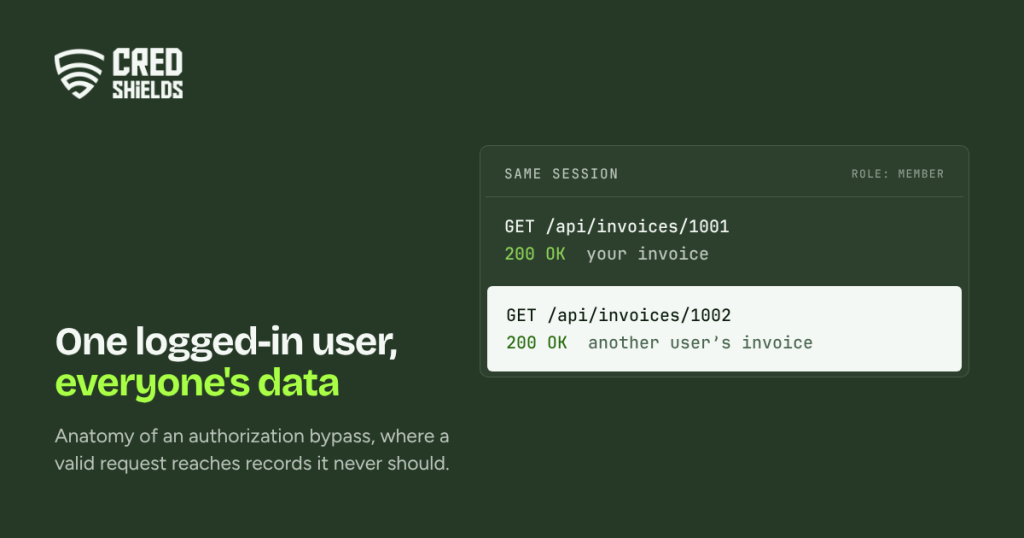
An authorization bypass lets a user reach data or actions their account should never have, usually by changing an identifier, calling a hidden function, or submitting a field the server failed to lock down. The requests are valid and the user may be fully logged in. The flaw is that the application confirmed who the user is but never checked what they are allowed to do. The business impact is often total, because one account can reach every account’s data.
Broken access control is the most common serious weakness in web applications, and an authorization bypass is how it turns into a breach. This guide is written for AppSec engineers, product teams, and technical leaders who want to understand how these flaws work at the request level, what they cost when exploited, why they slip past most automated testing, and how to test for them before an attacker does.
Table of Contents
What an Authorization Bypass Is
An authorization bypass is a failure to enforce what an authenticated user is permitted to do. Authentication confirms identity. Authorization governs permission. The two are separate controls, and an application can get the first exactly right while leaving the second missing, incomplete, or enforced only in the browser, where an attacker can remove it.
The prevalence is well documented. The OWASP Top 10:2025 keeps broken access control in first place, and every application tested showed some form of it. On APIs, the same failure leads the list: broken object level authorization is the top risk in the OWASP API Security Top 10. An authorization bypass is the act of exploiting that gap, and because the gap is so widespread, it is one of the first things a capable attacker tries.
Why Authorization Bypasses Happen So Often
Authorization is hard to get right for structural reasons, which is why the same flaw recurs across applications of every size. Three causes account for most real bypasses.
The first is that authorization is checked in the wrong place. A control enforced only in the user interface, by hiding a button or omitting a menu item, is no control at all, since an attacker calls the endpoint directly and never sees the interface. Access control is only real when it runs in trusted server-side code.
The second is that the check confirms the wrong thing. Many endpoints verify that a request carries a valid session, then act on whatever object the request names, without checking that the session’s user owns that object. The request is authenticated, so the application trusts it, but authentication was never the question.
The third is that authorization logic is scattered rather than centralized. When each endpoint implements its own check, a new endpoint added in a hurry, often one scaffolded quickly with AI assistance, inherits none of the protections the others have, and the gap ships unnoticed.
The Common Shapes of an Authorization Bypass
Authorization bypasses recur in a few patterns. The request examples below are illustrative and generic and use no client data.
Object-Level Bypass (IDOR)
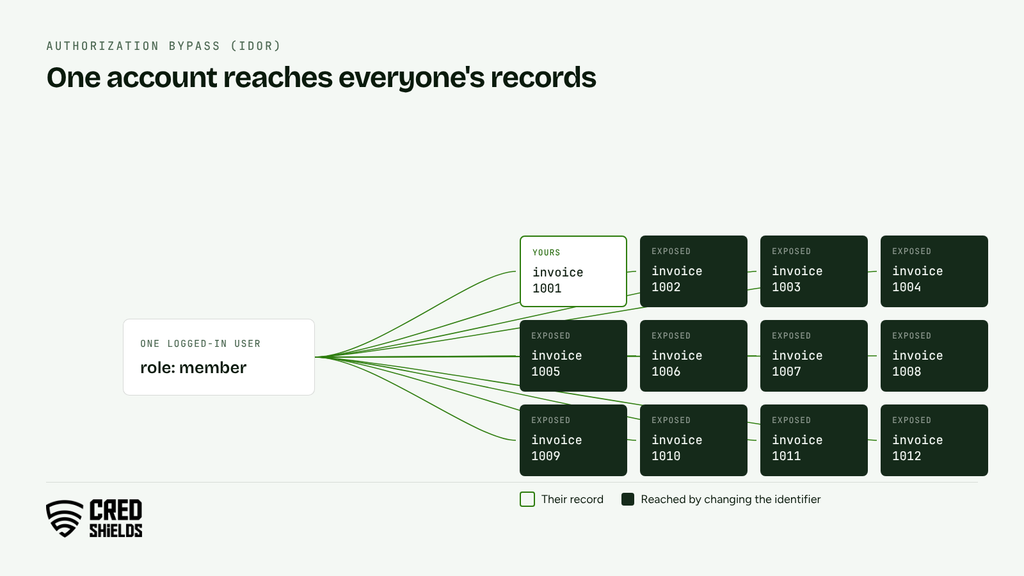
The most common shape. A request references an object by identifier, such as a call to retrieve the record at /api/invoices/1001, and the server returns it after checking only that the user is logged in. Changing the identifier to /api/invoices/1002 returns another user’s invoice. This is an insecure direct object reference, and it maps directly to the top API risk. It is especially common on endpoints that use sequential numeric identifiers, because an attacker can simply count through them.
Function-Level Bypass
An administrative function is hidden in the user interface but reachable directly. A standard user who sends a request to an admin-only endpoint, such as one that lists all users or changes a global setting, succeeds because the server enforced the restriction only by not showing the button. The function ran because nothing on the server checked the caller’s role.
Property-Level Bypass
A user updates their own profile, and the update request includes a field they should not control, such as role, account tier, or verified status. The server accepts the whole object and writes every field, so the user promotes themselves by adding one line to a request that was otherwise legitimate. This is privilege escalation through mass assignment.
Tenant Boundary Bypass
In multi-tenant SaaS, a user in one organization reaches another organization’s data because the application scopes its queries by user but not by tenant, or trusts a tenant identifier supplied in the request. One customer reads or edits another customer’s records, which for a B2B product is among the most damaging outcomes possible.
| Bypass type | How it is triggered | Typical result |
|---|---|---|
| Object-level (IDOR) | Changing a record identifier in the request | Reading or editing another user’s data |
| Function-level | Calling an admin or privileged endpoint directly | Performing actions reserved for higher roles |
| Property-level | Adding a restricted field to a valid update | Self-promotion to a higher privilege or tier |
| Tenant boundary | Reaching another tenant’s records across the boundary | Cross-customer data exposure |
Recommended read: If you or your team are planning an access control review of a plugin or platform, this article on CVE-2026-10753, a broken access control flaw CredShields found in Google’s Site Kit is a great place to start.
Anatomy of a Bypass: Step by Step
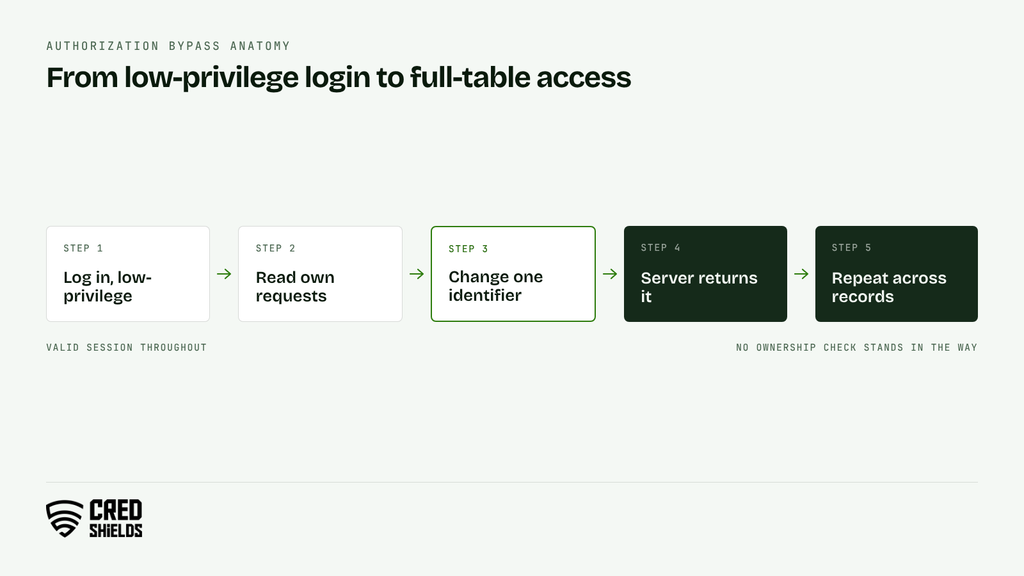
An authorization bypass follows a recognizable sequence, whether a human or an agent performs it. The illustrative walkthrough below shows the shape from first login to full exposure.
- The attacker logs in with a legitimate, low-privilege account, often one created through self-service signup.
- They observe how the application references objects, roles, and tenants, usually by reading the requests their own session sends and the client-side code that builds them.
- They alter a single element: an identifier, an endpoint path, an added field, or a tenant reference.
- They send the modified request, which is well formed, carries a valid session, and passes input validation.
- The server returns data or performs an action the account should never have been allowed, because no ownership or role check stood in the way.
- They repeat the change across identifiers or records to measure the full reach, which is frequently every record in the table.
The last step is what turns a single flaw into a full breach. Once one invoice can be read by changing an identifier, the same technique usually reads all of them, which is why a single object-level bypass on a sensitive endpoint can expose an entire customer base.
The Business Impact of an Authorization Bypass
The technical description understates the cost. An authorization bypass maps to concrete business outcomes, and the scenarios below show how the same class of flaw lands differently depending on what the application does.
| Application context | What the bypass allows | Business impact |
|---|---|---|
| Payments platform | Reading or initiating transfers on another account | Direct financial loss and fraud liability |
| Healthcare portal | Reaching another patient’s records | Regulatory penalties and loss of patient trust |
| B2B SaaS | Crossing tenant boundaries between customers | Breach of contract and loss of enterprise accounts |
| Marketplace or membership | Self-promoting to a paid or admin tier | Revenue leakage and loss of control over the platform |
| Identity or account system | Taking over another user’s account | Account takeover at scale and reputational damage |
These outcomes carry a measurable cost. The IBM Cost of a Data Breach Report 2026 put the global average breach cost at a record 4.99 million dollars, with the United States average at 11.5 million. Because an object-level bypass typically reaches every record of its type, a single authorization bypass on a sensitive endpoint can expose a large share of an organization’s data in one sweep, which places it among the highest-impact flaws an application can carry.
Recommended read: If you or your team are planning to understand where regulated data escapes, this article on what ASEAN health data breaches teach about EHR and healthcare data security is a great place to start.
Why Scanners Struggle With Authorization Bypasses
Many authorization bypasses are invisible to pattern-based scanning, and the reason is structural. The request to read invoice 1002 is identical in form to the legitimate request to read invoice 1001. Nothing in the traffic is malformed, so there is no signature to match and no anomalous response to flag. Confirming the flaw requires knowing that the current user should not own invoice 1002, which is a fact about the application’s data and permission model, which the shape of the request does not reveal.
That is why confirming an authorization bypass requires logging in as real users and comparing what different accounts can reach. A scanner, however intelligent its payloads, tests one request at a time and has no concept of which user should own which object. A clean scan therefore does not rule out an authorization bypass, which is one reason a passing scanner can leave an application fully exploitable: the most common serious flaw class is precisely the one pattern matching cannot confirm.
How to Prevent Authorization Bypasses
Preventing authorization bypasses is largely a matter of where and how the check is done. The practices below address the structural causes directly.
- Enforce every access decision in trusted server-side code, and treat any client-side check as presentational only.
- Deny by default, so a new endpoint is inaccessible until an explicit permission is granted.
- Check ownership on every object access, confirming that the authenticated user is allowed to reach the specific object named in the request, on every call.
- Centralize authorization logic so new endpoints inherit the same checks instead of reimplementing them, which is where gaps appear.
- Validate which fields a user may set on an update, rejecting attempts to write role, tier, or status through mass assignment.
- Scope every query by tenant in multi-tenant systems, and never trust a tenant identifier supplied by the client.
These controls close the gaps, and authorization testing confirms they actually hold under attack, which is the subject of the next section.
How to Test for Authorization Bypasses
Finding authorization bypasses takes authenticated testing that compares roles and tenants, which is exactly what pattern-based scanning cannot do. Agentic pentesting makes that practical at the pace applications change. AI agents log in as multiple users and roles, hold session state, and attempt each account’s actions and data access as another account, reporting only the bypasses they reproduce.
An agent testing for authorization bypasses does the following:
- Authenticates as users in different roles and, for multi-tenant products, in different tenants.
- Enumerates object identifiers, endpoints, and the fields each update request accepts.
- Attempts to read and modify objects that belong to other accounts.
- Calls privileged and administrative functions from lower-privileged sessions.
- Submits restricted fields such as role and tier in otherwise valid update requests.
- Reports each confirmed bypass with the request, the response, and the data or action it reached.
This authenticated testing runs against the scope and credentials you provide, across web applications and APIs. Because every finding is reproduced, remediation effort goes to real bypasses with proof attached.
Recommended read: If you or your team are planning an API security program where object-level authorization is the main risk, this case study on a fintech startup’s API security overhaul is a great place to start.
Authorization Bypass Testing Checklist
Use this checklist to confirm your testing covers authorization as thoroughly as authentication.
- Every object-returning endpoint is tested with an identifier belonging to another user.
- Administrative and privileged functions are called directly from a standard user session.
- Update requests are tested with restricted fields such as role and account tier added.
- Multi-tenant applications are tested across the tenant boundary with two tenant accounts.
- Access control is confirmed server-side, and client-only checks are treated as absent.
- Findings include the request, response, and the data or action reached.
- Authorization tests run on every significant release, since new endpoints and roles add new paths.
Recommended read: If you or your team are planning a SOC 2 audit that will scrutinize access controls, this article on SOC 2 penetration testing and what to expect before an audit is a great place to start.
Frequently Asked Questions (FAQs) About Authorization Bypasses in 2026
These answers cover the questions security teams and developers ask most often about authorization bypasses.
What is an authorization bypass?
An authorization bypass is a failure to enforce what an authenticated user may do, letting them reach data or actions beyond their rights using valid requests. The application checked who the user is but not what they are allowed to do, so a logged-in user can act outside their intended permissions.
What is the difference between authentication and authorization?
Authentication confirms identity, such as a login. Authorization governs permission, such as whether that identified user may read a specific record or call a specific function. An authorization bypass is a failure of the second control, even when the first worked correctly.
What is IDOR?
An insecure direct object reference is an object-level authorization bypass in which changing an identifier in a request returns another user’s object, because the server checks that the user is logged in and never checks that they own the object. It is the most common shape of authorization bypass and the top risk in the OWASP API Security Top 10.
What is broken access control?
Broken access control is the category of weakness where an application fails to enforce what users are allowed to do. It sits first in the OWASP Top 10:2025 and was present in every application tested. An authorization bypass is how broken access control is exploited in practice.
What is a privilege escalation bypass?
Privilege escalation is an authorization bypass that raises the attacker’s own permissions, often by submitting a restricted field such as role or account tier in an otherwise valid update request, or by calling a function reserved for a higher role. The result is an account that can do more than it was ever meant to.
Why do scanners miss authorization bypasses?
The malicious request is identical in form to a legitimate one, so there is no pattern or signature to match. Confirming the flaw requires knowing which user should own which object, which means testing as real users across roles and comparing results, something single-request scanning cannot do.
How do you test for authorization bypasses?
With authenticated testing that compares roles and tenants: logging in as multiple users, attempting to access each other’s objects and functions, calling privileged endpoints from low-privileged sessions, and submitting restricted fields. Agentic pentesting automates this and reports reproduced bypasses with evidence.
How do I prevent authorization bypasses?
Enforce every access decision server-side, deny by default, check object ownership on every access, centralize authorization logic so new endpoints inherit it, validate which fields a user may set, and scope every query by tenant in multi-tenant systems. Then test that these controls hold under attack.
Are authorization bypasses common in AI-generated code?
They are a frequent risk, because AI tools scaffold endpoints quickly and generated routes often share a template that omits ownership checks. Authorization rules are specific to each application, so a model has no way to know who should own a given object, which leaves the check to the developer.
How much damage can one authorization bypass cause?
Often a great deal, because the same technique that reads one record usually reads every record of that type. A single object-level bypass on a sensitive endpoint can expose an entire customer base in one sweep, which is why these flaws rank among the highest-impact weaknesses an application can carry.
Is an authorization bypass the same as a data breach?
An authorization bypass is the flaw; a data breach is the outcome when it is exploited to reach data the attacker should not have. Not every bypass is exploited, but an unaddressed bypass on a sensitive endpoint is one request away from a breach.
Where to Start With Authorization Bypass Testing
An authorization bypass is easiest to fix when you can see exactly how far one account reaches. CredShields One tests your application across the real roles and tenants you provide, tries to reach each account’s data and functions as another account, and reports every authorization bypass it reproduced with the request that proves it, the records it reached, and the server-side fix that closes it. Your team gets a precise, evidence-backed picture of access control in one report, with a retest once the fix ships. CredShields’ penetration testing services cover engagements that call for specialist or independent testing.