

Why API Security Fails When You Only Test Syntax Instead of Behavior
Modern software runs on APIs. Every mobile app, web dashboard, and microservice talks to your backend through API endpoints. When your engineering team ships a new feature, they usually push new API routes right alongside it.
Most security teams still test those APIs the old way. They run automated scanners that check OpenAPI specs, read code syntax, and look for missing encryption headers. That approach checks whether an API is built neatly. It does not check whether the API can be abused.
Syntax checks miss how real attackers break into modern systems. Attackers do not care if your JSON schema looks clean. They care about what happens when they send unexpected inputs, swap user tokens, or call endpoints out of order.
To protect modern APIs, you have to test behavior, not just code structure. Autonomous AI agents do this by interacting with your live endpoints like a real user and trying to break your application rules.
Here is why testing API syntax fails, and how behavioral testing closes the gap.
Table of Contents
1. Clean code syntax still allows unauthorized data access
An API endpoint can follow every coding best practice and still leak sensitive customer data. Picture an endpoint that fetches invoice details using an invoice ID in the request path. The code uses safe database queries, enforces HTTPS, and requires a valid login token.
A syntax scanner sees clean, compliant code and moves on. Yet if the backend never verifies whether the logged in user actually owns that invoice ID, any user can read every invoice in your database by changing one number. The OWASP API Security Top 10 ranks Broken Object Level Authorization as the number one risk to modern APIs for this exact reason.
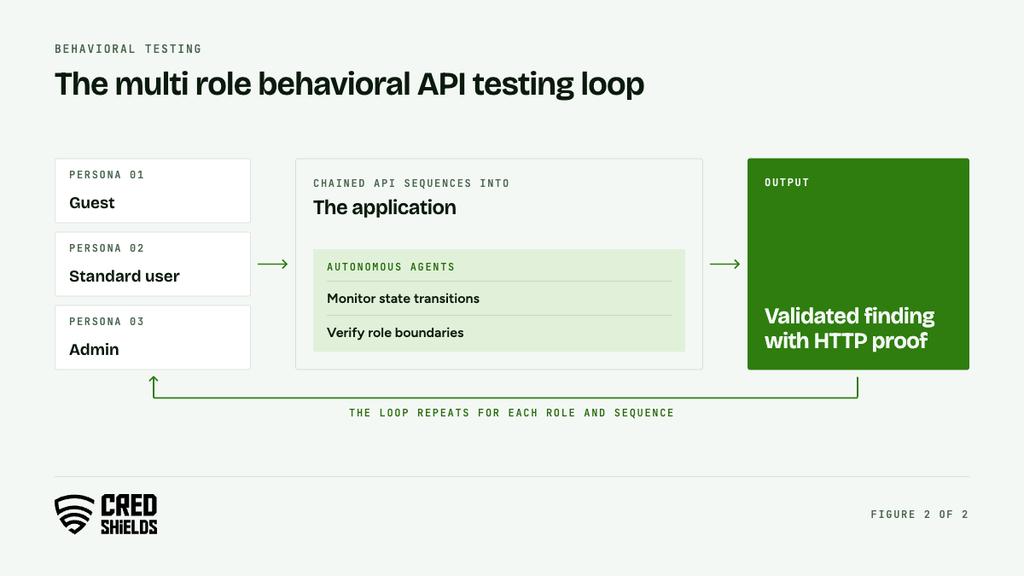
Testing behavior catches this flaw right away. Autonomous agents log into your API with multiple test accounts, capture valid requests, and swap object IDs across user sessions. If User A can read or alter data belonging to User B, the agent proves the breach with exact request and response evidence.
2. Static rules cannot keep up with daily API deployments
Engineering teams ship code faster now than ever before. According to the 2026 JetBrains Developer Ecosystem Survey, 85% of developers use AI tools to write their code. DORA research also shows that top engineering teams deploy code on demand, often multiple times a day.
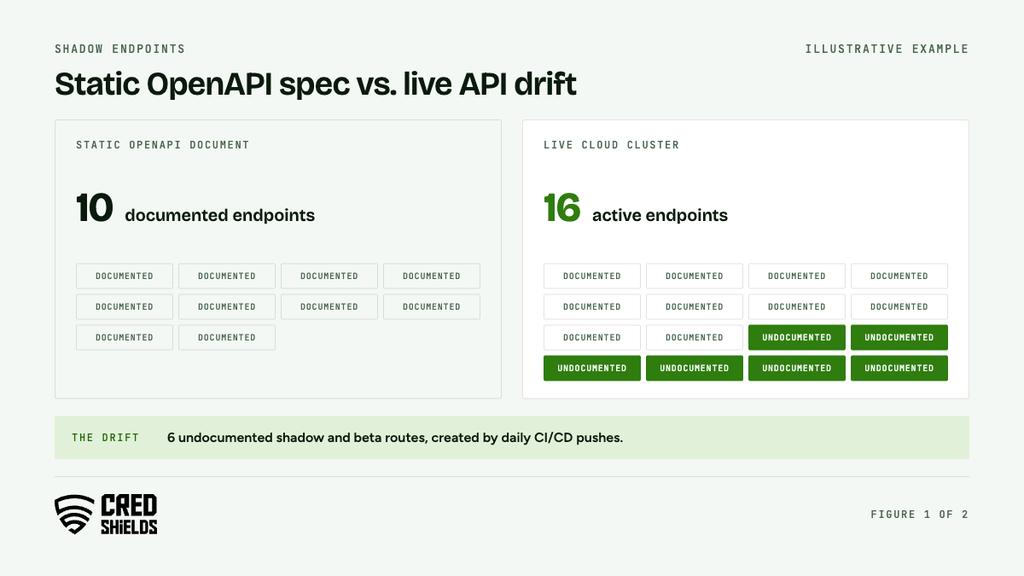
Every deployment can add new parameters, alter user permissions, or expose shadow endpoints that never made it into your official API documentation. Static scanners only check the endpoints they know about, and annual manual pentests go out of date the week after the report arrives.
Behavioral testing scales right alongside your release pipeline. Bringing autonomous agents inside your workflow lets you test live API behavior whenever developers push major updates or change authentication rules. When your team ships a fix, the agent retests the endpoint on the spot to confirm the vulnerability is closed.
3. Syntax scanners blind themselves to multi step API abuse
Attackers rarely exploit an API with a single malformed request. Instead, they string together valid API calls in ways your developers never intended.
Think about a password reset flow or a multi step checkout process. Each individual API call looks completely normal on its own. The syntax is valid, the headers are right, and the rate limits look fine. Yet when an attacker calls the final confirmation endpoint before completing the verification step, the API grants access without checking the earlier state.
Traditional scanners check endpoints one by one in isolation. They do not maintain session state across complex user journeys. Autonomous agents map out how your endpoints connect, walk through multi step workflows, and test what happens when steps are skipped, repeated, or called out of sequence.
4. Pattern matching floods your team with false alarms
When teams rely on syntax and pattern scanners for API security, they pay a heavy price in wasted engineering hours. Data from the National Institute of Standards and Technology shows that static scanners can hit false positive rates as high as 78% in complex codebases. The Ponemon Institute also reports that security and dev staff spend 50% to 80% of their security time just sorting through alerts.
Developers quickly stop trusting security tickets when most of them turn out to be theoretical warnings that a firewall or gateway already blocks. Meanwhile, real flaws sit unfixed in the backlog. Veracode notes in its State of Software Security Report that the average time to fix a flaw in traditional workflows stretches to 298 days.
Behavioral validation cuts out that noise before an engineer ever sees an alert. Autonomous agents form an attack hypothesis, send safe exploit payloads against your live API, and observe how the system responds. If a gateway rule or permission check blocks the attempt, the agent drops the warning. Your team only gets validated findings backed by reproducible proof.
5. AI written API code introduces subtle logic flaws
As developers lean on AI assistants to generate endpoints and data models faster, new risks slip into production. Veracode found in its GenAI Code Security research that nearly 30% of AI written code snippets carry known security weaknesses.
AI coding tools are great at writing clean syntax that passes unit tests. Yet they often miss subtle authorization checks, expose extra object properties in API responses, or trust client side input fields without verifying them on the server. Because the generated code looks polished, syntax scanners wave it right through.
Autonomous agents test what that generated code actually permits at runtime. They inspect API payloads, inject hidden role parameters, and test boundary conditions to uncover logic flaws that syntax reviews never spot.
Shifting from syntax checks to behavioral proof
Checking API syntax is only a starting point. You cannot secure fast moving microservices with tools that guess at risk from static rules or annual audits that go stale in weeks. When you bring autonomous behavioral testing inside your engineering workflow, you test how your APIs actually behave under attack, eliminate false alarm noise, and ship secure features on schedule.